Students as partners: Promoting competency-based education using design thinking
Competency-based education from a students’ perspective - students as partners
Students as partners: Promoting competency-based education using design thinking
Anja
Mücke

School of Business, University of Applied Studies Northwestern Switzerland, Switzerland.
How to cite: Mücke, A. (2026). Students as partners: Promoting competency-based education using design thinking In: 12th International Conference on Higher Education Advances (HEAd’26). Valencia, 15-18 June 2026. https://doi.org/10.4995/HEAd26.2026.21325
Abstract
Competency-based education (CBE) redefines the role of students from passive recipients of knowledge to active, self-directed learners. One approach embracing this is Students as Partners (SaP). The FHNW and its School of Business is committed to CBE and developed a new competency model collaboratively with lecturers and external stakeholders, students however, an essential stakeholder group in CBE, were not adequately involved. This mixed-methods study combined a student survey (N=373) and a design thinking process with 16 students to explore how CBE can be better understood and implemented at the School of Business from a students’ perspective. While the survey revealed low prior awareness and limited engagement with CBE, the design sprint enabled students to co-create effective prototypes to improve communication, understanding, and implementation of the competency model and CBE. The results highlight the importance of meaningful student involvement and demonstrate that participatory approaches can generate actionable solutions and strengthen organisational learning.
Keywords: competency-based education (CBE); Students as partners (SaP); Design Thinking; competency model; organisational change management; stakeholder management
1. Introduction
The shift from traditional, content-focused approaches to competency-based ones is one of the key drivers of transformation in higher education institutes (HEIs). Competency-based education (CBE) shifts the focus of curricula and teaching practices from the mere transmission of knowledge to the development of competencies (Brauer, 2021). In the context of CBE, students are not regarded as passive “consumers of knowledge” but as active subjects. A co-constructivist learning approach is used, i.e. learning is understood as an active, constructive, cumulative, goal-oriented, reflective and diagnostic, contextual and social process (Holmes, Tuin & Turner 2021). Self-directed learning is based on the idea that learners are active subjects who take personal responsibility for their learning process (Morris, 2019; Morris et al., 2023; Konrad, 2024). In self-directed learning, the students are no longer just taught knowledge; instead, they actively acquire competencies (Konrad, 2024: p. 36). However, research indicates that learners can only assume this role if certain prerequisites are met. First, learners must be aware that responsibility for learning rests with them and must be willing and able to enact this role. Second, learners must have a clear understanding of what competencies are, which competencies are expected of them, and why these are relevant, as transparency of learning outcomes is a central condition for self-regulation and competency development in CBE (Morris, 2019; Morris, 2023).
One approach that embraces the active role of students and fosters co-creation is Students as Partners (SaP). In this approach, students actively participate and co-create in teaching and learning through collaborative and reciprocal processes. For example, they can contribute to the design, decision-making, implementation, investigation or analysis of curricula, learning content and methods. (Mercer-Mapstone et al., 2017; Matthews et al., 2018, Omland et al., 2025). From the students' perspective, this means taking responsibility for their own learning process (self-directed learning) and contributing to and shaping the learning processes of others. In the context of CBE, this could entail assisting in the development, implementation and refinement of competency models, or contemplating the design and implementation of CBE.
The School of Business is committed to CBE and developed a new competency model in several iterations (Mücke & Röhm, 2025). While both lecturers and external stakeholders (e.g. future employers) were involved in the development of the new competency model to ensure participation, sense-making and professional development, the students’ perspective was not adequately addressed. For CBE to be successful, it is essential that all relevant stakeholders, especially students, are involved. Students can only take responsibility for their own learning and development if they understand which competencies they need to develop and why these are relevant to them. The following study addresses this issue by taking a SaP approach to integrate students' perspectives more effectively into CBE at the School of Business. The study aimed to answer the following research questions:
Q1: To what extent are students aware, that the School of Business is committed to CBE?
Q2: Do students know the new competency model?
Q3: How do students assess the new competency model, e.g. in terms of comprehensibility, relevance of competencies, usefulness?
Q4: What are the students' ideas and expectations regarding
implementation of the competency model among the student body?
CBE implementation of the competency model in teaching?
2. Method
2.1. Design and data collection
The study employed a mixed-methods approach combining quantitative and qualitative data analysis to generate a comprehensive understanding of students’ perspective. First, a survey of students and second, a context module.
First, an online survey was conducted addressing the students’ perspective. The questionnaire covered four topics: 1) Understanding and experience of competency; 2) The competency model; 3) CBE: design and ideas; and 4) Demographic information. The questionnaire consisted of both closed rating items and open questions. The rating items were assessed using a four-point Likert scale, for example, ranging from “agree” to “disagree”. In addition to the rating items, the survey included open-ended questions, for example asking for ideas or design suggestions for CBE.
Following the idea of SaP, students were already involved in the development of the survey. The questionnaire was pre-tested with the help of the student representatives and students from the “HRM and Organisational Behaviour II” module. In total, 13 people tested the questionnaire and provided feedback, which was then incorporated. The questionnaire was available in both German and English and was implemented as an online survey in Tivian. The survey was conducted during the first weeks of the summer semester in 2025. Students were invited and reminded by email. To increase the response rate, some lecturers encouraged participation and gave students time during their classes to complete it.
373 students took part in the online survey, corresponding to a response rate of 14%. The respondents were enrolled in different degree programmes: 94% in bachelor's degree programmes and 6% in master's degree programmes. 35% study full-time, 59% part-time and 6% in a flex model. The students have been enrolled in the university for between one and ten semesters, with 37% in the second semester and 19% in the fourth and sixth semester. 51% were male, 42% female and 7% identified as differently or did not answer this question.
Second, to gain a deeper understanding of students' ideas and expectations regarding the implementation of the competency model and CBE, a qualitative, action-oriented approach was chosen. For this purpose, a context module entitled “Change the Change – agile transformation based on a use case” (use case: HEI transformation: CBE) was designed, in which these research questions could be addressed and explored in more depth. Context modules are cross-programme modules that students can choose, and which usually comprise 3 ECTS credits. Sixteen bachelor's students took part in the context module from 14 to 17 April 2025: 15 female and 1 male. The students were from different degree programmes (business administration: 14; business informatics: 1; and international management: 1) and study at different locations (Basel: 3; Brugg: 6; Olten: 7). All of them study part-time.
The transformation case and the competency model were discussed in the context module together with students using the design thinking method (Plattner, Meinel & Leifer, 2011; Lewrick, Link & Leifer, 2020). Above all, however, expectations were gathered and concrete ideas were developed on how the competency model could be implemented among the student body and applied in teaching. Based on the six phases of design thinking, the module was designed so that students could experience a design thinking sprint over four days, learning about and trying out typical methods in each phase using the specific use case of “HEI transformation: promoting CBE”. To broaden the analytical scope beyond the sixteen participating students' perspectives, findings from the student survey served as a central data source during the observation phase of the design thinking process. Figure 1 shows how the module was designed using the six phases of design thinking.
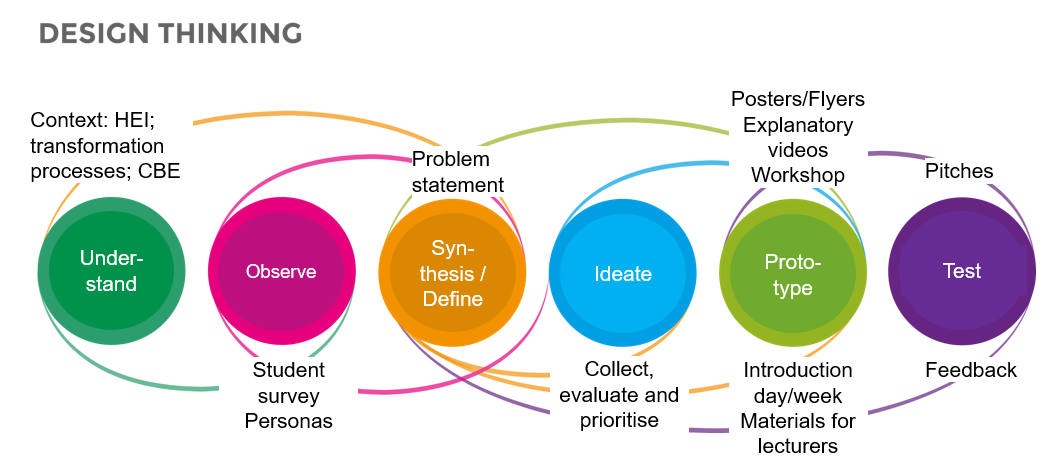
Figure 1. Overview context module
2.2. Data analysis
The data derived from the survey of 373 students were analysed using descriptive statistics. The qualitative responses were analysed using an inductive content analysis approach. First, all responses were systematically coded using MAXQDA and grouped into thematic categories. Categories were refined iteratively, and coding reliability was enhanced through peer review among the research team. The main objective of this step was to prepare and structure the data in a way that enabled the students participating in the context module to interpret, discuss and use it in the further phases of the design sprint. By synthesising the data into clear thematic clusters, visual summaries, and concise key insights, the aim was to ensure that the design sprint teams could meaningfully engage with the data and use it as a foundation for understanding and identifying needs, create and further develop ideas and use the insights for further iterations.
The outcomes of the design sprint were systematically documented by the two lecturers using multiple formats typical of design thinking processes, such as sticky notes, presentation slides, visualisations, and photo protocols. They included the capture of intermediate reflections, ideation outputs, prototypes, and group discussions. This approach ensured traceability of the process and transparency of the decision-making steps. All materials were consolidated into a structured protocol to support subsequent analysis.
3. Results
Q1: The majority (60%) of students were not aware that the School of Business is committed to CBE. 42% of respondents answered "no"; 18% answered "don't know" and 39% with “yes”.
Q2: Only 6% of students indicated that they had seen the competency model prior to the survey; 88% did not and 6% answered "don't know". Accordingly, 91% said they had not yet dealt before with the content of the competency model (yes: 5%; don't know: 4%).
Q3: As part of the survey the competency model was presented to the students and its components were described. They were then asked to assess it. Most students considered the competency model to be understandable, clear and useful. While most students agree that the competency model provides guidance on what is important in the programme, just under a third disagree. 89% also considered the focus of their degree programme on competencies to be useful (9% rather no; 1% no).
Q4: When asked to contribute ideas on how to implement the competency model among the student body and promote CBE, 62 respondents provided suggestions presented in Table 1.
Table 1. Contributed ideas of students to promote CBE and implement the model
Idea |
Status of Implementation |
More practical projects / real cases / internships / guest lectures |
|
More workshops/training sessions |
|
Content and methodological updates to the modules |
( ) |
Explicit communication of competencies |
|
Posters to promote competencies |
|
Competency map for each degree programme and the respective modules |
( ) |
Adaptation of module descriptions |
( ) |
Competency measurement and visualisation of progress |
|
Starting specialization earlier |
( ) |
Some of these ideas already have been or will be implemented as part of the curriculum revision. Examples include earlier entry into specialisation and an update of the modules and module descriptions. The context module systematically integrated these ideas and other survey findings to explore how the competency model can be implemented among the student body and how CBE can be designed from a student perspective. The results of the “ideate” and “prototype” phases show that a wide range of ideas were developed and included the integration of CBE into the university's vision/mission statement, an interactive homepage, self-assessment/tracking of competencies, a comic, a podcast, competency mapping (roadmap), the adaptation of module evaluation, assignment/project work on competencies, an app/self-e-learning. The ideas were prioritised and rated using an effort-benefit-matrix and the highest-rated ideas were selected by the students and developed further into prototypes. Figure 2 provides an overview of the selected ideas.
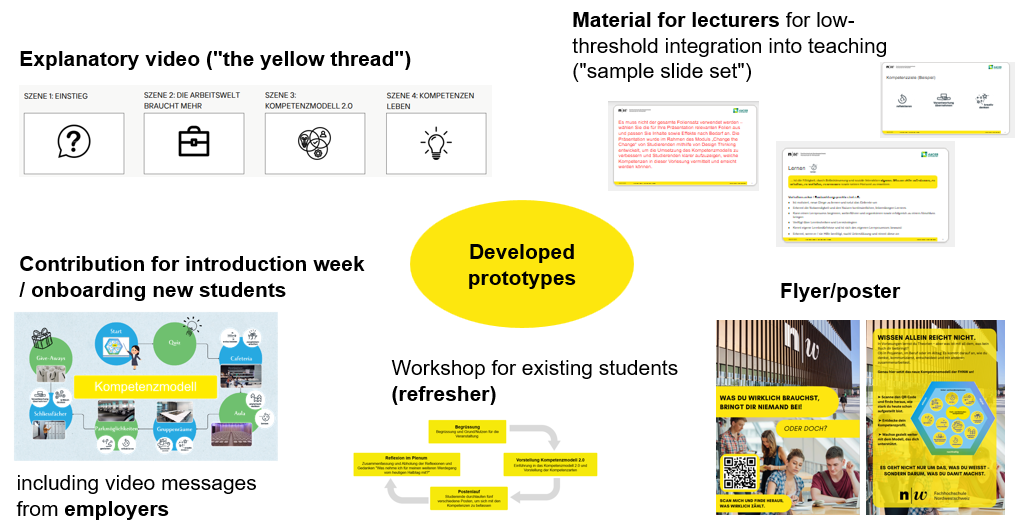
Figure 2. Ideas that were further developed into prototypes
One group had initially selected competency tracking via the Moodle dashboard as a prototype but rejected it during the first iteration in the spirit of “fail fast” in favour of developing a prototype for an explanatory video instead. The students developed and documented their prototypes in groups so that they could be further developed within the organisation. Additionally, the students wrote individual reflection reports, reflecting on both the content (CBE) and the design thinking method used.
4. Discussion and lessons learnt
The student survey results were unsurprising: students lacked awareness of both the School of Business’s commitment to CBE and the competency model itself (Q1/2). From a change management perspective, a key weakness was the absence of prior communication and engagement with this stakeholder group. A key lesson learned is that students should have been informed and involved at a much earlier stage of the process.
Students who participated tended to view the competency model positively and recognise its benefits (Q3). However, with a response rate of only 14% most of the students could not be motivated to participate in the survey. This may be attributable to a range of factors: students may have perceived little value in participating, as they do not expect their feedback to have a tangible impact. Another possible reason is that the topic was not considered sufficiently relevant. Furthermore, feedback from the context module suggests that students are frequently exposed to a high volume of emails and survey requests, resulting in survey fatigue and a tendency to disregard such invitations. The results show that there is still a great need for information and action. The prototypes developed address this. Using the students' refined prototypes would not only help to communicate and implement CBE but also sends a signal to students that participation makes a difference.
For students to recognise the value of participating and contributing as real partners, it is important to keep them informed and to use their input (“no pseudo participation”). To this end, the student representatives were involved, and the project's status and initial results were communicated via the student council newsletter and website. Participants in the module were also informed separately about the implementation status of their prototypes and were involved in further developing them.
It is equally important to integrate the student perspective into the organisation and to implement the identified areas for action, as it is to keep students informed. To this end, the results were presented at the programme directors’ conference, where they were positively received. Funding was subsequently approved for the development of an explanatory video, and the remaining prototypes were further advanced. The sample slide set for lecturers, for instance, represented a quick win and was made available by summer 2025. In addition, selected onboarding measures were implemented for students commencing in the autumn 2025 semester. Finally, the explanatory video has been produced and is now available in both German and English.
From a didactic point of view, the chosen method was successful. The module's design was complex and involved considerable preparation effort for the lecturer, such as the student survey, which was an important database for phase two of the design thinking process, “observe”. However, it proved its worth in practice. The chosen method was appropriate for familiarising the students with the problem and developing usable prototypes. The quantity and quality of the ideas generated were impressive given the time available. Student satisfaction was also very high: all students would retake the module and recommend it to their colleagues. Based on the results it would be useful to offer the module again, but instead of using the CBE case study, to focus on another university-relevant topic (e.g. understanding of teaching and learning; teaching spaces). To ensure that SaP does not remain a one-off event, it is important to make it a permanent feature of the organisation and use it as a central element of organisational learning. While the university already involves students in various areas, it could do so more explicitly and collaboratively, particularly regarding university development. Promoting the competency model and CBE requires effort and a long-term commitment from everyone involved. It would be useful to repeat the survey to ascertain the impact of the measures taken including the new more competency-based curriculum on awareness, assessment and perception of CBE among the students.
Acknowledgements
I like to thank Ruth Röhm and Ellenor Hunn for contributing to the study and Anne Jansen for her valuable feedback.
References
Mücke, A., & Röhm, R. (2025). Promoting competency-based education through the development of a competency model: lessons learned from a change perspective. In: 11th International Conference on Higher Education Advances (HEAd’25). Valencia, 17-20 June 2025. https://doi.org/10.4995/HEAd25.2025.19745
Brauer, S. (2021). Towards competence-oriented higher education: a systematic literature review of the different perspectives on successful exit profiles. Education and Training. 63. https://doi.org/10.1108/ET-07-2020-0216
Holmes, A.G.D., Tuin, M.P., & Turner, S.L. (2021). Competence and competency in higher education, simple terms yet with complex meanings: Theoretical and practical issues for university teachers and assessors implementing Competency-Based Education (CBE). Educational Process: international journal, 10(3): 39-52. https://dx.doi.org/10.22521/edupij.2021.103.3
Konrad, K. (2024). Selbstgesteuertes Lernen neu denken. Mit neuen Konzepten von der Lehrersteuerung zum Schülerhandeln. Beltz Juventa DOI: 10.25656/01:30218; 10.3262/978-3-7799-7903-6
Lewrick, M., Link, P., & Leifer, L. (2020). Das Design Thinking Toolbook. Die Besten Werkzeuge & Methoden. Versus/Vahlen.
Matthews, K.E., Dwyer, A., Hine, L., & Turner, J. (2018). Conceptions of students as partners. High Educ 76, 957–971 https://doi.org/10.1007/s10734-018-0257-y
Mercer-Mapstone, L., Dvorakova, S., Matthews, K., Abbot, S., Cheng, B., Felten, P., Knorr, K., Marquis, E., Shammas, R., & Swaim, K. (2017). A Systematic Literature Review of Students as Partners in Higher Education. International Journal for Students as Partners. 1. 10.15173/ijsap.v1i1.3119.
Morris, T.H. (2019). Self-directed learning: A fundamental competence in a rapidly changing world. Int Rev Educ 65, 633–653. https://doi.org/10.1007/s11159-019-09793-2
Morris, T. H. (2023). Four Dimensions of Self-Directed Learning: A Fundamental Meta-Competence in a Changing World. Adult Education Quarterly, 74(3), 236-254. https://doi.org/10.1177/07417136231217453
Morris, T. H., Bremner, N., & Sakata, N. (2023). Self-directed learning and student-centred learning: a conceptual comparison. Pedagogy, Culture & Society, 33(3), 847–866. https://doi.org/10.1080/14681366.2023.2282439
Omland, M., Hontvedt, M., Siddiq, F., Amundrud, A., Hermansen, H., Mathisen, M., Rudningen, G., & Reiersen, F. (2025). Co-creation in higher education: a conceptual systematic review. Higher Education, 90, 1017 - 1047. https://doi.org/10.1007/s10734-024-01364-1.
Plattner, H., Meinel, C., & Leifer, L. (2011). Design thinking: Understand – Improve – Apply, understanding innovation. Springer.