Competency-Based Talent Development in Industry-Specific Universities: A Case Study of Digital Intelligence Empowerment in Public Administration
A Case Study of Digital Intelligence Empowerment in Public Administration
Competency-Based Talent Development in Industry-Specific Universities: A Case Study of Digital Intelligence Empowerment in Public Administration
Siyu Yao
 ,
Xinru Dong, Yuning Liu, Yanling Zhou, Fan Zhang, Yaoyao Cheng,
Xiaochen Gong
College of Humanities and Law, Beijing University of Chemical Technology, China
How to cite: Yao, S. Y.; Dong, X. R.; Liu, Y. N., Zhou, Y. L.,Zhang, F.; Cheng, Y. Y.; Gong, X. C. (2026). Competency-Based Talent Development in Industry-Specific Universities: A Case Study of Digital Intelligence Empowerment in Public Administration. In: 12th International Conference on Higher Education Advances (HEAd’26). Valencia, 15-18 June 2026. https://doi.org/10.4995/HEAd26.2026.21537
Abstract
The rapid advancement of digital and intelligent technologies is reshaping public governance systems and redefining the requirements for competency-based education for public management professionals. Industry-specific universities, while possessing strong engineering and industrial resources, often face structural tensions in translating these advantages into effective public administration education. This paper addresses these challenges by proposing an integrated competency-based talent development framework centered on five-dimensional competencies, guided by a 'three-integration' concept—digital intelligence, engineering-humanities, and science-education integration—and operationalized through a 'three-creation' practice pathway. The framework systematically aligns curriculum design, teaching processes, and cultivation outcomes with the demands of digital-intelligence-driven governance, offering a replicable and practice-oriented model for industry-oriented universities. Preliminary application results indicate that this model effectively enhances students' data literacy and cross-disciplinary problem-solving abilities.
Keywords: Digital Intelligence; Industry-Specific Universities; Public Administration; Competency-Based Education
1. Introduction
The global shift toward a digital era driven by big data and artificial intelligence has made technology-enabled governance central to modernizing national governance systems. In China, the coordinated development of education, science and technology, and talent cultivation has reshaped knowledge production and competency-based education demands in public administration. Traditional management paradigms are increasingly replaced by data-driven, intelligence-assisted models. Industry-specific universities face a unique paradox: their strong engineering background and rich industry resources offer differentiation, but without effective translation into educational potential, the gap between general governance theory and industry practice may widen (Ji et al., 2025; Cai et al., 2022). To address this, the study proposes a talent cultivation framework based on five-dimensional competencies, guided by a “Three-Integration” pedagogical concept and implemented through a three-creation practice pathway.
2. Digital-Age Challenges in Public Administration Talent Development
Despite ongoing efforts toward digital transformation, the deep restructuring of public administration talent cultivation in industry-oriented universities continues to lag behind the rapid evolution of intelligent governance practices. This mismatch is manifested in three interrelated challenges.
2.1. Misalignment between Talent Development Goals and Digital Governance
Digital and intelligent technologies are transforming public management toward a “Data Empowerment, Human-Machine Collaboration, and Algorithmic Co-Governance” paradigm, demanding a shift in talent cultivation from standardized public administration to context-specific agile governance. Yet gaps remain between conceptual updates and practice: digital literacy lags as programs underemphasize data skills, technology, and integrated governance (Chen, 2024; Song & Huang, 2025); industry-specific adaptation is limited as governance theory is rarely integrated with sector expertise; and responsiveness to complex scenarios is insufficient, leaving students ill-prepared for non-linear, high-risk, and cross-regional challenges in the digital intelligence era (Dai & Cui, 2025).
2.2. Disconnect Between Academic Knowledge and Governance Practice
Public administration is practice-oriented, yet rapid digital intelligence developments have outpaced textbooks, creating gaps between teaching and dynamic governance scenarios. First, fragmented courses, such as Big Data and Python, leave digital intelligence marginal and poorly integrated (Zhou, 2025). Second, governance logic analysis lags, as teaching emphasizes macro institutional texts while neglecting algorithmic operations and technical mechanisms (Li & Wang, 2025). Third, practical training is limited, with simulations disconnected from real-time data, failing to capture real-world complexity and hindering students’ transition from theory to practice (Jing & Yang, 2024).
2.3. Fragmentation of Traditional Education in the Digital Innovation Era
Generative AI-driven digital education reform is reshaping higher education teaching paradigms (Su & He, 2025), yet industry-specific universities face systemic challenges: fragmented resource allocation leaves digital tools disconnected, hindering integration of smart labs and big data into a cohesive loop; industry-education collaboration remains superficial, with short-term projects failing to embed technical standards, policy experience, and industry data into talent cultivation (Xu, 2025); and cross-boundary integration is weak, with limited interdisciplinary collaboration and underdeveloped off-campus digital ecosystems restricting students’ interdisciplinary competencies (Jia et al., 2020).
3. Innovating Public Administration Talent in the Digital Intelligence Era
The iterative evolution of digital intelligence is reshaping public governance and creating unprecedented demands on the knowledge and capabilities of governance talents. Cultivating public administration professionals must move beyond traditional models and develop a systematic educational framework aligned with the strategic goal of modernized governance.
3.1. Five-Dimensional Competencies for Modern Governance
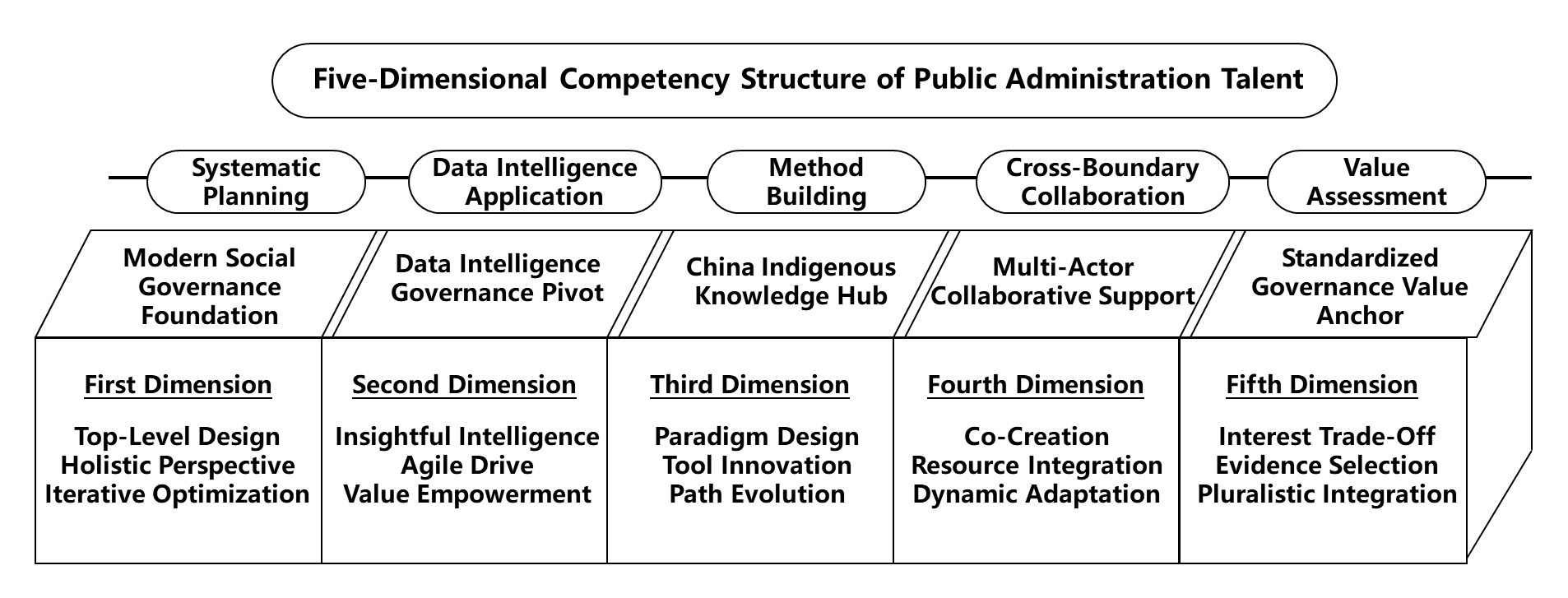 Adopting
a competency-based education approach drives conceptual innovation,
with public administration competencies in the digital age reshaped
across five dimensions: system coordination, digital intelligence
application, methodological construction, cross-border collaboration,
and value judgment (Figure 1).
Figure 1. Five-Dimensional Competency Structure of Public Administration Talent
In the digital intelligence era, public administration talents require five interrelated competencies. System coordination enables analysis of complex policy scenarios and strategic decision-making. Digital intelligence application transforms technology into actionable knowledge aligned with institutional needs. Methodological construction grounds governance theory in local contexts for relevant frameworks. Cross-border collaboration fosters interdisciplinary, multi-level resource integration (Hu & Bai, 2024). Finally, value judgment guides ethical decision-making, ensuring digital tools advance public interest and human-centered governance.
3.2. Three-Integration Talent Framework under Digital Intelligence
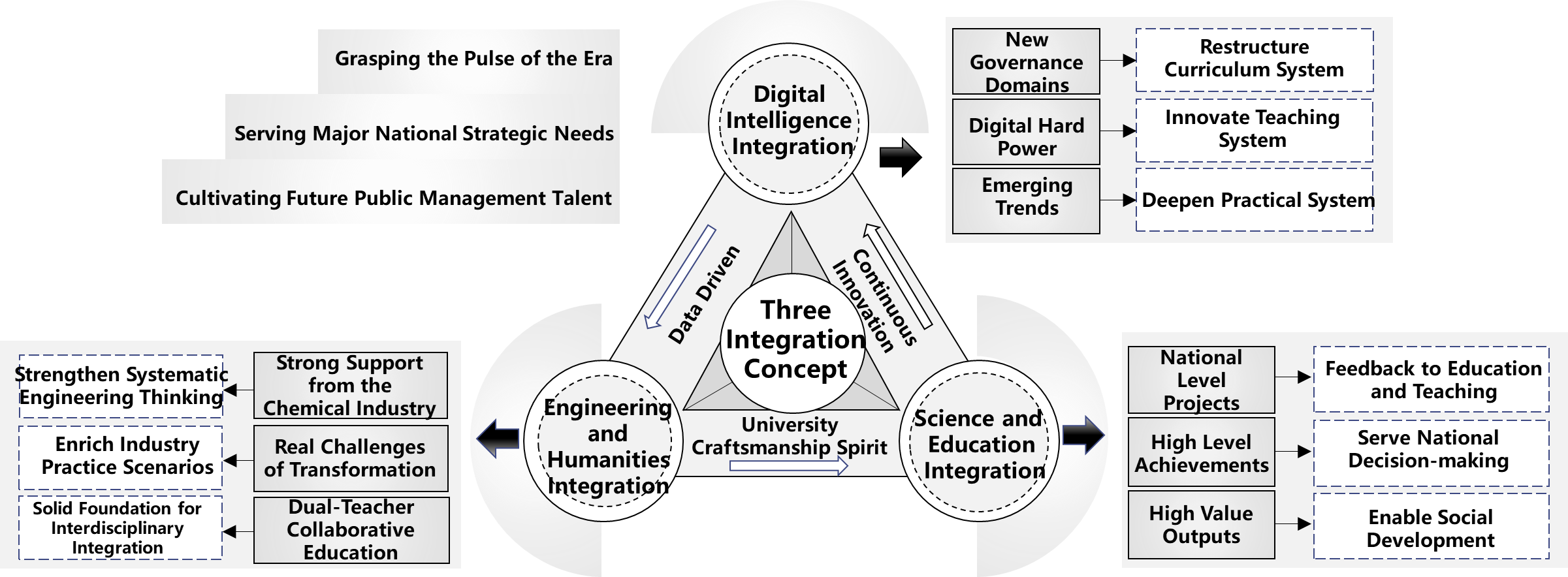 Amid
rapid global digital intelligence development, public administration
talent cultivation faces new demands. Using an industry-specific
university in China as an example, this study identifies the core
concept of public administration development as the “Three
Integrations” framework: Digital Intelligence,
Engineering-Humanities, and Science-Education Integration (Figure 2).
Figure 2. “Three-Integration” concept for Public Administration Talent cultivation
Digital intelligence integration: Reshape disciplinary epistemology with digital intelligence, embedding digital government and smart governance into the curriculum. Integrate computational thinking, data analysis and intelligent decision-making into training, deepen practice via scenario-based, data-driven tasks, and cultivate students to solve complex public problems. This forms a new data-driven, intelligence-assisted governance paradigm, combining technical rationality and humanistic care.
Engineering-liberal arts integration: Leverage industry-culture integration to highlight the university’s strengths. Apply engineering systems thinking to public administration training, enrich practical scenarios and enhance cross-disciplinary problem-solving. Establish dual-mentor collaborative platforms to support sustainable interdisciplinary talent development, cultivating graduates with both technical system understanding and governance insight.
Science-education integration: Build a research-education ecosystem to drive innovation. Integrate national research projects and real-world data into teaching, encourage teacher-student collaborative research, and convert disciplinary knowledge into practical governance solutions. This alignment keeps talent cultivation in line with national strategic needs and promotes academic and social outcomes.
4. Paths for Cultivating Public Administration Talent under Digital Intelligence
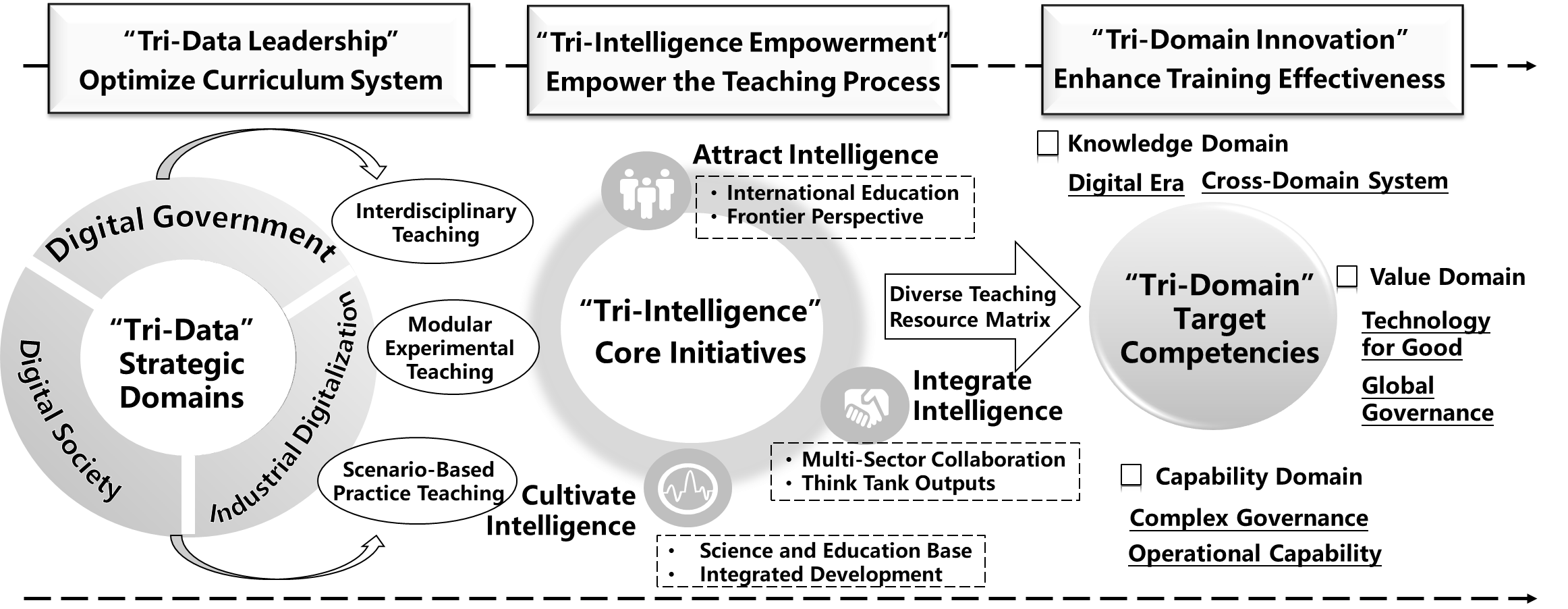 Guided
by the core concepts of Digital Intelligence, Engineering–Humanities,
and Science–Education integration, the “Three Creation”
practice path centers on optimizing curricula with Tri-Data
Leadership, empowering teaching with Tri-Intelligence, and enhancing
training with Tri-Domain Innovation. Driven by national strategic
needs, it develops students’ comprehensive potential and forms an
integrated framework of innovation leadership, capability, and vision
(Figure 3), translating educational concepts into actionable plans.

Figure 3. The Practical Pathway for Three-Creation in Public Administration Talent Development
4.1 Tri-Data Leadership for Curriculum Reform
“Tri-Data Leadership” creates a cross-disciplinary, scenario-based curriculum across digital government, digital society, and industrial digitalization, aligning national strategic priorities with teaching content and bridging gaps between knowledge and real-world scenarios.
Cross-disciplinary theoretical foundation: Optimize Tri-Data teaching via frontier courses including Digital Government, Smart Governance and Computational Social Sciences, integrating public administration theory with big data and AI. Special lectures and forums share the latest governmental, industrial and academic achievements, improving students’ digital governance literacy and interdisciplinary capabilities.
Modular experimental training: Upgrade experiments with a modular “scenario simulation + practical exercise” system in the Smart Government Lab, covering emergency decision-making, intelligent policy-making, and smart city operations. This transforms complex governance challenges into repeatable exercises, developing students’ practical problem-solving skills.
Scenario-based practical exercises: Expand practice through field research, report writing, and participation in national projects, aligning with strategic and industrial needs. Students gain firsthand experience with digital transformation and national initiatives, strengthening applied knowledge and practical awareness.
4.2. Tri-Intelligence Empowerment in Education
“Tri-Intelligence Empowerment” establishes an interactive, integrated, and open teaching resource system through intelligence introduction, development, and integration, bringing international educational advances, science-education dynamics, and think tank research into teaching to continuously support public administration talent cultivation.
Introducing intelligence: Leverage international expertise to broaden teaching frontiers. Programs introducing specialists in digital government, intelligent governance, and science policy bring frontier knowledge into courses, enhancing students’ understanding of cutting-edge research and promoting internationalized talent development.
Cultivating intelligence: Enhance talent development through dynamic, integrated teaching. Smart Government Labs, interdisciplinary platforms, regional research bases, and case competitions combine theory and practice, strengthening students’ applied skills and practical capabilities.
Integrating intelligence: Transform multi-disciplinary research into teaching resources. Teacher-student research on digital governance, industrial policy, and sustainable development is integrated into courses and exercises, connecting theory with real governance challenges and fostering students’ awareness of social value and intrinsic motivation.
4.3. Tri-Domain Innovation for Talent Development
“Tri-Domain Innovation” aims to fully develop students’ knowledge, abilities, and values, bridging the gap between talent cultivation goals and the demands of the digital intelligence era.
Knowledge domain: Integrate computational thinking and methodology into core public administration courses, enabling students to master big data, AI and other digital tools. Interdisciplinary courses and frontier research help students grasp technology’s governance impact and build systematic analytical skills for complex issues.
Capability domain: Cultivate practical skills through multi-level platforms such as the Smart Government Lab, school-industry courses, and rural research bases. Students use data analysis and decision-support tools to address real problems—from environmental data in industrial transformation to emergency decision-making and policy analysis—strengthening their ability to define problems, apply methods, and propose solutions in uncertain contexts.
Value domain: Embed social responsibility and ethics into the curriculum, with topics like Algorithmic Ethics and Data Justice. Students apply technology responsibly, translate think tank research and social practices into actionable insights, and develop critical thinking, social awareness, and future-oriented leadership in global digital governance.
5. Preliminary Results and Discussion
To evaluate the effectiveness of the project, both qualitative and quantitative indicators were considered. The following subsections present the main outcomes: first, improvements in student competencies, followed by measurable achievements and program outputs.
5.1. Improvement in Student Competencies
The project enhanced students’ digital intelligence competencies and analytical skills through 12 high-fidelity virtual training scenarios, averaging 72 simulations and 80 exercises per year. Students gained hands-on experience in governance, data analysis, and decision-making, winning over 20 national awards-more than 60% in data analytics-demonstrating the effectiveness of the competency-based model in fostering technical proficiency.
5.2. Output-Oriented Achievements
The project achieved significant academic and institutional outcomes, establishing multiple university-level Rural Revitalization Study Bases and holding more than 40 academic forums for experiential learning. Six on-campus case competitions generated 132 cases and a collection exceeding 1.5 million words. Leveraging National Social Science Fund initiatives, the project advanced teaching reform and received a provincial teaching innovation award, demonstrating strong impact on teaching quality and academic influence.
6. Conclusion
The digital intelligence era is reshaping public administration education. Industry-focused universities can leverage resources for differentiated development but face structural challenges in talent cultivation, including lagging goals, knowledge gaps, and fragmented mechanisms. An integrated system based on five-dimensional competencies, the three-integration concept, and the three-creation path links digital technologies with industry strengths to enhance talent quality. Future reforms should emphasize interdisciplinary integration, data-driven evaluation, and ethical AI thinking to align education with governance modernization.
References
Cai, J., Wang, Q., Ren, B., & Chen, W. (2022). Construction of public administration discipline and talent cultivation from the perspective of the new liberal arts: A case study of Beihang University. Journal of Beihang University (Social Sciences Edition), 35(5), 11–19. https://doi.org/10.13766/j.bhsk.1008-2204.2022.0601
Chen, Z. (2024). Exploration of a specialized training mode for public administration oriented toward applied talents: A case study of public administration at Nanjing University of Posts and Telecommunications. University Education, (21), 108–112. https://doi.org/10.3969/j.issn.2095-3437.2024.21.023
Dai, S., & Cui, X. (2025). Generative logic, realistic representation, and future dimensions of environmental intelligence in the age of digital intelligence. Academic Research, (11), 78–86. https://doi.org/10.3969/j.issn.1000-7326.2025.11.013
Hu, Y., & Bai, S. (2024). Multi-agent cooperative innovation supernetwork model and governance pathways of the digital ecosystem. China Science and Technology Forum, (10), 53–62. https://doi.org/10.13580/j.cnki.fstc.2024.10.006
Jia, H., Zhou, H., & Han, Y. (2020). Research on the co-cultivation of innovation ability and research practice of graduate students in public administration: Evidence from universities in S Province. Science and Technology of Chinese Universities, (8), 56–61. https://doi.org/10.16209/j.cnki.cust.2020.08.013
Ji, R., Xu, Z., & Liu, X. (2025). Research on the mechanism of cultivating autonomous learning ability of college students in the era of artificial intelligence: Using undergraduate graduation design of engineering majors as the carrier of educational practice. Chinese University Teaching, (11), 10–18. https://doi.org/10.3969/j.issn.1005-0450.2025.11.003
Jing, Z., & Yang, Q. (2024). AIGC-enabled paradigm shifts in educational research: Mechanisms, risks, and countermeasures. Chinese Journal of Educational Technology, (3), 68–75. https://doi.org/10.3969/j.issn.1006-9860.2024.03.010
Li, X., & Wang, S. (2025). Artificial intelligence empowering grassroots agile governance: Logical mechanisms, practical obstacles, and response strategies. Administrative Reform, (11), 33–43. https://doi.org/10.14150/j.cnki.1674-7453.2025.11.007
Song, S., & Huang, H. (2025). Construction and practical exploration of a big data platform for public management discipline knowledge services. Laboratory Research and Exploration, 44(11), 202–208. https://doi.org/10.19927/j.cnki.syyt.2025.11.035
Su, X., & He, Q. (2025). Exploring artificial intelligence–enabled teaching and learning scenarios and model innovation: A case study of programming courses. Chinese University Teaching, (6), 65–72. https://doi.org/10.3969/j.issn.1005-0450.2025.06.010
Xu, G. (2025). Community of industry and education: Toward the institutionalized construction of school–enterprise relations. Journal of East China Normal University (Educational Science Edition), 43(11), 1–12. https://doi.org/10.16382/j.cnki.1000-5560.2025.11.001
Zhou, J. (2025). An analysis of the two-dimensional drive for the intelligent transformation of public administration curricula in the era of digital governance. Knowledge Economy, (33), 167–170. https://doi.org/10.3969/j.issn.1007-3825.2025.33.046