Redesigning Assessment: New Paradigm of Engineering Education in the OBE Era
Redesigning Assessment: New Paradigm of Engineering Education in the OBE Era
Redesigning Assessment: New Paradigm of Engineering Education in the OBE Era
Dipali
Bansal1
 ,
Rashima Mahajan2
,
Viha Goel3
1Department of ECE, Manav Rachna University; Faridabad, India, 2Department of CSE, Manav Rachna International Institute of Research & Studies, Faridabad, India, 3Alumni, University of Oxford, UK.
How to cite: Bansal, D.; Mahajan, R.; Goel, V. (2026). Redesigning Assessment: New Paradigm of Engineering Education in the OBE Era. In: 12th International Conference on Higher Education Advances (HEAd’26). Valencia, 15-18 June 2026. https://doi.org/10.4995/HEAd26.2026.21547
Abstract
Outcome-Based Education (OBE) is adopted by Higher Education Institutions to attain a futuristic competence pertinent to both industry and society. However, the assessment strategies adopted, continue to focus mostly on lower-order cognitive skills and create a mismatch between the desired program outcomes. This gap necessitates examinations reforms to assess higher order thinking, innovativeness and problem solving. This paper implements Performance Indicators, which connect Course Outcomes (COs) to Program Outcomes (POs) and demonstrates that restructured assessment pattern effectively measures learning outcomes. The sample assessment includes equal representation of higher-order levels of Bloom, 28 % application based questions, 22 % analytical, 32 % design-based and fewer than 30 % lower-order questions. Mapping revealed that 53 % of questions were adding to PO1, 21 % to PO2 and 26 % to PO3. The redesigned method aligns with teaching, assessment, and learning outcomes providing a sustainable model to improve graduate competency in OBE era.
Keywords: Outcome-Based Education (OBE), Performance Indicators, Program Outcomes, Bloom’s Taxonomy, Assessment Reform, Sustainable Engineering Education
1. Introduction
Technical education at Higher Education Institutes (HEIs) is being driven by Outcome-Based Education (OBE) concept for countries that are in agreement with Washington Accord globally. This approach endorses commitment to quality assurance to produce futuristic graduates who can keep pace with the technological advancements and industry requirements. Most of the HEIs in India have adopted the OBE context while defining the Course Outcomes (COs) for each Course in the syllabus and for linking them with the Program Outcomes (POs). The exam questions are also linked directly with the COs. However, the link between the exam questions and the POs is still not very clear leading to ambiguous attainment of student learning outcomes. The current examination system primarily assesses the lower learning levels of Bloom’s hierarchy which covers remembering, understanding & applying the knowledge acquired. It is high time we begin assessment of higher learning levels like design & analysis of complex problems, demonstration of ability to solve complex problems, and synthesis & creation. Today the employers not just look for aptitude in graduates, they also assess their soft & life skills like team spirit, communication skills, lifelong learning, ethics & moral values etc. The present examination & assessment strategy misses this link. It is therefore important to reduce this gap by making reforms in the existing examination & assessment methodology.
Recent literature has also highlighted the necessity of visible mapping of assessment between COs and POs in the OBE framework (Bohra, 2024), (Ali, 2024). Rubrics-based evaluation has enhanced inter reliability and correspondence between the assessment and the learning outcomes (Thite, 2024), (Mahajan, 2021), (Bansal, 2019). The analysis of Student Outcome (SO) data is now automated by AI, determining trends and performance disparities across the cognitive level (Luo, 2025), (Kizilcec, 2024). Evidence of this is also supported by the findings of empirical research that limits question in the low-order Bloom, improves the attainment of higher-order cognition and graduate competency in engineering learning (Sabri, 2025), (Cheng, 2025). The research on the OBE-based assessment reforms also emphasize the enhancement of accreditation evidence credibility and student involvement in reflective learning (Nakad, 2025) through mapping frameworks by regulatory bodies like AICTE in India. Research Questions Framed based on the gap analysis are:
RQ1: How much more reliable are PO attainment measures obtained by using PIs to map COs to POs?
RQ2: How does capping lower-level Bloom questions (≤ 30 %) influence the level of cognition?
RQ3: What is the effect of CO-PI-PO mapping on faculty/student freedom of perceptions of assessment validity and transparency?
RQ4: Which cognitive level (application, analysis, creation) is more consistent between the proposed and the traditional assessment in a technical core course (e.g. Digital Signal Processing - DSP)?
2. Material and Method
Our design will be top-down where the POs will be used in creating COs. POs guide the curriculum design & delivery, the assessment methodology and they also indicate the skills & knowledge to be acquired by the graduate on the completion of the program. Courses taught in the curriculum form the base for a program, and therefore COs attained for each course decides the learning levels achieved, which in turn leads to attainment of POs. Therefore, a matrix mapping COs with POs is required as the first step for assessment to gauge the effectiveness of the program. The POs are generic statements, which cannot be measured directly from the COs. So, to quantify the attainment of POs, a measurable approach is required to be framed that can connect POs with the assessment strategies. One way to achieve this is to define Performance Indicators (PIs). The prime difference between POs and PIs is that, the POs are non-measurable statements whereas, PIs are explicit statements to quantify the performance achievements of a graduate and are derived from the POs. PIs help in removing the ambiguity in assessing the competency level of a student by clearly listing the concrete actions required to be performed. PI statements include an action verb viz. define, solve, demonstrate, interpret, analyse etc. covering levels of Bloom’s Taxonomy and the content being referred to (McBeath, 1992), (Bloom, 1956). To implement POs, we specify PIs for each CO where each PI is a clear statement of observable student behaviour. Figure 1 below depicts the mapping of Program Outcomes with assessment strategies through PIs.
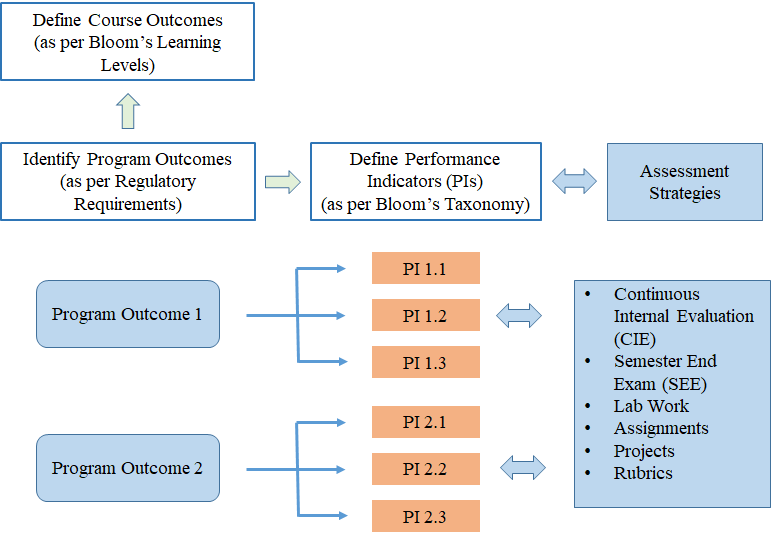
Figure 1. Mapping Program Outcomes with Assessment Strategies through Performance Indicators
As a case study we have used a Digital Signal Processing (DSP) course and applied the following procedure:
1. Mapping CO to PI to PO: There are 3 to 4 PIs of each CO. A CO-PI-PO matrix is built depicting the contribution of each PI to one or more POs, with assigned weights.
2. Exam questions are designed to target certain PIs. The CO and PI of each question are indicated as well as the PO(s) supported by the question. Questions are categorized into the Bloom’s revised version.
3. Less than 30% of total questions involves only Remembering & Understanding. Every COs and significant PIs are represented.
4. Sample Exam paper is analyzed. The distribution of mark is measured on the basis of COs, PIs, POs, and levels of cognition. Every correct answer adds to the PO score of the student according to the CO-PI-PO mapping weights. Compounded scores generate PO attainment.
5. Ensure that each CO is addressed. Make certain that questions actually correspond to the desired PIs. Make certain that distribution at the cognitive level satisfies design requirements.
Program Outcomes linked with Knowledge and Attitude Profile (WK) as laid down by National Board of Accreditation (NBA GAPC V4.0) in India for Engineering programs are taken as sample to understand & suggest related PIs for a course on Digital Signal Processing (DSP) and its link with the COs and the assessment strategy. Steps followed are as under:
STEP 1: DSP is generally taught in the third year of the Engineering program, and so achievement of higher order of cognitive skill is desired. The COs are thoughtfully framed benchmarking the course curriculum of leading academic institutions. Sample Course Outcomes statements defined for DSP: On completion of this course, students will be able to
CO1: Represent signals in continuous and discrete-time & frequency domain.
CO2: Analyze discrete-time systems using Z-Transform.
CO3: Understand Discrete-Fourier Transform & Solve Fast Fourier Transform algorithms.
CO4: Design IIR & FIR Digital Filters for various applications.
CO5: Apply Digital Signal Processing for analysing real-life signals.
STEP 2: All courses in the curriculum should be mapped with all the POs listed. A matrix is constructed as shown in Table 1 to link all the POs & WKs of Engineering program listed by NBA with the COs of the course on DSP.
STEP 3: As is clearly evident from Table 1, PO1, PO2, PO3, PO4 & PO5 are strongly correlated with the COs of the course DSP under consideration. So suggestive PI statements are constructed as shown in Table 2 for only these relevant POs to understand the concept.
Table 1. Matrix for mapping of Program Outcomes & Course Outcomes of DSP
Mapping of POs & WKs with COs |
CO1 |
CO2 |
CO3 |
CO4 |
CO5 |
PO1: Engineering Knowledge: WK1 to WK4 |
√ |
√ |
√ |
√ |
√ |
PO2: Problem Analysis: WK1 to WK4 |
√ |
√ |
√ |
√ |
√ |
PO3: Design/Development of Solutions: WK5 |
√ |
√ |
√ |
√ |
√ |
PO4: Conduct Investigations of Complex Problems: WK8 |
√ |
√ |
√ |
√ |
√ |
PO5: Engineering Tool Usage: WK2 and WK6 |
√ |
√ |
√ |
√ |
√ |
PO6: The Engineer and The World: WK1, WK5, WK7 |
|
|
|
√ |
√ |
PO7: Ethics: WK9 |
|
|
|
|
|
PO8: Individual and Collaborative Team work |
|
|
|
|
|
PO9: Communication |
|
|
|
|
|
PO10: Project Management and Finance |
|
|
|
|
|
PO11: Life-Long Learning: WK8 |
|
|
|
√ |
√ |
Table 2. Performance Indicator Statements for Program Outcomes relevant to DSP
Performance Indicator Statements for Program Outcomes relevant to DSP Course |
|
PO1: Engineering Knowledge. (WK1 to WK4) |
|
PI 1.1 |
Student should be able to Apply the knowledge of mathematics like calculus, discrete structures, and statistics to arrive at a solution to a DSP problem |
PI 1.2 |
Student should be able to Understand a DSP problem using engineering fundamentals |
PI 1.3 |
Student should be able to Design a solution to a DSP problem using engineering specialization of signal processing & electronics engineering |
PO2: Problem Analysis. (WK1 to WK4) |
|
PI 2.1 |
Student should be able to Articulate a problem statement using mathematics, science & engineering |
PI 2.2 |
Student should be able to Find published literature related to real-world engineering issues |
PI 2.3 |
Student should be able to Analyze complex problems related to DSP |
PI 2.4 |
Student should be able to Justify solutions using mathematics, science & engineering |
PO3: Design/Development of Solutions. (WK5) |
|
PI 3.1 |
Student should be able to Design solutions to complex problems related to DSP |
PI 3.2 |
Student should be able to Develop processes & designs to address health & well-being and environmental issues using DSP |
PI 3.3 |
Student should be able to Evaluate the processes & designs developed using DSP |
PO4: Conduct Investigations of Complex Problems. (WK8) |
|
PI 4.1 |
Student should be able to Design experiments related to DSP |
PI 4.2 |
Student should be able to Analyze the outcome of the DSP experiment |
PI 4.3 |
Student should be able to Interpret DSP data |
PI 4.4 |
Student should be able to Synthesise DSP data to validate the result |
PO5: Engineering Tool Usage. (WK2 and WK6) |
|
PI 5.1 |
Student should be able to Identify tools & resources related to DSP |
PI 5.2 |
Student should be able to Apply DSP tools & resources to design related experiments & algorithms |
PI 5.3 |
Student should be able to Apply DSP techniques to model & simulate engineering problems |
PI 5.4 |
Student should be able to Analyse DSP data for its limitations |
STEP 4: Assessment strategy is planned and examination questions for Continuous Internal Evaluation (CIE), Lab work and Semester End Exam (SEE) are aligned with the COs, the PIs and the cognitive Bloom’s Level (BL) expected. A sample SEE question paper for DSP is shown as an example in Table 3 linking specific questions with the COs, PIs and BLs.
Table 3. Sample DSP Question Paper
Q. No |
Questions |
Marks |
CO |
BL |
PI |
1a) |
Plot the signal x[n] = u[n] – u[n-4] |
2 |
1 |
3 |
1.1 |
1b) |
Test if y[n] = n. x[n] is Linear or not |
2 |
1 |
5 |
2.3 |
1c) |
Plot the signal x[n] = - 2.δ [n + 1] + 2.δ [n] + δ [n - 2] + 2.δ [n - 3] |
2 |
1 |
3 |
1.1 |
1d) |
Find the DTFT of x[n] = 2n u[n] |
4 |
1 |
3 |
1.1 |
2a) |
Find the ZT of x[n] = n. u[n] |
2 |
2 |
3 |
1.1 |
2b) |
Explain properties of Region of Convergence (ROC) of Z Transform. |
3 |
2 |
2 |
1.2 |
2c) |
Find the impulse response of a Causal LTI system given by y[n] – y[n-1] = x[n] + x[n-1] Then find the output response for unit step input |
5 |
5 |
4 |
1.3 2.3 |
3a) |
Given x[n] = [2, 1, 2, -1, 3, 2, -3, 1] Find X[k] using DIT FFT Algorithm |
6 |
3 |
4 |
1.3 2.3 |
3b) |
Find the DFT of the sequence below using linear transformation method. x[n] = [1, 0, -1, 2] |
4 |
3 |
3 |
1.3 |
4a) |
Realize the Direct Form I for the IIR system function
|
5 |
4 |
6 |
3.1 |
4b) |
Determine the order and 3dB cut-off frequency for the design of Butterworth filter satisfying the following constraints
|
5 |
4 |
6 |
3.1 |
5a) |
List the features and block diagram of a commercial Digital Signal Processor |
4 |
5 |
2 |
1.2 |
5b) |
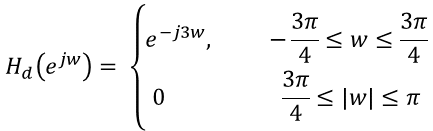
An LPF is to be designed with the following desired frequency response
Determine
the filter coefficient
Also
find frequency response
|
6 |
5 |
6 |
3.1 |





3. Results & Discussions
The proposed examination reforms in the preceding section present a mapping between the COs, PIs and the POs, which may benefit students & faculty in accurately evaluating the learning outcomes attained. As written exams form the basis for grading graduate attributes achieved, it is important to link the exam questions with the cognitive level achieved through the COs and the POs. An intermediary step of defining PIs is introduced for reliable assessment of learning outcomes. Bloom’s learning levels have been taken into consideration while defining the COs, the PIs and also the questions asked in the paper. The sample question paper presented is balanced having various difficulty levels and assesses higher cognitive levels of Bloom as shown in Figure 2 below. As is evident, POs can be addressed by the PIs listed for various courses in the curriculum. Figure 3 presents the analysis of PO attainment through the PIs defined for the sample course. In the DSP case study, the question paper distribution is balanced on the levels of cognition. 28 % Application-level questions; 22% Analysis-level; 32% Design/Creation-level and Fewer than 30 % were committed to Remembering/Understanding, so our constraint is met. The mapping indicated 53 % questions were added to PO1 (engineering knowledge), 21% to PO2 (problem-solving skills), 26 % to PO3 (creative design and innovation). This was translated into measurable PO achievement which is within the expectations of student competence in knowledge, analytical thinking, and innovation. Faculty and student qualitative feedback also indicated the need to have better clarity in expectations and alignment between teaching, assessment, and outcomes.
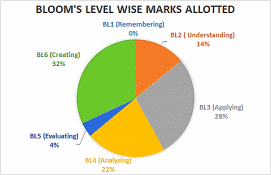
Figure 2. Graph representing Bloom’s Levels addressed in Sample DSP question paper
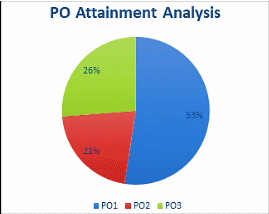
Figure 3. Graph representing PO attainment in Sample DSP question paper
4. Conclusion
The paper concludes that incorporating the PIs in the assessment framework provides a valid and scalable system of associating COs with POs & PIs and addresses all set research questions. It is suggested that the HEIs should keep the questions with lower-order Bloom level to 30 % and cover all COs in balanced proportions. This methodology can be adopted to improve the validity of outcome achievement and align the graduate competencies to the needs of industry and society, better. The methodology can be scaled out to other courses to evaluate the curriculum holistically. The suggested methodology will offer a scalable, transparent and measurable system of redesigning assessment in OBE-based curricula. It is recommended to impose less than 30% limit on low-order Bloom levels, map all COs with multiple performance indicators, ensure a mix of various cognitive levels for assessment in the question papers and groom the faculty to map and implement the approach on each course and constantly improve based on the result. This paradigm shift can enable HEIs to enhance the plausibility of assessment, enhance the match with industry expectations and enhance engineering graduates learning. The framework is very general and can be used in any discipline, and can serve as a model of accreditation-based educational change.
References
Ali Q. I. (2024) Towards more effective summative assessment in OBE: a new framework integrating direct measurements and technology. Discov Educ vol. 3, 107
Bansal D.; Grover N.; Choudhary R.; Mahajan R.; Vats A.; Chaudhary I.; Kaur G. (2019) A Holistic Approach to Assess Learning Outcome Attainment Levels for Engineering Programs. EDUCON 1285-1293. 2019. 10.1109/EDUCON.2019.8725035
Bloom B.; Engelhart M.D.; Furst E.J.; Hill W.H.; Krathwohl D.R. (1956) Taxonomy of educational objectives Handbook 1: cognitive domain. London, Longman Group Ltd.
Bohra N.S.; Johri A.; Wasiq M. (2024) Systematic approach of measuring program outcomes of management postgraduate program. Front. Educ. vol. 9:1404946.
Chen Y.P.; Huang Y.M. (2025) LUPDA: A comprehensive rubrics-based assessment model for STEAM education. Int. J. STEM Educ., vol. 12, 45
Kizilcec R.F.; Huber E.; Papanastasiou E.C.; Cram A.; Makridis C.A.; Smolansky A.; Zeivots S.; Raduescu C. (2024) Perceived impact of generative AI on assessments: Comparing educator and student perspectives in Australia, Cyprus, and the United States. Computers and Education: Artificial Intelligence. Vol.7, 100269
Luo J.; Zheng C.; Yin J. et al. (2025) Design and assessment of AI-based learning tools in higher education: a systematic review. Int J Educ Technol High Educ vol. 22, 42
Mahajan R.; Bansal, D. (2021) Designing Performance Metrics and Rubrics to Assess Student Outcome Attainment in Engineering Project Design Course. Journal of Education, vol. 203(2), 459-467
McBeath R.J; R. J., Ed. (1992). Instructing and evaluating in higher education: A guidebook for planning learning outcomes. Englewood Cliffs, NJ: Educational Technology Publications. ISBN-0-87778-242-3
Nakad M.; Gardelle L.; Abboud R.J. (2025) Stimulating Engineering Students’ Potential for Sustainable Development. Sustainability, vol. 17, 1073
NBA Self-Assessment Report (SAR) Format Undergraduate Engineering Programs Graduate Attributes and Professional Competencies Version 4.0 (GAPC V4.0)
Sabri O.K. (2025) Rethinking sustainability in engineering education: a call for systemic change. Frontiers in Education, vol. 10, 1587430
Thite S.; Ravishankar J.; Tomeo-Reyes I.; Ortiz A. (2024) Design of a simple rubric to peer-evaluate the teamwork skills of engineering students. European Journal of Engineering Education, vol 49, 623 – 646.