Transcre8ion: An Interuniversity Project on Transcreation between Human Creativity and Artificial Intelligence
Transcre8ion: An Interuniversity Project on Transcreation between Human Creativity and AI
Transcre8ion: An Interuniversity Project on Transcreation between Human Creativity and Artificial Intelligence
Katrin Herget1
 ,
Yvonne Hendrich2
1Department of Languages and Cultures / CLLC, University of Aveiro, Portugal, 2Department of Romance Languages, Johannes Gutenberg University, Mainz, Germany.
How to cite: Herget, K., Hendrich, Y. (2026). Transcre8ion: An Interuniversity Project on Transcreation between Human Creativity and Artificial Intelligence. In: 12th International Conference on Higher Education Advances (HEAd’26). Valencia, 15-18 June 2026. https://doi.org/10.4995/HEAd26.2026. 21550
Abstract
Transcreation has gained increasing relevance in translation studies and professional practice as artificial intelligence (AI) and machine translation continue to automate routine translation tasks while struggling with creativity and cultural mediation. This paper presents initial findings from the Transcre8ion Project, an interuniversity research initiative investigating transcreation in the Portuguese–German language pair from both corpus-based and questionnaire-based perspectives. A multilingual corpus of comercial and promotional texts was compiled and qualitatively analysed to identify transcreational strategies and challenges. In parallel, a pilot study was conducted to examine whether evaluators can distinguish between human and AI-generated transcreations and which quality criteria guide their judgments. Results from a pretest questionnaire (n = 9) suggest that participants are often able to identify the origin of transcreations and that functionality, cultural adequacy, naturalness, creativity, and aesthetic appeal play a central role in evaluation. Although the findings remain exploratory, they have provided valuable input for the design of the main questionnaire, which is currently being completed by respondents.
Keywords: Transcreation; Portuguese–German translation; corpus-based analysis; artificial intelligence in translation; Pilot questionnaire.
1. Introduction
The Transcre8ion Project, funded by the German Academic Exchange Service (DAAD), emerged from university-level translation teaching at BA and MA level, where a central objective has been to encourage students to engage more actively with creative problem-solving and with text genres with persuasive and motivational functions. In current teaching practice, however, students increasingly rely on automatic translation systems and AI-generated suggestions, often adopting outputs quickly and with limited critical reflection. Focusing on creative text genres offers a productive pedagogical response to this development. Such texts make the limitations of automated systems particularly visible and create opportunities for discussion, comparison of alternative solutions, and reflective evaluation of translation quality. The project therefore examines transcreation as a pedagogical approach with the aim of developing teaching materials that promote creative competence and critical engagement with AI. Transcreation has gained renewed relevance in the context of rapid advances in translation technologies and artificial intelligence. In 2016, well before the current expansion of neural machine translation and generative AI, David Katan described a professional crossroads for translators, who could either compete with machines in low-risk translation or reposition themselves as transcreators addressing cultural distance and creative value (pp. 377-378). His observation remains highly relevant today. If translators are to remain visible and professionally valued, creativity and cultural competence must become central components of their professional identity. “There really is no question about it: if T/I’s are to survive, then they must make the transcreational turn” (Katan, 2016, p. 378).
Building on this pedagogical and theoretical background, the Transcre8ion Project combines corpus-based analysis with empirical research to examine how transcreation operates in the Portuguese–German language pair. The study draws on a corpus of one hundred texts representing different degrees of creativity and cultural adaptation, including both parallel texts with existing transcreations and monolingual source texts requiring newly proposed solutions. Human and AI-generated transcreations are compared using the Comparative Transcreation Evaluation Survey, in which respondents evaluate selected transcreations. A pilot study has already been completed and has guided the design of an ongoing larger-scale survey involving translators, students, and general readers.
The project pursues two main objectives: pedagogically, to integrate empirically grounded transcreation materials into translator training and develop creative and critical competence; analytically, to explore the extent to which AI systems can model creative translation and how such outputs are perceived by respondents. In doing so, the project contributes to broader debates on the future role of translators in an increasingly automated environment.
2. Defining Transcreation: Theoretical Background
Although widely used in professional practice, transcreation remains a contested concept in translation studies. Jiménez-Crespo (2024, p. 310) situates transcreation “under the umbrella of Translation with a capital T, a heterogeneous group of transformative and mediatory practices that include creative transformations of ST (source texts) into TT (target texts)”. Carreira (2020, pp. 25-26) describes it as strategy or service, although “it is quite probable that transcreation might be a dual natured phenomenon, where both approaches are compatible”. Earlier, Gaballo (2012, p. 111) defined transcreation as an intra- or interlingual reinterpretation adapted to the target audience, emphasizing its holistic nature and its role in overcoming limits of untranslatability. Benetello (2018, p. 41) goes further by positioning transcreation not as a subcategory of translation but as a distinct professional practice requiring hybrid competencies: translator, copywriter, cultural mediator, and marketer. Schreiber (2023, p. 224) highlights a terminological gap between professional and academic usage. In professional settings, “translation” is often reduced to linguistic transfer, while creative adaptation is labeled transcreation or localization. In academic discourse, however, translation has expanded toward broad notions such as cultural translation. Schreiber warns against both extremes: overly narrow definitions marginalize creativity, while overly broad definitions become analytically vague. He proposes to reserve the concept of creativity for cases in which no standard solution exists within a given language pair. Building on this debate, Błaszkowska (2021, p. 351) conceptualizes transcreation as a further evolutionary stage within a continuum of translation practices, situated between literary translation and machine translation. Because machine translation increasingly dominates technical domains, transcreation becomes especially relevant in areas where human creativity and rhetorical impact remain indispensable. She therefore calls for a more systematic theoretical engagement with this still fuzzy concept. From a professional perspective, Sattler-Hovdar (2016) emphasizes the strategic dimension of transcreation in corporate communication, defining it as “translating plus strategic creative adaptation” (p. 21). According to the author, transcreation is particularly relevant when texts shape brand image and public perception, such as in advertising, press releases, or corporate communication, while technical and legal texts fall outside its scope. The process is described as multi-stage, complex, and closer to authoring than to straightforward translation. Finally, the rise of AI has intensified debates about whether creative translation can be automated. Jiménez-Crespo (2024, p. 311) consideres creativity “a unique human skill or capacity that adds “human” value to high risk, high revenue, or critical content types in the age of AI”. With regard to automation, Sattler-Hovdar (2021) observes that while high-volume, informative translation lends itself to technological support, the motivational copy-creation end of the continuum is “all about the IMPACT of the text and the uniqueness of messages, you want to stand out and not sound like everybody else, and so that is all about human brain work, possibly supported by AI for, say, brainstorming purposes” (2021, section The Trans-Creation Continuum). In line with this continuum model, the present study conceptualises transcreation not as a clearly bounded category but as part of a dynamic continuum of translation practices shaped by varying degrees of creative agency and AI involvement.
3. Corpus Design and Data Structure
The corpus comprises two main components. The first is a bidirectional parallel corpus consisting of German and Portuguese source texts and their corresponding transcreations in the other language, drawn from professional communication contexts. Analysis of this component is based on existing source-target text pairs. The second component consists of a monolingual corpus of Portuguese source texts for which no official German transcreation is available. For these texts, transcreation solutions are proposed within the study, allowing for variation and comparison of translation strategies. The two corpus components serve complementary purposes: the parallel corpus documents existing professional practices, whereas the monolingual corpus provides a basis for the systematic comparison of newly proposed transcreation solutions. Text selection focused on genres such as advertising slogans, brand statements, product brochures, website headlines, and short campaign texts drawn primarily from commercial and corporate communication. These genres were selected because they typically require a high degree of cultural adaptation, making them particularly suitable for transcreation research. The corpus includes texts with varying levels of creative complexity.
4. Methodological Framework
The analytical approach combines qualitative textual analysis with the production of target texts. Procedures differ according to corpus type but are guided by a shared aim: to identify and describe transcreation strategies. For the parallel corpus, existing German and Portuguese transcreations are examined through close qualitative analysis, with attention to strategic shifts between source and target texts, including changes in metaphor, tone, register, and persuasive framing. For the monolingual corpus, the research team develops transcreation proposals in both language directions, depending on the source text. These versions are treated as provisional solutions rather than finalized translations. Each proposal is accompanied by a written commentary documenting the translation problem, the alternative options considered, and the reasoning behind the selected solution. This documentation makes the decision-making process explicit and enables comparison of strategies across texts, while also generating material for later use in translator training. In addition to the human-produced versions, AI-generated transcreations are produced for the same source texts using identical prompts and input conditions. No post-editing is applied in order to examine the unmodified system output. Human and AI versions are paired and prepared for subsequent evaluation.
5. Pretest Questionnaire Design
To complement the corpus-based analysis, the project incorporates a structured questionnaire designed to assess how target texts are perceived by readers. In the present contribution, the pre-test is treated as an integral component of the overall research design and as the first empirical phase of a multi-stage study. Its primary purpose was to assess the feasibility of an approach focusing on reader evaluation of transcreations and to identify the evaluative criteria readers employ when judging human and AI-generated transcreations. The pre-test involved nine participants drawn from professional translators, students of translation studies, and native speakers without formal translation training. This heterogeneous sample was included to capture a range of perspectives rather than to support group-based comparison. The questionnaire followed a two-stage design combining quantitative and qualitative components. In the first stage, participants were presented with one Portuguese source text and two corresponding German target versions, one produced by a human and one generated by an AI system. The origin of the target texts was not disclosed. Participants evaluated each version using five-point Likert scales measuring perceived adequacy as a transcreation. In the second stage, participants provided open-ended comments in which they explained their evaluations, identified perceived strengths and weaknesses, and indicated whether they assumed a given version to be human- or AI-generated. This design allowed the study to capture not only preference patterns but also the reasoning processes underlying evaluative judgments. Analysis of the qualitative responses in the pre-test revealed a set of recurring evaluative dimensions that were consistently used by participants when assessing transcreations. Five criteria emerged as particularly salient: functionality, cultural adequacy, naturalness, creativity, and aesthetic appeal. These dimensions reflect an effect-oriented understanding of transcreation that prioritises communicative success and audience resonance over formal correspondence. Rather than being treated as definitive results, these findings were used to inform the construction of the current questionnaire. The evaluation criteria identified in the pre-test were operationalised as rating dimensions and guiding categories for qualitative feedback in the ongoing large-scale study. The revised questionnaire is currently being administered in a larger-scale survey involving professional translators, students, and non-specialist readers.
6. Preliminary Results
Each participant evaluated a total of 30 target texts (15 human-produced and 15 AI-generated), so the percentages represent aggregated individual judgments across all participants. The table below shows how frequently participants correctly identified human and AI-generate transcreations, how often misclassifications occurred, and to what extent uncertainty was reported.
Table 1. Detection accuracy for human and AI-generated transcreations
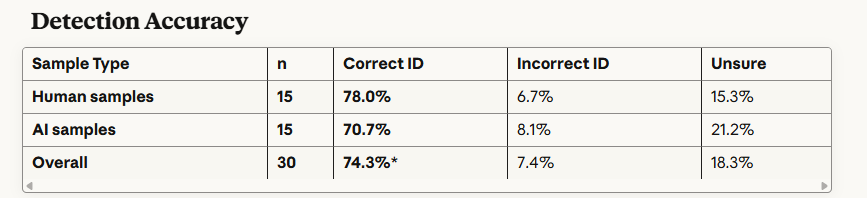
Across all evaluations, the overall detection accuracy reached 74.3%, indicating that participants were able to distinguish between human and AI-generated transcreations. The proportion of incorrect identifications was relatively low at 7.4%, while 18.3% of the judgments were marked as uncertain. For the human samples (15 evaluations per participant), 78.0% of the cases were correctly identified as human. Misclassifications occurred in 6.7% of the judgments, and 15.3% were marked as uncertain. This suggests that human transcreations were generally somewhat easier to recognize. For the AI samples (also 15 evaluations per participant), the correct identification rate was slightly lower at 70.7%. The proportion of incorrect identifications was marginally higher at 8.1%, and the share of uncertain judgments increased to 21.2%. These results indicate that AI-generated texts were more difficult for participants to classify with confidence.
A total of 247 free-text justification segments were manually coded. Each segment corresponded to an individual evaluative comment referring to one of the presented target texts. The responses were analysed through iterative reading in order to identify recurring evaluative criteria. Five main dimensions emerged from this process: functionality, cultural adequacy, naturalness, creativity, and aesthetic appeal. The analysis shows that participants primarily relied on instrumental and contextual criteria when evaluating transcreations. Two closely related dimensions – functionality and cultural adequacy – dominated the evaluations. Respondents focused on whether a slogan effectively conveyed the intended message within its multimodal context and whether it aligned with target-cultural expectations, brand voice, and audience norms. Naturalness and creativity also played an important role. Naturalness reflected sensitivity to idiomatic fluency, with preferred variants described as “natural” or “human-like,” and dispreferred ones as “awkward” or “mechanical.” Creativity was typically inferred indirectly, with participants criticizing solutions that were overly literal, insufficiently reformulated, or unable to reproduce wordplay and rhetorical effects. Aesthetic appeal, although mentioned less frequently, contributed to evaluative distinctions where rhythm, memorability, and stylistic polish were perceived as relevant. Overall, the qualitative data indicate that evaluators assess transcreations holistically, prioritizing communicative effectiveness, while also valuing linguistic naturalness, creative adaptation, and stylistic quality. The justification patterns further highlight consistent strengths attributed to human transcreations and recurring weaknesses perceived in AI-generated outputs.
7. Discussion
The pilot results support the assumption that transcreation remains closely tied to human competencies such as cultural sensitivity, and creative problem-solving. While AI systems can produce grammatically fluent output, they continue to show limitations in contextual interpretation, strategic adaptation, and the handling of culturally embedded or affective meaning, particularly in persuasive and creative genres. The study further demonstrates the value of reception-based evaluation for capturing dimensions of transcreation quality beyond purely linguistic criteria. Criteria such as functionality, cultural adequacy, naturalness, creativity, and aesthetic appeal provide a practice-oriented framework for assessment. Although exploratory, the findings validate the research design and support its extension to larger datasets. From a pedagogical perspective, the combination of corpus analysis and empirical evaluation offers valuable resources for translator training and critical engagement with AI-generated output.
8. Conclusion
The Transcre8ion Project provides initial insights into how human and AI-generated transcreations are perceived in the Portuguese–German context. While the pilot sample is small, the results point to several aspects that appear to shape successful transcreation. Participants were often able to distinguish between human and AI outputs, although some cases remained ambiguous. This suggests that observable differences persist, even if the boundary between human and machine performance is not clear-cut.
Beyond these findings, the pilot study also played an important methodological role, helping to refine the questionnaire and evaluation procedures for the next phase of the project. The study further highlights the pedagogical relevance of transcreation, particularly for developing creative competence and encouraging critical evaluation of AI-generated output in translator training. As the corpus grows and the study is extended to a larger group of participants, more reliable conclusions will be possible. Future work will aim to clarify how closely AI can approximate creative translation and which aspects remain closely tied to human expertise.
Acknowledgments
The authors gratefully acknowledge the funding provided by the German Academic Exchange Service (DAAD) for the Transcre8ion Project.
References
Benetello, C. (2018). When translation is not enough: Transcreation as a convention-defyingpractice. A practitioner's perspective. The Journal of Specialised Translation, 29, 28-44. https://doi.org/10.26034/cm.jostrans.2018.028
Błaszkowska, H. (2021). Translation und Transkreation: Zu Differenzen der Begriffssystematik zwischen Theorie und Praxis. In Angewandte Linguistik – Neue Herausforderungen und Konzepte (pp. 343-351). Vandenhoeck & Ruprecht GmbH & Co. KG.
Gaballo, V. (2012). Exploring the boundaries of transcreation in specialized translation. ESP Across
Jiménez-Crespo, M. A. (2024). Transcreation in Translation and the Age of Human-Centered AI: Focusing on “Human” Creative Touch. In L. Kostopoulou & P. Charalampidou. New Perspectives in Media Translation. Transcreation in the Digital Age. (pp. 309–318). Palgrave Macmillan.
Jiménez-Crespo, M. A. (2025). Human-centeredness in Translation: Advancing Translation Studies in a human-centered AI era. INContext 5:1, 7-17.
Katan, D. (2016). Translation at the crossroads: Time for the transcreational turn? Perspectives 24(3), 365-381.
Napoles, A. M., & Stewart, A. L. (2018). Transcreation: An implementation science framework for community-engaged behavioral interventions to reduce health disparities. BMC Health Services Research, 18(3), 1–8. https://doi.org/10.1186/s12913-018-2890-y
Pedersen, D. (2017). Transcreation in theory and practice. Journal of Translation Studies, 2(1), 35–50.
Sattler-Hovdar, N. (2016). Transkreation: Vom Über-Setzen zum Über-Texten. BDÜ Fachverlag.
Sattler-Hovdar, N. (2021, August 13). The Transcreation Continuum. Transcreation Experts. https://www.transcreationexperts.com/transcreation-continuum/
Schreiber. M. (2023). Zum Begriff der Kreativität aus translationswissenschaftlicher Sicht, insbesondere im Hinblick auf Phraseologismen. Trans-kom 16(2), 222–232.
Torresi, I. (2010). Translating Promotional and Advertising Texts. St. Jerome Publishing.