The Participant-Apprentice: How Recursive, Experiential Education Enhances Qualitative Methods Training
Participant-Apprentice: How Recursive, Experiential Education Enhances Qualitative Methods Training
The Participant-Apprentice: How Recursive, Experiential Education Enhances Qualitative Methods Training
Thi Bich Truong1
 ,
James R. Adams2
,
Victoria Lowerson Bredow3
,
Robert J. Garcia1
,
Connie McGuire3
,
Kathleen R. Johnson1
1Department of Earth System Science, University of California Irvine, United States of America, 2Department of Anthropology, University of California Irvine, United States of America, 3Research Justice Shop, University of California Irvine, United States of America.
How to cite: Truong, T. B.; Adams, J. R.; Bredow, V. L.; Garcia, R. J.; McGuire, C.; Johnson, K. R. (2026). The Participant-Apprentice: How Recursive, Experiential Education Enhances Qualitative Methods Training. In: 12th International Conference on Higher Education Advances (HEAd’26). Valencia, 15-18 June 2026. https://doi.org/10.4995/HEAd26.2026.21570
Abstract
This paper presents a retrospective single-case qualitative study of a curriculum module centered on a classroom-based mock focus group that gives students a concrete experience of qualitative research from the position of the “participant-apprentice.” We analyze the instructional context and implementation to generate actionable insights into effective experiential learning with an interdisciplinary cohort of STEM and social science students.
Keywords: Experiential Education; Community-Engaged Learning; Qualitative Research Training
1. Introduction
Growing recognition of the need to integrate STEM with community engagement and the social sciences has increased the number of interdisciplinary learning spaces. These spaces often use locally situated, collaborative, problem-oriented approaches. However, interdisciplinary training programs struggle to cultivate robust interdisciplinary identities of science graduate students. Multiple disciplinary pressures and time demands of collaboration also complicates pedagogical outcomes in such training programs (Burk & Larson, 2025). These challenges are compounded by how social science methods are typically taught. Introductory-level social science research training is often linear and procedural, reducing methods to checklists, best practices, or "into a series of concrete steps for students to memorize and follow" (Dancis et al., 2023, p. 5)—reproducing what Freire (2000) called the "banking model" of education. For STEM students entering interdisciplinary work, this reductive approach does not foster the flexible, context-sensitive thinking that community-engaged qualitative research demands.
How do we teach community-engaged, qualitative research to entry-level students, including STEM students, in ways that avoid oversimplifying research? Experiential learning––or learning by doing––represents a promising way forward. Experiential learning supports learners in their education, work, and personal development through direct engagement with research processes rather than memorization of procedures (Kolb, 2014, p. 4). Deeply experiential approaches to learning stress the transformative potential for all involved, including educators (Valiente-Riedl et al., 2022). While experiential learning often occurs outside the classroom through field-based (physical, virtual) or community-engaged work (Dolphin et al., 2019; Welch & Plaxton-Moore, 2019), classroom-based experiences can also provide meaningful encounters with research practice.
This paper presents a retrospective single-case qualitative study of a curriculum module centered on a classroom-based mock focus group that gives students a concrete experience of qualitative research from the position of the “participant-apprentice.” We analyze the instructional context and implementation to generate actionable insights into effective experiential learning with an interdisciplinary cohort of STEM and social science students. We collected and anonymized the data according to our IRB protocol (UCI #1719).
2. Setting
2.1. Program
This study is situated within the Climate Justice Initiative (CJI) at the University of California, Irvine (UCI) an R1 public institution in Orange County, California. CJI is an interdisciplinary program that integrates geoscience education and community-based research, based in UCI’s Department of Earth System Science and in partnership with the Research Justice Shop (RJS) and Department of Anthropology. CJI brings together fellows (graduate students and post-baccalaureates) to collaborate with local community-based organizations through a one-year traineeship emphasizing mixed-methods research and nested mentorship. This study’s participants are from a cohort of 12 fellows (six graduate students and six post-baccalaureates) spanning backgrounds in Earth System Science, Urban Planning and Public Policy, Engineering, Sociology, and Education.
Fellows enrolled in a year-long course, Climate Justice Practicum (henceforth, “Practicum”), meeting weekly for 110 minutes over four academic terms. The fellows (henceforth, “students”) engaged in lecture, discussion, interactive activities, and field trips. Practicum co-instructors include staff and faculty from geosciences, social sciences, and directors from UCI’s Research Justice Shop (RJS), who, through “tinkering,” emphasized iterative experimentation in community-engaged learning and supported reflection on community-based research throughout the year (Welch & Plaxton-Moore, 2019; Mulder et al., 2006).
2.1.1. Participants and Module
This study examines a single course module about focus groups conducted in Spring 2025. We designed a module (Table 1) with learning goals of distinguishing focus groups from other methods and participating in and reflecting on a mock focus group. We accomplished this with lecture-based instruction, an in-class mock focus group and debrief, and a follow-up assignment. We held the mock focus group and debrief in an in-person Practicum (n=10). We assigned all students (n=12) to review the recording and transcript and write summaries of the mock focus group. We disseminated a facilitation guide and gave a follow-up lecture to share our facilitation decisions during the session (beyond the scope of this paper).
Table 1. Focus Group Module - Description of Activities (Spring Term, 2025).
Activity |
Date |
Topic / Name |
Platform |
Duration |
1 |
April 2 |
Lecture: Focus Groups |
|
48 minutes |
2 |
April 2 |
Mock Focus Group |
YouTube |
24 minutes |
3 |
April 2 |
Debrief Discussion |
YouTube |
24 minutes |
4 |
April 8 |
Assignment: Written Summary |
Canvas (text) |
Self-paced |
Platform indicates recording platform for sharing media or learning management system (LMS). Activities 1-3 occurred during the same 110-minute Practicum period (breaks are not listed). Activity 4 was self-paced work
3. Results
We analyzed transcripts, recordings, and student work from the mock focus group, debrief, and summary assignment to illustrate how we cultivated experiential learning in the context of education scholarship, with an emphasis on “concrete experiences” (Kolb, 2014). Here, we describe the instructional design and implementation to help contextualize later discussion of how we cultivated experiential learning throughout this module.
3.1. The Mock Focus Group
The pedagogical value of the mock focus group exercise began with how we separated the focus group, both spatially and operationally, from the regular Practicum operations. First, we delivered a 45-minute lecture on the history, methods, and applications of focus groups. We then gave the students a brief five-minute break and instructed them to reconvene in another room for our “mock focus group.” The focus group room was much smaller than our regular classroom. It was also furnished with movable chairs that we arranged in a semicircle around a flip chart. We set up a video camera in the corner, and a boundary microphone. Upon their return, we had already assumed our roles as focus group researchers (facilitator and flip chart recorder, notetaker, audio recorder, host, observer). We ran the session as a live focus group, beginning with welcoming participants to the space, asking them to fill out a sign-in sheet, and to wear name tags.
We modeled the focus group in realistic phases: 1) a warm-up interactive activity, a personal mapping activity of students' journey to class that day, 2) a discussion grounded in one “headache” from their experience commuting to work that morning, and 3) a more creative discussion about an ideal or desirable commuting experience.
Throughout these activities and discussions, our facilitator modeled numerous “micro-skills,” such as active listening, being fully present, and paraphrasing group responses affirmatively. Considerable attention was devoted to communicating how the focus group's primary purpose was to facilitate collective meaning-making, echoing the lecture’s way of distinguishing focus groups from interviews. The facilitator also skillfully projected both approachability and confidence, which contributed to maintaining a smooth and productive discussion flow.
3.2. The Debrief
We concluded the mock focus group recording and immediately began a new recording for the debrief. Everyone (students and instructors) reflected on the experience and shared perspectives. Students steered the debrief discussion, eliciting responses from co-instructors that, in turn, provoked comments and these questions from other students, in this sequence:
“We're kind of chatty, but for more quiet people, how would you really go about that?”
“I was wondering, if you notice as a facilitator, that there's a perspective missing, but based on initial conversations…let's say everyone commented on walking, but then you know somebody drove. Can you say, ‘oh can you speak on that?’”
“I'm curious, too. I know there was a moment where you were like, ‘Good thing I'm not talking about my experiences, or something like that. Do you think it’s a good way to get more people to talk by sharing your own experiences?”
“So, in this case, you were a note taker and also a lead facilitator?”
“Let's say you have your first focus group, and then there's a question that wasn't in your plan that generates a lot of conversation. Is it okay to then adjust it for your future focus groups, or is it better to maintain consistency for finding the results?”
Following the experience with a debrief enabled students to ask and hear questions about the method that might not otherwise have occurred to them, and to share and respond to one another's thoughts and experiences. Seven out of ten students raised questions or discussion topics; a stark contrast to the preceding lecture, in which zero students asked questions. Furthermore, instructors fielded questions in a more interactive manner, providing open-ended, context-specific responses rather than simple rules or dichotomies. This allowed us to directly engage the students’ specific concerns while also exploring alternative designs and implementation options. As such, the “debrief” helped shift from teaching methodology as a procedure to approaching it as a recursively creative and reflective process.
3.3. The Focus Group Summary
The summary assignment evidenced different ways students think about qualitative data, including what they considered to "count" as data, as well as different styles of analyzing and categorizing it. The assignment also demonstrated the way they felt during the focus group. In one particular summary, a student focused on their own personal experience of marginalization within the focus group. They also shared new information, relevant to the prompts, that was not mentioned during the focus group or the subsequent debrief. In their own words, “I honestly think that I didn't share this because I had a hard time listening to my coworkers, because of the situation I'm in.” This shows the student’s firsthand discovery of how group relations and behaviors constrain the types of data that can be obtained through focus groups. Overall, the written summary was an interpretive assignment that provided another way of accessing the diversity of the students' experiences, orientations, interests, and learning from the class. This approach can enable learning outcomes that are unique to individual students, while also providing standard learning on focus group methodologies.
4. Discussion
We discuss our findings in the context of Kolb's (2014) articulation of experiential learning as a four-stage learning cycle: 1) concrete experience, 2) reflective observation, 3) abstract conceptualization, and 4) active experimentation. We also close this section with an analysis of our own experience as educators, providing a retrospective analysis of what we learned through planning, implementation, and assessment. While elements of this presentation are linear in flow, it’s important to note that the actual learning process is much more immanent and simultaneous. Reflective observation and abstract conceptualization were happening concurrently at all times. And every step was enabled by some form of active experimentation that was, itself, a new concrete experience. A summary of these findings is in Figure 1.
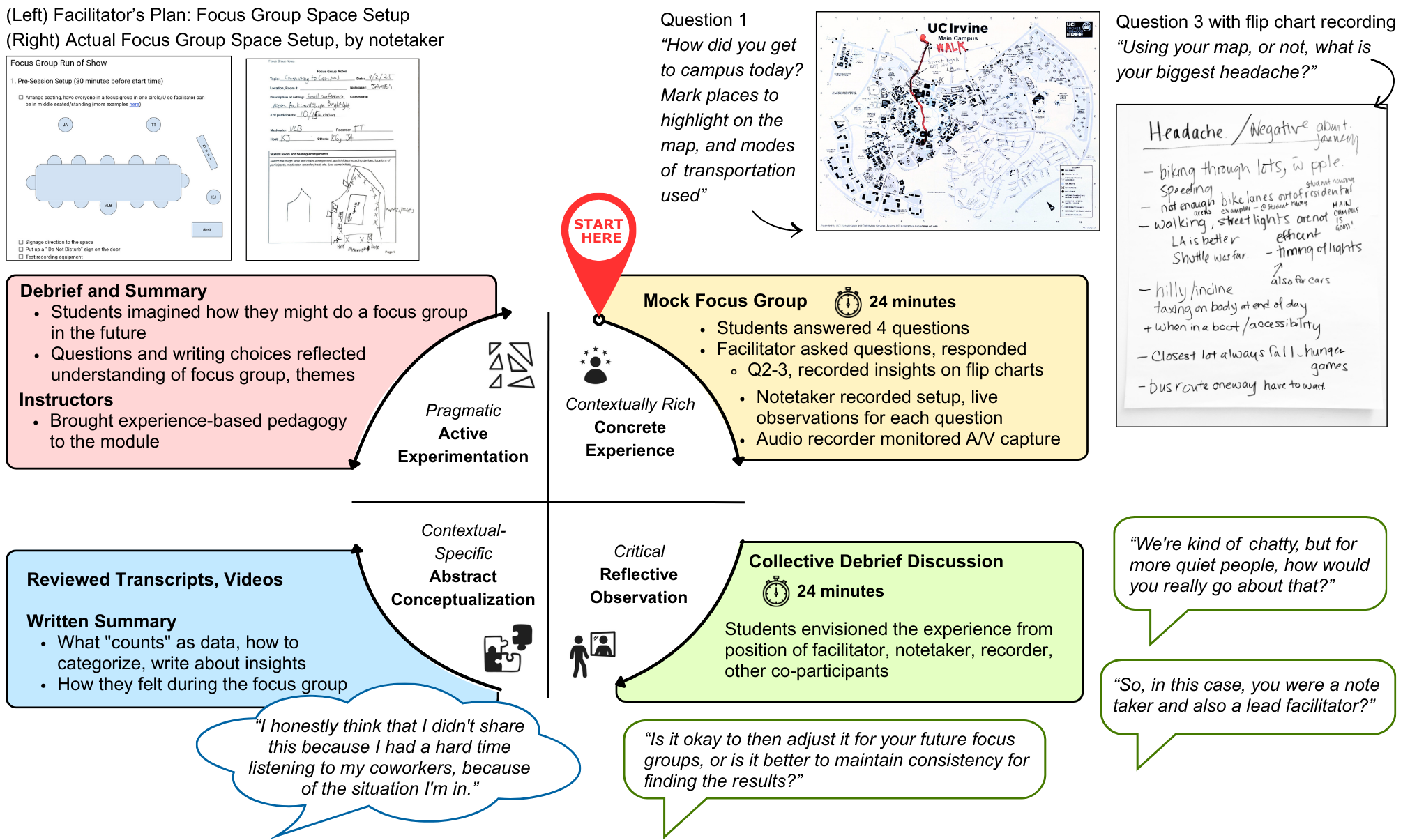
Figure 1. Experiential learning during and after a mock focus group, starting with concrete experience. Four stage experiential learning cycle modified from Morris (2020) and Kolb (2014), with each stage contextualized with summarized findings, example quotations, data products and outputs.
4.1. Kolb’s Experiential Learning Cycle
Our mock focus group provided the initial concrete experience that kick-started all other aspects of experiential learning. Positioning students as “participant-apprentices,” a superposition of the learner and the object of study, enabled us to provide more direct exposure to how we, as researchers, can co-produce knowledge with interlocutors. It thus provided our students with a rich and complex experience of this methodology, including what it feels like to participate, the kind of responses people are (or are not) compelled to provide, and the interpretive value and limitations of those responses.
This superposition also structurally enabled the students to consider the mock focus group from multiple perspectives, simultaneously, which is a key signature of Kolb’s notion of reflective observation (Morris, 2020). For example, the students' responses during the debrief showed that, even while answering our focus group prompts, they were already envisioning the experience from the position of the facilitator, the notetaker, the recorder, and their other co-participants. The debrief’s set of lingering curiosities and concerns also evidenced what Kolb defines as abstract conceptualization, showing how they were reconciling what they observed in this mock focus group with their own experiences, and active experimentation imagining whether and how they might do something similar themselves in the future (Morris, 2020). Experimentation and conceptualization also appeared in the summary assignment, where students’ writing choices reflected their understanding of the focus group, its themes, and key insights. This summary also supported another mode of reflective observation, one that was more private and self-paced, which, importantly, enabled at least one student to think and write more critically about their experience in the focus group.
Lastly, it's important to emphasize how much we learned from the exercise as facilitators, educators, and researchers (Valiente-Riedl et al., 2022). Through our own reflective observations, we noticed how the active experimentations we brought to our module, as part of our experience-based pedagogy, can be abstracted and reconceptualized as part of focus group research design. After analyzing the pedagogical outcomes of different pieces of our module, we recognized the value of apportioning time to debrief the focus group with participants, field their questions, hear their understandings and takeaways. Additionally, by providing a space for post-focus group reflections, written by participants in response to a transcript or recording, can surface thoughts and perspectives folks were either unable or uncomfortable sharing in a group setting. Such interventions help us to contextualize and interpret focus group discussions, while providing a meaningful way of bringing the participants into the project as epistemic partners and co-producers of knowledge.
4.2. Study Limitations
This is a co-instructor narrative grounded in our facilitation and documentation expertise; thus, student perspectives are less visible. Student mastery of focus group methods, data processing, or ability to enact focus group roles independently remains uncertain. In the written summaries, students often focused on descriptive observations and on quantifying responses, and less on interpretation of responses. This mirrors the limited observation–inference gaps made by students evaluated after completing virtual field experiences in a geology lab class (Dolphin et al., 2019). Adding follow-up assignments for students to practice the interpretive process would better align with qualitative research and geology’s hermeneutic traditions. Future studies could benefit from a larger sample size than this cohort. Given the study’s focus on the single cohort, short-term and longitudinal surveys would enable collecting metacognitive reflections and assessing if students applied this classroom experiential learning to their community-engaged research projects.
5. Conclusion
Efforts to teach more participatory and community-based approaches within higher education reflect the intention to protect communities while satisfying ethical review (Flicker et al., 2007). However, such efforts can push qualitative research training towards rigid formalization (Dancis et al., 2023), despite the need for more open, flexible, and emergent principles of recursive design (Dari et al., 2019). While this ethically motivated will-to-standardize is understandable, such rigidity fails to ensure the protection of communities (Guillemin & Gillam, 2004), and also robs students of unique and important considerations of qualitative research design: how to recognize and incorporate one’s own personal and unique interests, skills, thought style, and sensibilities into their engagement with place-specific dynamics of the research site (Maxwell, 2013). Our experiential approach, by contrast, reveals how the unique configuration of students––including their interests, insights, capacities, and skills––shaped the knowledge that emerged and evolved from the classroom. What we did, and what experiential learning does, is cultivate that configuration and appreciate, document, and name it.
In this paper, we discussed a focus group module, focusing on a key activity of a “mock focus group” as a classroom-based, experiential approach that enables a concrete experience of qualitative research from the position of participant-apprentices. Returning to the central question: how should we teach community-engaged, qualitative research without oversimplifying research? The focus group module––taught in a recursive manner and starting with the concrete experience of the focus group––enhanced student learning (from the superposed perspective of the researched and the researcher), enhanced our learning as instructors, as we took on focus group researcher roles and heard the students’ reflections back. Finally, education became productive of new knowledge and insights, and produced an experimental method of focus groups that is being worked into our continually evolving CJI curriculum as part of the recursive structure of active experimentation in experiential learning. Recursively incorporating changes in how we as educators understand, think about, and utilize the knowledge that we teach prevents experiential learning from becoming procedural reproductions of the banking model.
Acknowledgments
The U.S. National Science Foundation (Award # 2228216) provided support for this study. We are grateful to two anonymous peer reviewers, whose comments improved this manuscript. We would also like to thank trainees of the Climate Justice Initiative Cohort 2024-2025: Mohammed Bah, Damien Bonds, Miranda Elizarrarás Botello, Anya Desai, Alexander Diaz, Tatiana Flores, Victoria Nguyen, Kevin Olivas Ordoñez, Mikiztli Sarapura Ortiz, Bryant Labajo Pahl, Salwa Sidahmed, and Alexis Woods. We are grateful for your open-minded participation in this class session and for your care and commitment throughout the fellowship and beyond.
References
Burk, N. R., & Larson, G. S. (2025). Inter/disciplining Identities: How Disciplinary Identity Impacts Interdisciplinary Collaboration. Perspectives on Science, 33(5), 545–578. doi: 10.1162/POSC.a.5
Dancis, J. S., Coleman, B. R., & Ellison, E. R. (2023). Participatory Action Research as Pedagogy: Stay Messy. Journal of Participatory Research Methods, 4(2). doi: 10.35844/001c.75174
Dari, T., Laux, J. M., Liu, Y., & Reynolds, J. (2019). Development of Community-Based Participatory Research Competencies: A Delphi Study Identifying Best Practices in the Collaborative Process. The Professional Counselor, 9(1), 1–19.
Dolphin, G., Dutchak, A., Karchewski, B., & Cooper, J. (2019). Virtual field experiences in introductory geology: Addressing a capacity problem, but finding a pedagogical one. Journal of Geoscience Education, 67(2), 114-130. doi: 10.1080/10899995.2018.1547034
Flicker, S., Travers, R., Guta, A., McDonald, S., & Meagher, A. (2007). Ethical Dilemmas in Community-Based Participatory Research: Recommendations for Institutional Review Boards. Journal of Urban Health : Bulletin of the New York Academy of Medicine, 84(4), 478–493. doi: 10.1007/s11524-007-9165-7
Freire, P. (2000). Pedagogy of the oppressed (30th anniversary ed). Continuum.
Guillemin, M., & Gillam, L. (2004). Ethics, Reflexivity, and “Ethically Important Moments” in Research. Qualitative Inquiry, 10(2), 261–280. doi: 10.1177/1077800403262360
Kolb, D. A. (2014). Experiential Learning: Experience as the Source of Learning and Development. FT Press.
Maxwell, J. A. (2013). Qualitative Research Design: An Interactive Approach (3rd ed). SAGE Publications.
Morris, T. H. (2020). Experiential learning–a systematic review and revision of Kolb’s model. Interactive Learning Environments, 28(8), 1064-1077. doi: 10.1080/10494820.2019.1570279
Mulder, H. A. J., Jørgensen, M. S., Pricope, L., Steinhaus, N., & Valentin, A. (2006). Science shops as science-society interfaces. In A. Guimares Pereira, S. Guedes Vaz, & S. Tognetti (Eds.), Interfaces between Science and Society. (pp. 278–296). Greenleaf Publishing. doi: 10.4324/9781351280440-17
Valiente-Riedl, E., Anderson, L., & Banki, S. (2022). Practicing what we teach: Experiential learning in higher education that cuts both ways. Review of Education, Pedagogy, and Cultural Studies, 44(3), 231–252. doi: 10.1080/10714413.2021.1985372
Welch, M., & Plaxton-Moore, S. (2019). The craft of community-engaged teaching and learning: A guide for faculty development. Campus Compact.