Leveraging Intelligent Systems to Enhance Student Engagement and Attendance in the Classroom
Leveraging Intelligent System to Enhance Student Engagement and Attendance in the Classroom
Leveraging Intelligent Systems to Enhance Student Engagement and Attendance in the Classroom
Nagham Mohammad

Mathematics and Statistics, University of Guelph, Canada.
How to cite: Mohammad, N. (2026). Leveraging Intelligent Systems to Enhance Student Engagement and Attendance in the Classroom. In: 12th International Conference on Higher Education Advances (HEAd’26). Valencia, 15-18 June 2026. https://doi.org/10.4995/HEAd26.2026.21581
Abstract
This paper explores the use of intelligent classroom-response systems to enhance student engagement and attendance in large introductory mathematics and statistics courses from the students’ perspective. The primary aim was to assess how tools like Top Hat influence real-time interaction, understanding, and the resolution of misconceptions during lectures. Students reported through course evaluations and their responses to Top Hat questions that using Top Hat in class increased engagement, improved comprehension, and enhanced motivation, leading to higher attendance rates compared to traditional lecture formats. The findings suggest that integrating intelligent systems into classroom instruction not only creates a more interactive and responsive learning environment but also positively affects students’ learning experience. These insights underscore the value of adopting such systems to strengthen student engagement and improve attendance.
Keywords: student engagement, intelligent systems, classroom-response technology, active learning, artificial intelligence (AI).
1. Introduction
The transition to university often poses significant challenges for students, particularly in large-enrollment mathematics and statistics courses. Many first- and second-year students experience mathematics anxiety, defined as feelings of tension and apprehension that interfere with performance in math- or statistics-related subjects (Luttenberger et al., 2018). Large class sizes (over 200 students) can amplify this anxiety, as students may feel anonymous, unsupported, and hesitant to ask questions, which can reduce engagement and hinder learning. Additionally, emerging research indicates that increased reliance on artificial intelligence (AI) tools for academic support may alter traditional engagement patterns. Some studies suggest that heavy AI use is associated with decreased academic involvement, such as lower participation and attendance in formal class activities, potentially exacerbating feelings of disconnection in large courses (Mohammad et al., 2025; Smith, Johnson, & Lee, 2024).
Despite these challenges, evidence shows that enhancing student engagement through active learning, collaborative exercises, or strong instructor support can help reduce math anxiety by boosting confidence, self-efficacy, and participation (Brownell, 2018; Khasawneh et al., 2021; Mohammad et al., 2023).
In the introductory mathematics and statistics courses at the University of Guelph in Canada, individual classes frequently have several hundred students, making meaningful interaction challenging. Research shows that traditional lecture-based instruction tends to limit opportunities for students to actively participate or receive timely feedback, which can hinder conceptual understanding and long-term retention (Freeman et al., 2014). In the three courses examined in this paper, MATH*1080–Elements of Calculus I, STAT*2080–Introductory Applied Statistics I, and STAT*2230–Biostatistics for Integrative Biology, instructors face significant challenges in maintaining engagement and ensuring that learners are following key concepts throughout the lesson.
Classroom-response technologies (CRS), often referred to as “clicker systems”, have emerged as promising tools for supporting active learning in high-enrollment courses. Early work by Mazur (1997) on Peer Instruction demonstrated that real-time questioning can help students confront misconceptions and deepen conceptual understanding. Subsequent studies have shown that systems such as clickers or digital platforms can promote participation, support formative assessment, and make large-class instruction more interactive (Caldwell, 2007; Bruff, 2009). More recent research continues to support these findings, demonstrating that CRS can improve student performance, engagement, and attendance in large STEM courses (Dixson et al., 2020; Kay et al., 2021; Li & Li, 2023).
Platforms such as Top Hat extend these ideas by allowing instructors to pose questions, collect responses instantly, and modify instruction based on immediate feedback. While not a complete solution, these tools have shown potential for increasing student interaction, supporting active engagement, and fostering a more dynamic classroom environment. In addition, students sometimes perceive the use of interactive platforms like Top Hat in large lecture settings as a form of instructional “kindness,” noting that these tools help create a more supportive, inclusive, and approachable learning atmosphere (Mohammad et al., 2025).
This paper examines the use of Top Hat in these courses and discusses how such technology supports student engagement and enhances the learning experience.
2. Background
This work was conducted at the University of Guelph in Ontario, Canada, focusing on student responses related to Top Hat during the Fall 2025 and Winter 2026 semesters. The study involved MATH*1080 and STAT*2080 in Fall 2025, and STAT*2230 in Winter 2026. We have been using Top Hat in these courses for several years to support interactive instruction and enhance student engagement.
2.1. Course Context: MATH*1080, STAT*2080 and STAT*2230 at the University of Guelph
These courses typically enroll large sections of 200 or more students, creating a setting where individual students can feel like just a number. This high-enrollment structure provides an ideal context for evaluating intelligent learning systems aimed at improving student engagement and attendance.
2.1.1. MATH*1080 (Elements of Calculus I) is used across several degree programs, mainly in the life sciences and applied sciences.
This course provides an introduction to the calculus of one variable with emphasis on mathematical modelling in the biological sciences. The topics covered include elementary functions, sequences and series, difference equations, differential calculus and integral calculus. In the Fall 2025 semester, a total of 1,448 students were enrolled across four lecture sections and four corresponding lab sections. All Fall offerings of the course included three traditional lectures per week based on a custom course manual, complemented by a weekly lab session providing additional practice problems and extensions of key concepts. Student attendance was not mandatory and was not recorded, except for exams and tests.
2.1.2. STAT*2080 (Introductory Applied Statistics I) is a second-year applied statistics course used in many science programs (biology, environmental, health, agriculture and some social science programs).
The topics covered in this course include frequency distributions, graphing and tabulation of data, measures of central tendency, variability and association, elementary probability, hypothesis testing and confidence intervals, basic concepts of experimental design, treatment designs, simple linear regression and correlation. Examples come from a variety of disciplines, including family studies, education, marketing, medicine, psychology and sociology. In the Fall 2025 semester, a total of 235 students were enrolled in the course. All offerings included three traditional lectures per week based on a custom course manual. Student attendance was not mandatory and was not recorded, except for exams and tests.
2.1.3. STAT*2230 (Biostatistics for Integrative Biology) is a specialized statistics course mainly for Integrative Biology and related life science programs.
This course introduces students to the design, completion and interpretation of research projects, including identifying categories of research questions, types of data, data gathering methods, efficient graphical and numerical methods to summarize data, standard statistical analyses involving parameter estimation and hypothesis tests, and interpreting results in the context of research goals. Statistical concepts underlying the practical aspects of biological research are emphasized. Computer-intensive laboratory sessions focus on practical data organization, visualization, statistical analysis using software, and interpretation and communication of statistical results. In Winter 2026, the course enrolled 300 students across one lecture section and eight lab sections. The course included three one-hour lectures per week and a weekly lab, with labs focusing on RStudio-based data analysis and applied practice. Attendance was optional and not recorded, except for exams, tests, and graded assignments.
2.2 What is Top Hat?
Top Hat is a web-based student response system that enables instructors to conduct polls, initiate discussions, deliver lecture materials, and monitor attendance. It allows students to engage in these activities using their own devices. According to social constructivist theories, effective learning occurs within a supportive community where students interact positively and learn collaboratively (Lin et al., 2021). Peer discussions have been shown to increase answer accuracy and boost student confidence in their responses (Tullis & Goldstone, 2020).
The use of interactive technology in classrooms offers several advantages. Instructors can tailor lessons to address specific student needs by identifying areas of weakness more easily (Aljaloud et al., 2019). Additionally, students build stronger connections with peers, enabling resource sharing and mutual support (Lin et al., 2021).
3. Assessment Structure
3.1. Top Hat Assessment Structure
Top Hat was implemented as an integral part of lecture sessions. Instructors used the platform to present 1–3 multiple-choice or short-answer questions per lecture, allowing students to respond individually. For each Top Hat question posed during class, students received two marks: one for participation (regardless of accuracy) and one for a correct response. The questions were intentionally short and directly related to the material taught that day or the day before, allowing students to immediately apply newly introduced concepts. Students were encouraged to first work through each question independently and then discuss their ideas collaboratively before submitting an answer. If the instructor observed low performance on a question, indicating that a concept had not been fully understood, they would re-explain the material and provide either a second attempt at the same question or a similar follow-up question to allow students to correct their responses. To calculate the final Top Hat grade, only the best 80% of a student’s Top Hat marks were used. No alternate dates or make-up opportunities were provided for missed questions; dropping the lowest 20% of marks was intended to account for absences or technical issues, such as problems with internet connectivity.
3.2. Course Grading Scheme
All courses (MATH*1080, STAT*2230, and STAT*2080) used the same two grading schemes each year; however, students did not select between them. Instead, final grades were calculated under two different schemes, and the higher outcome was applied automatically. While the schemes differed in the weighting of tests and the final exam, both allocated 5-6% to Top Hat questions. Including Top Hat in both schemes ensured that participation and engagement were consistently recognized as essential components of learning. The weighting encouraged students to attend lectures regularly, engage with in-class questions, and benefit from immediate feedback on their understanding. Embedding Top Hat into both assessment schemes reinforced the courses’ instructional goals by promoting continuous engagement, supporting comprehension, and enhancing formative learning throughout the term.
3.3. Student Feedback
Student feedback was collected through the standard end-of-semester Student Feedback Questionnaires. Overall, class reviews were very positive, although Top Hat was mentioned only occasionally. Feedback on the course structure was also highly positive. A few students suggested incorporating more Top Hat questions throughout the class, rather than leaving them for the last 10 minutes, while others reported occasional internet connectivity issues. Selected feedback comments are provided below:
Everything was great. Top Hat was great (MATH*1080).
I really enjoyed Top Hat and the selected practice problems (MATH*1080).
If I didn’t understand something, she always explained the concept very well while going over Top Hat questions. Had a very positive experience with this course (MATH*1080)
I also enjoyed the course and found the Top Hat component very engaging (MATH*1080).
Top Hat was very Helpful. Helps understand concepts easily (MATH*1080).
Doing Top Hat during class was very helpful (STAT*2080).
Top Hat really keeps us engaged (STAT*2080).
I really really enjoyed this course! I loved the Top Hat questions (STAT*2080).
Enjoying the learning environment, Top Hat engaging (STAT*2080).
In addition, students responded to several questions about Top Hat administered through the Top Hat platform, with results shown in Figure 1 and Table 1. Some courses were offered in Fall 2025, while others were offered in Winter 2026; therefore, the corresponding results reflect the specific term during which data were collected for each course.
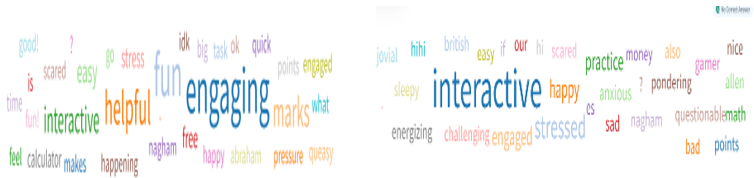

Figure 1. Course students’ one-word responses to the question “Using one word only, what comes to mind when you hear ‘Top Hat,’ and how does it make you feel?” Left: STAT*2080 (Fall 2025). Right: STAT*2230 (Winter 2025).
|
Agree |
Disagree |
Neutral |
|||
|
STAT* 2080 F25 |
STAT* 2230 W26 |
STAT* 2080 F25 |
STAT* 2230 W26 |
STAT* 2080 F25 |
STAT* 2230 W26 |
Using Top Hat in class motivates me to attend lectures more regularly. |
66% |
87% |
3% |
3% |
31% |
10% |
Using Top Hat in class enhances my engagement during lectures. |
69% |
81% |
5% |
3% |
26% |
16% |
Using Top Hat in class helped me understand the course material better. |
68% |
81% |
10% |
3% |
22% |
16% |
3.4. Grade Data
Below are the Top Hat class statistics for each course, which indicate that the majority of students enrolled in the Fall 2025 courses actively used Top Hat during lectures. Student responses in Top Hat activities were high, and their performance on these graded activities also reflected strong engagement.
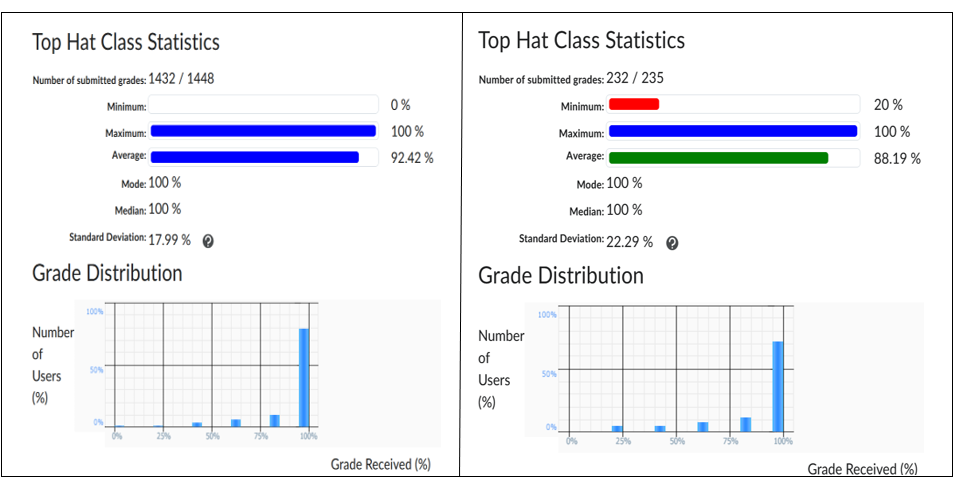
Figure 2. Left: Top Hat participation and course grades for MATH*1080 (Fall 2025). Right: Top Hat participation and course grades for STAT*2080 (Fall 2025).
4. Conclusions
The use of Top Hat in lectures and assessments consistently encouraged students to participate actively, attend class regularly, and engage with course material in real time, while providing immediate feedback that helped clarify misconceptions and reinforce learning. Student feedback was largely positive, with suggestions emphasizing the value of incorporating interactive questions throughout the lecture rather than only at the end. By allocating a fixed percentage of the grade to Top Hat, engagement was formally recognized, promoting continuous involvement and reinforcing the courses’ instructional objectives by supporting comprehension, enhancing formative learning, and sustaining engagement throughout the term. The long-term integration of Top Hat since Fall 2018 demonstrates that such interactive tools can be effectively embedded across multiple courses over several years, yielding consistently positive outcomes without significant disruption. Overall, this work can be viewed as program evaluation activity and performance review used exclusively for improvement purposes; the results are not intended to be generalizable without further experimental study.
References
Aljaloud, A., Gromik, N., Kwan, P., & Billingsley, W. (2019). Saudi undergraduate students’ perceptions of the use of smartphone clicker apps on learning performance. Australasian Journal of Educational Technology, 35(1), 85-99. https://doi.org/10.14742/ajet.3340
Brownell, S. E. (2018). The influence of active learning practices on student anxiety in large‑enrollment college science classrooms. International Journal of STEM Education, 5(23). https://doi.org/10.1186/s40594-018-0123-6
Bruff, D. (2009). Teaching with classroom response systems: Creating active learning environments. Jossey-Bass.
Caldwell, J. E. (2007). Clickers in the large classroom: Current research and best-practice tips. CBE—Life Sciences Education, 6(1), 9–20. https://doi.org/10.1187/cbe.06-12-0205
Dixson, M. D., Worrell, F. C., & Peugh, J. (2020). The use of clickers to improve student engagement and performance in large STEM courses. Journal of College Science Teaching, 49(3), 24–33.
Freeman, S., Eddy, S. L., McDonough, M., Smith, M. K., Okoroafor, N., Jordt, H., & Wenderoth, M. P. (2014). Active learning increases student performance in science, engineering, and mathematics. Proceedings of the National Academy of Sciences, 111(23), 8410–8415. https://doi.org/10.1073/pnas.1319030111
Kay, R., LeSage, A., & Scherpbier, A. (2021). Classroom response systems and student engagement in large classes: Evidence from STEM disciplines. Journal of Educational Technology Systems, 50(4), 503–523. https://doi.org/10.1177/00472395211019273
Khasawneh, R. T., Gosling, J., & Williams, L. (2021). Mathematics anxiety in higher education: A meta-analysis. Studies in Higher Education, 46(8), 1592–1609. https://doi.org/10.1080/03075079.2019.1706903
Li, H., & Li, X. (2023). Digital clicker systems in university mathematics and statistics: Effects on student interaction and learning outcomes. International Journal of STEM Education, 10(12), 1–15. https://doi.org/10.1186/s40594-023-00456-7
Lin, T., Kraatz, E., Ha, S. Y., Hsieh, M., Glassman, M., Nagpal, M., Sallade, R., & Shin, S. (2021). Shaping classroom social experiences through collaborative small-group discussions. British Journal of Educational. Psychology, 92(1), 131-154. https://doi.org/10.1111/bjep.12442
Luttenberger, S., Wimmer, S., & Paechter, M. (2018). Spotlight on math anxiety. Frontiers in Psychology, 9, 868. https://doi.org/10.3389/fpsyg.2018.00868
Mazur, E. (1997). Peer instruction: A user’s manual. Prentice Hall.
Mohammad, N. M., Demers, M., McCubbin, E., Mitchell, J., & Fulmer, S. (2025). How college students use ChatGPT. Pedagogical Research, 10(4), em0250.
Mohammad, N., Nagham, N., Kraus, D., Richards, G., & McCubbin, E. (2025). Students’ perception on blending mathematics teaching with kindness. Journal of Mathematics and Science Teacher, 5(2), Article em077. https://doi.org/10.29333/mathsciteacher/16057
Mohammad, N., Nagham, N., Nica, M., Mihai, L., Levere, K. M., & Okner, R. (2023). Promoting engagement via engaged mathematics labs and supportive learning. International Electronic Journal of Mathematics Education, 18(2), em0732. https://www.iejme.com/download/promoting-engagement-via-engaged-mathematics-labs-and-supportive-learning-12960.pdf
Smith, A., Johnson, B., & Lee, C. (2024). AI dependence and academic engagement in large university courses. Journal of Higher Education & Technology, 15(2), 123–138. https://doi.org/10.1234/jhet.2024.01502
Tophatmonocle Corporation. (n. d.). Top Hat for students. Top Hat. https://tophat.com/students/
Tullis, J. G., & Goldstone, R. L. (2020). Why does peer instruction benefit student learning? Cognitive Research: Principles and Implications, 5(1), Article 15. https://doi.org/10.1186/s41235-020-00218-5