Pedagogical Approaches to Educating Ethical Marketers
Pedagogical Approaches to Educating Ethical Marketers
Pedagogical Approaches to Educating Ethical Marketers
Gunta
Grinberga-Zalite1
 ,
Andra Zvirbule1
,
Joanna Hernik2
,
Ksenija Furmanova1
1Faculty of Economics and Social Development, Latvia University of Life Sciences and Technologies, Latvia, 2Faculty of Economics, West Pomeranian University of Technology, Poland
How to cite: Grinberga-Zalite, G.; Zvirbule, A.; Hernik, J.; Furmanova, K. (2026). Pedagogical Approaches to Educating Ethical Marketers. In: 12th International Conference on Higher Education Advances (HEAd’26). Valencia, 15-18 June 2026. https://doi.org/10.4995/HEAd26.2026.21588
Abstract
Concerns about unfair business practices, greenwashing, and unsustainable consumption, which have occasionally caused actual harm to society, are growing among citizens and policymakers as a result of the shift of communications to the digital sphere, which is also having an increasing impact on consumer choices. The need for ethically grounded marketing education is justified by this shift. The purpose of this study is to investigate the role of ethics in contemporary marketing communication and to provide cutting-edge pedagogical strategies for training the upcoming generation of ethical marketers in higher education. The study aims to develop and test a stakeholder-informed pedagogical model for integrating ethics into marketing and business studies, as well as to investigate ethical discourses in marketing communication and their educational significance. A mixed-methods research design was used to achieve the research objective, combining a narrative literature review with qualitative focus group interviews, which were afterwards interpreted by a phenomenological analysis approach. The research findings show that ethics in marketing communication acts as a strategic and rational basis, while integrative pedagogical models that combine experiential, reflective and digital learning effectively improve ethical understanding, sustainability competencies and professional responsibility.
Keywords: marketing education; ethical marketers; stakeholder-informed pedagogy; pedagogical model.
1. Introduction
According to the research data of Majaliwa (Majaliwa et al., 2024), there is a strong positive correlation between marketing communication strategies, especially digital ones, and changes in the behavior of both individual consumers and the wider society, for example, in the implementation of responsible and socially desirable consumption. Manasra’s latest study (Manasra, 2025) also proves that marketing communications strongly influence consumer behavior, promoting their attraction to brands, using the emotional power of brands, personalization and social influence. In addition, digital channels are of great importance today, promoting interaction and motivation in real time. However, these techniques for generating immediate purchase motivation are not always in line with the individual's responsibility and logical reasoning. According Shah (Shah et al., 2023), targeted engagement is more prevalent on digital platforms, particularly social media, than on traditional media like television, and it has a significant impact on younger consumers. Additionally, Shah’s bibliometric analysis shows the explosive growth of behavioral psychology, content marketing, and AI-driven personalization. By 2026, digital advertising spending is expected to surpass 75% globally. According to Shah’s research findings, there will be a gradual shift in emphasis from short-term sales to long-term societal benefit in the areas of authenticity, data privacy, targeted brand communication, and the promotion of sustainable consumption. As early as the 1980s, a period of marketing expansion and professionalization, Hasty’s research group (Hasty et al., 1980) proposed that marketing professors should adopt marketing teaching methods and course content that integrate ethical issues into their curricula. This view was supported by research findings that showed that students perceive different marketing practices differently based on their personal ethical acceptability. Hasty’s study found that after graduating from business-oriented study programs, young marketing professionals had become more tolerant of certain ethical requirements and understood their nature and relevance. Non-business students who had taken an introductory course in business also became more tolerant of these practices than those who had not. Also in 2024, the most recent results of similar research by Thirusanku (Thirusanku et al., 2024) confirms that integrating ethics into marketing curricula significantly improves students’ ethical understanding, decision-making, and dilemma recognition, and that marketing students educated in this way have a deeper understanding of the nature of marketing ethics than students in other majors. Specialized ethics courses or integration throughout the curriculum have also been shown to improve pedagogical outcomes, including transformative learning and compliance with ethical standards for CSR and sustainability. Bibliometric analysis conducted by Thirusanku et al. confirms that ethics education reduces organizational harm and various externalities caused by unethical marketing, while promoting brand trust and consumer loyalty through transparent practices. Moreover, bibliometric analysis conducted by the author (Furmanova & Grinberga-Zalite, 2025) reveals that corporate social responsibility, social marketing, sustainable marketing and other keywords and their frequency of use in such academic databases as SCOPUS, Science Direct, and Web of Science show an upward trend of use in research, where responsible marketing communication becomes an increasingly important topic that has strong relation with environment, climate, and policy changes.
The above findings are supported and complemented by the study by Nair et al., which provides evidence that the inclusion of formal ethical issues in undergraduate and graduate courses promotes an understanding of value-based business practices, considering educators as key to a sustainable business environment in the face of increasing consumer scrutiny. Thus, fundamental ethical issues should be included in all core courses, not just in individual modules, prioritizing moral philosophies such as deontology alongside real-world scenarios for practical socialization. In this regard, Dastane (Dastane et al.,2026), who paid special attention to the spread of digital marketing in their study, in the latest bibliometric analysis reveals the growing impact of artificial intelligence, the emergence of increasingly new technologies and digital transformation, which is also relevant in ethical marketing education, as the demand for ESG reporting increases. Dastane’s recent research highlights interdisciplinary approaches that link ethics to sustainability, social responsibility, and consumer behavior directly in the online context. As the future research directions, Dastane’s group or researchers emphasize tailored pedagogy, making meaningful, global comparisons, and proactive strategies for ethical digital marketing in the context of changing consumer ethics. In authors’ opinion, the overall literature studies suggest that different aspects of ethics in marketing education so far have been widely discussed; however, there is still a lack of clear and integrated teaching approaches. In particular, little attention has been paid to models that not only integrate experiential, reflective, and digital learning, but also involve key stakeholders. This research gap justifies the originality of the current study.
The current research addresses the following research question: How can ethics be effectively integrated into marketing education? The aim of the research was to examine ethics in marketing communication and to develop and pilot an integrative pedagogical model for marketing education. The specific research tasks were: 1) to examine theoretical and empirical discourses on ethics in marketing communication and their relevance for marketing education; 2) to develop and pilot a pedagogical model integrating ethics education in marketing and business studies, with the active involvement of educators, students, and industry representatives as future employers of ethically trained marketing specialists. This study employed a mixed-methods research design that combined a narrative literature review with qualitative focus group interviews. The focus group data were subsequently analysed using a phenomenological analysis approach to capture participants’ lived experiences and perceptions.
2. The Role of Ethics in Marketing Communication
Laczniak et al. (2019) define marketing ethics as principles that guide moral decision-making, emphasizing consumer welfare, public good, and prevention of harm that go beyond simple compliance with the law. The authors’ conducted narrative literature study is based on a combination of conceptual and empirical literature, including foundational works on normative and descriptive marketing ethics, as well as recent empirical studies and bibliometric analyses addressing ethical marketing, sustainability, and contemporary pedagogical approaches. Based on the main findings of the explored literature sources, the authors created Table 1, which summarizes the relevant terminology on marketing ethics, particularly drawing on normative and descriptive ethics frameworks and showing how the listed dimensions primarily refer to the ethical nature of marketing actions and practices, while also implicitly reflecting the professional responsibilities of marketers.
Table 1. The role of ethics in marketing communication based on the literature review
Ethical dimension / concepts |
Key theoretical and empirical insights |
Implications for marketing communication |
Definition of Ethics in Marketing |
Ethics guide moral decision-making beyond legal compliance, with consumers evaluating brands based on perceived moral intent and societal responsibility. |
Marketing communication should align with moral expectations to maintain credibility and legitimacy. |
Normative vs. Descriptive Ethics |
Normative ethics defines how marketers ought to act, while descriptive research reveals actual behaviors and consumer responses that inform ethical standards. |
Ethical strategies should balance prescriptive principles with empirical insights. |
Honesty in Marketing Communication |
Honesty entails truthful, non-misleading communication and has been shown to strengthen consumer trust and positive brand attitudes. |
Truthful communication reduces scepticism and supports long-term trust. |
Transparency |
Transparency involves open disclosure of business practices and is strongly associated with increased consumer trust and loyalty. |
Transparent communication enhances engagement, particularly in digital contexts. |
Social responsibility |
Ethical marketing prioritizes stakeholder well-being and sustainability, with consumers rewarding credible ESG commitments. |
Responsible communication strengthens brand legitimacy and trust-based relationships. |
Normative Ethics as Moral Compass |
Normative ethics provides moral direction beyond profit maximization, though it remains underutilized in marketing research. |
Reinforcing normative ethics elevates ethical decision-making and communication standards. |
Trust and Brand Relationships |
Ethical and transparent marketing fosters commitment-based relationships supported by empirical evidence. |
Ethical communication serves as a strategic asset for long-term brand relationships. |
Handling negative information |
Ethical norms support openness in adverse situations, with evidence showing positive effects on perceived resilience. |
Proactive transparency in crises enhances trust and brand resilience. |
Source: authors’ compilation based on Laczniak & Murphy (2019), Hasty et al. (1980), Thirusanku et al. (2024), Dastane et al. (2026), Ali et al. (2025), Pelse et. al. (2025)
As reflected in Table 1, the conducted analysis of the relevant theoretical literature and empirical experiences indicates that ethics in marketing communication is not merely a compliance mechanism, but rather a strategic and relational foundation. Normative ethics prescribes what ethical marketing should be. Descriptive ethics, on the other hand, shows how marketing actually works in practice and how it is perceived by consumers. In authors’ opinion, cutting-edge sustainable marketing education requires the integration of both approaches.
Laczniak emphasizes the underuse of normative thinking in marketing ethics research in his publication (2019), advocating for its revival for strong customer-brand relationships. Honesty requires non-misleading statements, admission of errors, and authentic communication to build trust. Transparency involves openness about procurement, pricing, and decisions, promoting accountability and consumer trust. Social responsibility goes beyond ensuring compliance, stakeholder engagement, ethical alignment of ends and means, and virtue-based practices for long-term societal harmony. Thus, transparency practices should build consumer trust by reducing perceived risks, enabling informed choices, and signalling responsibility, as evidenced by empirical research showing a strong correlation between openness and loyalty. Moreover, the empirical evidence obtained by Ali et al. (2025) reveals a 0.72 correlation coefficient between transparency and consumer trust, with ethical marketing at 0.78, confirming both drive stronger brand relationships per Commitment-Trust Theory. Accordingly, transparent firms see higher engagement and loyalty, as consumers reward verifiable ESG progress and reject opacity amid rising scepticism; and thus, studies affirm that addressing negative data openly boosts resilience perceptions, outperforming perfectionist narratives. These findings are relevant for marketing education as they highlight the need to embed ethics not only as a compliance function, but also as a strategic and relational pillar of effective marketing.
3. Pedagogical Model Integrating Ethics Education in Marketing and Business Studies
As academic teachers of marketing discipline at Latvia, Lithuania and Poland public universities, the authors are particularly motivated to refine their teaching methodologies, continuously seeking innovative ways to incorporate the latest trends in sustainable, ethical, and transparent marketing into their courses. This drive, rooted in practical classroom experience, underscores the need for robust pedagogical advancements. Based on a thorough analysis of prior research trends and findings, the authors propose an original pedagogical model for sustainability marketing education (Figure1). Although the model is proposed in the context of sustainability marketing education, here ethics is understood as the most significant dimension of sustainability. This model synthesizes experiential, reflective, and digital learning methods and explicitly connects them to their pedagogical contributions, thereby extending existing frameworks and offering a more integrative approach to developing ethical and sustainability-oriented marketing competencies. According to this model, sustainable marketing education is conceptualized as an integrative learning process that combines experiential, reflective, and digital pedagogies. By aligning practice-based learning with critical ethical reflection and technology-enhanced instruction, the model develops students’ moral reasoning, systems thinking, and responsibility toward stakeholders and society. Although the model mainly focuses on marketing ethics, it is also based on the key learning theories. It builds on experiential, reflective, and constructivist approaches, thus emphasizing learning through practice, critical reflection, and active student involvement rather than just content delivery. Therefore, this model supports the formation of ethically competent marketers capable of addressing sustainability challenges in complex, digitalized markets.
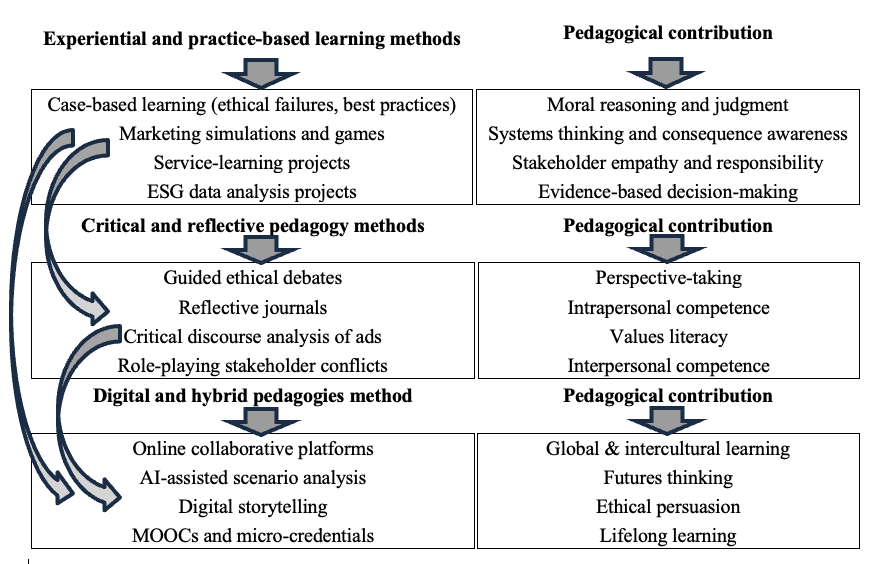
Figure 1. The Integrative Pedagogical Model for Ethical and Sustainable Marketing Education. Source: authors’ contribution
The suggested model was tested for academic validation in 2025 during Erasmus+ teaching mobility activities in universities in Central and Eastern Europe (Poland, Lithuania, and Latvia). The proposed model was validated through a pilot study that involved both students, educators, and industry representatives, with feedback collected via focus groups and afterwards analyzed by using a phenomenological approach. In particular, three focus groups with nine marketing educators, three industry representatives, and forty-seven bachelor's-level students enrolled in business and economics-related study programs comprised the pilot. A phenomenological analysis approach was used to analyse various types of qualitative feedback that were gathered after the pilot was implemented. A qualitative research method called phenomenological analysis is used to investigate and analyse participants' lived experiences, perspectives, and interpretations of a particular phenomenon. The approach focuses on comprehending how people perceive and interpret a phenomenon, rather than measuring its frequency or prevalence. Data are typically analysed through systematic coding, thematic clustering, and interpretive synthesis to identify shared meanings and essential structures of experience (Creswell & Poth, 2016).
Overall, the interview participants supported the model’s pedagogical validity, which suggests that integrating experiential, reflective, and digital methods meaningfully enhance ethical awareness, sustainability competencies, and professional readiness in marketing education. However, some challenges that are crucial for such model practical application are unclear assessment criteria for ethical and sustainability competencies, the need for stronger integration across other study courses that students have in their study programmes and insufficient industry collaboration in experiential learning was highlighted as a significant challenge, which is currently exacerbated by declining industry interest in internship arrangements and in the long-term education and training of future workforce members.
4. Conclusions
Marketing communication, which is lately practiced through digital and social media channels, has a strong and measurable influence on consumer choices, purchasing decisions and broader consumption behaviors. Unethical marketing communication may contribute to overconsumption, distorted consumer decision-making, and trust diminishing, thus demonstrating that marketing influence is not value-neutral.
The latest literature studies revealed that honesty, transparency, and social responsibility are central ethical dimensions that significantly enhance consumer trust, brand loyalty, and long-term relationship quality.
In addressing the current research question, the analysis of secondary data and the authors’ empirical findings indicate that experiential, reflective, and digital pedagogical approaches are currently the most effective in fostering ethical thinking, systems thinking, and stakeholder-oriented decision-making. The proposed integrative pedagogical model in authors’ organized focus group interviews was perceived as relevant, transformative, and professionally meaningful by educators, students, and industry representatives.
Developing ethically competent marketers requires systemic alignment between ethical theory, empirical evidence, pedagogical design, and institutional and industry support. The main challenges currently hindering the development of up-to-date and market-oriented sustainable marketing education in the analysed countries are related with unclear assessment criteria for ethical and sustainability competencies, insufficient integration of ethics across curricula, and limited collaboration with industry. These challenges are also impeded by insufficient industry engagement in internships and long-term workforce development, which constrains opportunities for experiential learning. Developing ethically competent marketers requires such cutting-edge pedagogical approaches that integrate ethical theory, empirical evidence, pedagogical design, and institutional and industry support.
The research findings suggest that ethics should not be taught as a standalone study course but should rather be integrated throughout marketing curricula. This could be achieved by incorporating more practical and reflective learning methods and by strengthening collaboration with industry stake-holders to ensure curricula’s alignment with real-world trends and practice.
References
Ali, S. M. S., Dakshinamurthy, T., Priyadarshi, P., Mittal, M., S, N. & Sanjay, K. (2025). Consumer Trust in Digital Brands: The Role of Transparency and Ethical Marketing. Advances in Consumer Research, 2(1), 106-114.
Creswell, J. W., & Poth, C. N. (2016). Qualitative inquiry and research design: Choosing among five approaches. Sage publications
Dastane, O., Aw, E. C.-X., Fandos-Roig, J. C., & Sánchez-García, J. (2026). Ethical marketing: a review and research agenda. Marketing Intelligence & Planning. https://doi.org/10.1108/MIP-01-2024-0007
Furmanova, K., & Grinberga-Zalite, G. (2025). Smart and responsible marketing communication: a literature review of the foundations, challenges, and future directions. Research for rural development, 40, 512.
Hasty, R. W., Bellizzi, J. A., & Losser, S. (1980). Integrating Ethical Considerations into Marketing Courses: The Role of the Marketing Professor. Journal of Marketing Education, 2(2), 15-22. https://doi.org/10.1177/027347538000200204 (Original work published 1980)
Laczniak, G. R., & Murphy, P. E. (2019). The role of normative marketing ethics. Journal of Business Research, 95, 401-407.
Majaliwa, A., Rurema, R. G., Kwizera, N. & Urwibutso, N. (2024). Effect of Marketing Communication Strategies on Consumer Preferences and Purchasing Decisions: A case of Huye Complex Market in Huye District, Rwanda. Journal of Research Innovation
Manasra, M. (2025). The Impact of Marketing Communications on Consumer Behavior in The Saudi Arabian Telecom Industry. European Scientific Journal, ESJ, 21 (34), 29. https://doi.org/10.19044/esj.2025.v21n34p29
Nair, K. R., & Kumar, S. (n.d.). New Trends of Consumer Behaviour Towards Ethics in Marketing for Education. International Journal of Innovations in Engineering Research and Technology, 8(06), 71-81.
Pelse, M., Lenerts, A., Lejnieks, M. I., & Velickina, A. (2025). Sustainability assessment using the social progress and sustainable development indexes. International Multidisciplinary Scientific GeoConference: SGEM, 5(1), 523-529.
Shah, S. S., & Asghar, Z. (2023). Dynamics of social influence on consumption choices: A social network representation. Heliyon, 9(6), e17146. https://doi.org/10.1016/j.heliyon.2023.e17146
Thirusanku, J., & Yi, T. H. (2024). Integrating Ethics into Marketing. Journal of Business & Economic Policy, 12, 30-43. https://doi.org/10.30845/jbep.v12p4c