Bridging the Gap Between EDI Expectations and Research Practice: A Mixed‑Methods Evaluation of an Asynchronous elearning Toolkit
Bridging the Gap Between EDI Expectations and Research Practice: Evaluation of an elearning Toolkit
Bridging the Gap Between EDI Expectations and Research Practice: A Mixed‑Methods Evaluation of an Asynchronous elearning Toolkit
Lennie Foster1, Katy McKenzie2, Simon Rees3
1Loughborough Business School, Loughborough University, United Kingdom, 2Research and Innovation, University of Nottingham, United Kingdom, 3Centre for Academic Development, Durham University, United Kingdom.
How to cite: Foster, L.; McKenzie, K.; Rees, S. (2026). Bridging the Gap Between EDI Expectations and Research Practice: A Mixed‑Methods Evaluation of an Asynchronous elearning Toolkit. In: 12th International Conference on Higher Education Advances (HEAd’26). Valencia, 15-18 June 2026. https://doi.org/10.4995/HEAd26.2026.21617
Abstract
This study evaluates the development and impact of a digital learning resource, the Embedding EDI in Research Planning, Proposals, and Practice Toolkit, designed to support researchers in integrating Equity, Diversity, and Inclusion (EDI) principles into research design and delivery. The toolkit addresses a practical support gap, particularly for early-career researchers, by offering a flexible, scenario-based digital resource grounded in real-world research contexts. Thematic embedding within energy and net-zero research enables users to engage with EDI principles in ways that are immediately relevant to their disciplinary practice. A mixed-methods evaluation, including pre- and post-training surveys and follow-up interviews, found statistically significant improvements in participants’ confidence, conceptual awareness, and intent to apply EDI principles. The findings suggest that interactive, context-sensitive resources can effectively bridge the gap between policy expectations and researcher capability in inclusive research design. Future development will focus on expanding disciplinary coverage and integrating the toolkit into researcher training programmes.
Keywords: equity, diversity and inclusion; research design; asynchronous learning; scenario‑based learning; early career researchers; mixed‑methods evaluation.
1. Introduction
Equity, Diversity, and Inclusion (EDI) is increasingly mandated across the UK research landscape, with organisations such as UKRI, EPSRC and the Royal Academy of Engineering emphasising that inclusive practices underpin research innovation and impact. Empirical evidence supports this view: diverse teams demonstrate enhanced creativity, decision‑making and problem‑solving (AlShebli et al., 2018; Hofstra et al., 2020). Yet researchers, particularly those early in their careers, continue to report uncertainty about how to embed EDI meaningfully into research design, collaboration, and funding applications (Kent et al., 2022; Castañeda‑Kessel et al., 2023). In practice, this often leads to superficial or compliance‑driven EDI statements rather than carefully considered and context‑specific approaches (Mugo & Puplampu, 2022).
The risks of non‑inclusive research design are well documented. For example, the historic omission of female crash‑test dummies in vehicle safety testing has contributed to greater injury and fatality rates for women (Criado‑Perez, 2019), illustrating how bias embedded early in research and development can have significant real‑world consequences. Embedding EDI at the planning stage is therefore both an ethical imperative and a driver of research quality (El Boghdady, 2025; Wolbring & Nguyen, 2023).
Despite widespread recognition of the importance of EDI, structural barriers persist, including inequities in participation, under‑representation in research leadership, and limited access to practical, discipline‑specific guidance (Prince & Francis, 2023). While funders such as UKRI and Wellcome increasingly expect EDI to be integrated throughout the research lifecycle, existing support tools often remain fragmented or overly generic. Resources such as the EPSRC EDI Action Plan, NIHR INCLUDE framework and the CREDS EDI Cube offer useful prompts but provide limited hands‑on guidance for operationalising EDI in day‑to‑day research practice (EPSRC, 2022; NIHR INCLUDE Project, 2020; Higginson, 2023).
At the same time, digital and asynchronous learning approaches have become established as scalable and flexible modes of professional development. Meta‑analyses show that online and blended learning can be as effective as, or more effective than, traditional instruction (Means et al., 2013; Varkey et al., 2023). Asynchronous formats offer particular benefits for researchers managing competing demands, enabling learners to engage at their own pace (Means et al., 2013; Varkey et al., 2023). Scenario‑based learning can further support applied understanding by immersing learners in authentic decision‑making contexts (Lin et al., 2021), while reflective practice and variation theory help develop deeper conceptual awareness (Marton & Booth, 1997).
Practitioner feedback and internal consultation identified a consistent need among early‑career researchers for practical, context‑relevant guidance to embed EDI in research proposals and design (internal consultation data, 2024). In response, a consortium of UK‑based researcher‑development specialists created and piloted an in‑person workshop that improved participants’ confidence and the quality of their EDI statements. Building on its success and the need for flexibility and wider reach the consortium developed the Embedding EDI in Research Planning, Proposals, and Practice Toolkit, a modular digital resource designed to support researchers across disciplines and career stages.
This study evaluates the effectiveness of the toolkit in supporting changes in understanding, confidence and application of EDI principles. It addresses two research questions:
In what ways does engagement with the toolkit relate to researchers’ understanding and application of EDI principles?
How do these patterns vary across career stages?
2. Toolkit Development
The toolkit was developed in response to evidence that early‑career researchers often lack practical, discipline‑relevant guidance on embedding EDI within research proposals and project planning (internal consultation data, 2024). Building on a successful in‑person workshop that improved the quality of participants’ EDI statements, the team sought to create a scalable, flexible resource accessible across institutions and career stages.
The resulting Embedding EDI in Research Planning, Proposals, and Practice Toolkit is a modular, self‑paced digital resource integrating foundational EDI concepts, scenario‑based activities, and guidance for writing EDI statements and Equality Impact Assessments. Rather than offering prescriptive solutions, it encourages critical reflection and context‑specific decision‑making.
Development followed an iterative co‑design process grounded in participatory and user‑centred design principles (Sanders & Stappers, 2008). Feedback from researchers, researcher‑developers and professional services staff informed decisions on accessibility, content format, and the integration of authentic case studies tailored to interdisciplinary and net‑zero contexts.
To maximise access, the toolkit was hosted on the free version of Canvas, with inclusive design features supporting users in transient or cross‑institutional roles. Since its launch in July 2025, it has been accessed by users from more than 45 UK institutions. The present study examines whether and how toolkit engagement influences researchers’ understanding, confidence, and application of EDI principles.
3. Methodology
This study used a pre–post cross‑sectional survey design to evaluate the impact of the Embedding EDI in Research Planning, Proposals, and Practice toolkit. Independent samples completed the surveys before and after engaging with the resource (pre n = 48; post n = 15). The pre‑training survey captured baseline EDI familiarity, confidence, perceived importance, and prior application. The post‑training survey assessed perceived changes in these areas and intent to apply learning. All items used 1–5 Likert‑type scales. Conceptually aligned items were mapped onto six themes (knowledge, conceptual awareness, perceived importance, confidence, application likelihood, and EDI integration intent), with knowledge assessed post‑only. Outliers in the larger pre‑sample were removed using the IQR method to reduce the influence of extreme values.
Pre–post differences were analysed using Mann–Whitney U tests, while post‑training subgroup differences by career stage were explored using Kruskal–Wallis tests for application likelihood and integration intent. Qualitative data were collected through free‑text survey responses and eight purposively sampled semi‑structured interviews, which were analysed using reflexive thematic analysis (Braun & Clarke, 2006) to contextualise survey findings. All analyses were conducted in Python using standard scientific libraries.
4. Results
4.1. Quantitative Findings
Significant improvements were observed across four thematic areas following toolkit use. Confidence increased (pre M = 3.24, post M = 4.00, p = 0.001), as did conceptual awareness (pre M = 2.64, post M = 3.40, p = 0.022), application likelihood (pre M = 3.50, post M = 4.20, p = 0.009), and intent to integrate EDI (pre M = 3.67, post M = 4.60, p < 0.001). Perceived importance of EDI remained high and stable (pre M = 4.48, post M = 4.53, p = 0.790). Post‑training knowledge ratings indicated perceived improvement (M = 3.27 on a 1–5 scale). No statistically significant differences across gender were found in any of the six mapped areas, indicating broadly similar perceptions of the toolkit’s impact.
4.2. Illustrative Reflections
Short participant reflections contextualised these outcomes. Users reported increased confidence (e.g., “The toolkit was very useful as it gives insight to incorporating EDI into research methodology.”) and greater conceptual understanding (“The training has been helpful for informing my thinking around what I will have to do for REF EIAs.”). Practical application was frequently mentioned (“Overall very engaging and useful and a resource I intend to use and share more widely.”). One participant described a shift from reactive to intentional planning: “It made me think about EDI at every stage of planning, not just as an afterthought.”
4.3. Career Stage Differences
Career stage differences were observed for EDI integration intent (H = 8.17, p = 0.043), with Doctoral and Early Career researchers reporting higher scores than Senior Academics and Professional Services staff. Application likelihood showed a similar but non‑significant trend (H = 7.38, p = 0.061) with early‑career researchers reporting higher likelihood of applying what they had learned to their own research practice (Figure 1). These comparisons should be interpreted cautiously given small and uneven subgroup sizes.
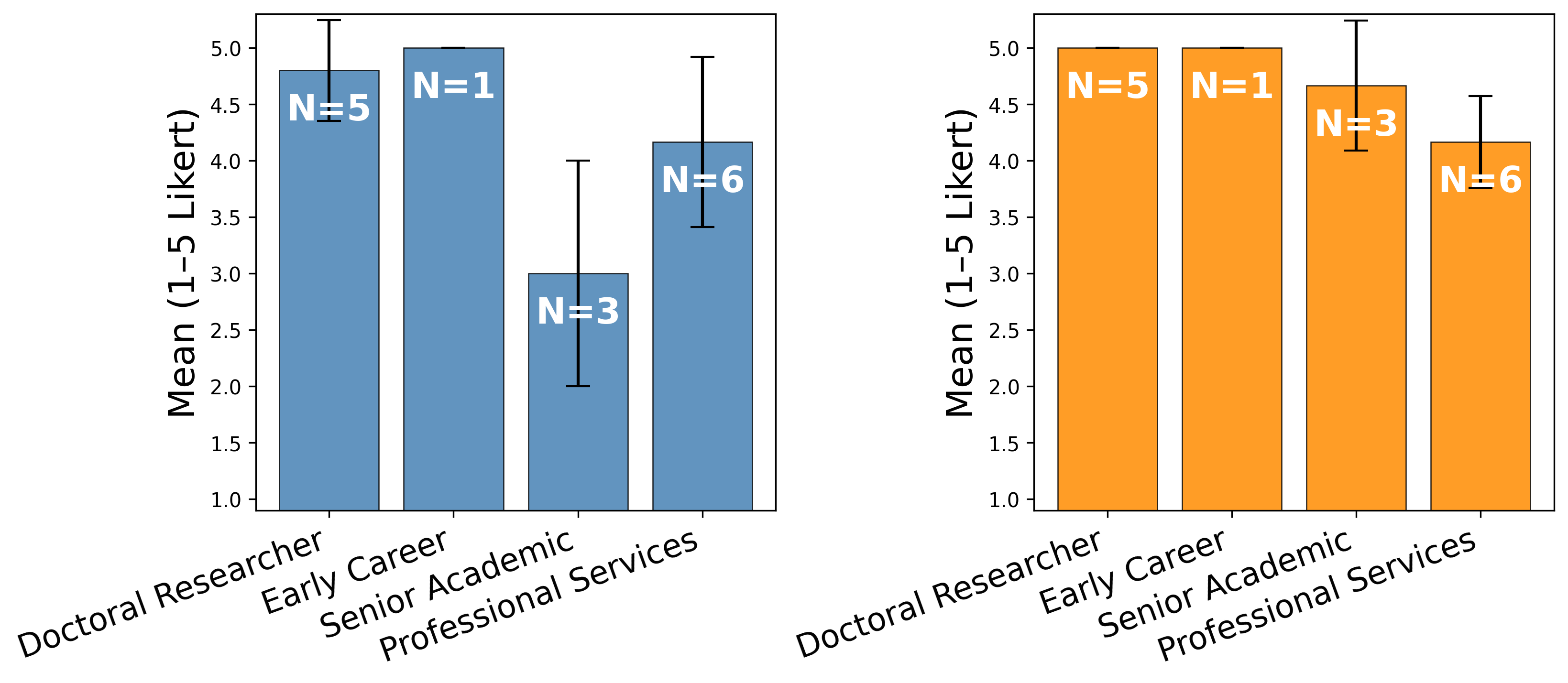
Figure 1: Mean scores for Application Likelihood (Panel A) and EDI Integration Intent (Panel B) across career stages (Doctoral Researcher, Early Career, Senior Academic, Professional Services). Error bars represent standard deviations; sample sizes (N).
4.4. Interview Themes
Interview data illustrated how participants experienced learning and change through the toolkit. Users emphasised the value of flexible, asynchronous access, describing how the ability to revisit content supported deeper engagement. Scenario‑based activities were reported to prompt critical reflection on overlooked aspects of research practice, including accessibility and spatial equity. Many participants described a conceptual shift from viewing EDI as a compliance requirement to recognising it as integral to research integrity. Others highlighted the portability of the toolkit across disciplinary and cultural contexts, while noting the need for further domain‑specific examples. Several participants also reported tangible behavioural changes, such as integrating EDI considerations into proposals or revising thesis work. Together, these insights complement the quantitative findings by illustrating how users interpreted and applied the toolkit’s concepts in practice.
5. Discussion
This evaluation demonstrates that the Embedding EDI in Research Planning, Proposals, and Practice Toolkit is an effective intervention for strengthening researchers’ confidence, conceptual awareness, and intentions to embed EDI within their work. These findings align with evidence that diverse teams and inclusive research practices enhance creativity, methodological rigour, and impact (AlShebli et al., 2018; Hofstra et al., 2020), and reinforce sector expectations that EDI should be integrated throughout the research lifecycle (EPSRC, 2022; NIHR INCLUDE Project, 2020).
The toolkit’s modular, asynchronous format appears central to its effectiveness. Participants valued the flexibility to revisit content, with one interviewee noting the usefulness of “downloadable transcripts… which make it easier for me to review and revisit the content at any time.” This aligns with research showing that online and blended learning can achieve strong outcomes when learners are able to self‑pace and re‑engage with material (Means et al., 2013; Varkey et al., 2023). Scenario‑based learning also supported deeper engagement, consistent with literature demonstrating that authentic contexts can prompt critical reflection and highlight overlooked design issues (Lin et al., 2021). Participants echoed this, describing how the scenarios led them to notice previously unconsidered accessibility concerns, such as “where to put the temperature monitor… I didn’t think about how some people couldn’t reach it.”
A key qualitative pattern was the conceptual shift from viewing EDI as an external requirement to recognising it as integral to research integrity. One participant reflected, “At the beginning I saw EDI as just principles… now I see it as a reflection of how I see the world.” This change resonates with calls in the literature for EDI to move beyond tokenistic compliance toward embedded, reflexive practice (Serrao, 2020; Lane et al., 2025). Several participants reported behavioural changes, including integrating EDI into proposals and revising thesis work, indicating early signs of applied impact.
Career‑stage differences also provide insight. Early‑career researchers reported stronger intentions to apply EDI principles than senior academics, reflecting trends in the literature suggesting that ECRs may be more motivated or better positioned to adopt emerging norms around inclusive research practice (Kent et al., 2022). This pattern also highlights the potential need for leadership‑oriented EDI training to support senior academics, whose modelling of inclusive practice plays a critical role in shaping research culture.
Participants appreciated the thematic embedding of scenarios within net‑zero and interdisciplinary research, which supported transferability and relevance. However, some expressed interest in broader case studies and cross‑cultural examples, reflecting wider calls for domain‑sensitive and globally adaptable EDI guidance (Higginson, 2023). Expanding the scenario library may therefore further increase the toolkit’s applicability across diverse research environments.
This study has limitations. Sample sizes, particularly post‑training and within subgroups, were modest, and the self‑selected nature of participation may have introduced bias towards those already engaged with EDI. The cross‑sectional design also limits assessment of long‑term behavioural change. Future work could examine longitudinal outcomes and explore institutional factors that support or inhibit sustained EDI engagement.
Overall, the findings suggest that well‑designed, scenario‑based asynchronous learning can strengthen researchers’ capability and motivation to embed EDI principles into research planning and practice. By providing accessible, reflective, and contextually relevant support, the toolkit helps bridge the gap between EDI policy expectations and the practical skills required for inclusive research design.
6. Conclusion and Next Steps
The Embedding EDI in Research Planning, Proposals, and Practice Toolkit offers a practical, accessible way to support researchers in integrating EDI into research design. The evaluation indicates strong potential to enhance inclusive research practice through flexible, context‑relevant learning aligned with sector expectations.
Further toolkit development could focus on expanding the case‑study library to enhance disciplinary and cultural relevance and creating leadership‑focused materials to support senior academics in modelling inclusive practice. Future evaluations would benefit from longitudinal designs and larger, more balanced samples to explore sustained behavioural change and institutional influences on EDI adoption. By continuing to evolve in response to user feedback, the toolkit has strong potential for wider integration into researcher‑development provision and sector‑wide training frameworks.
Acknowledgements
This work was supported by C‑DICE and the EDI+ Fellowship Programme. The authors thank the wider toolkit development team for their contributions to the design and implementation of the Embedding EDI in Research Planning, Proposals, and Practice Toolkit, as well as all participants and advisory board members who contributed to the evaluation.
References
AlShebli, B., Rahwan, T., & Woon, W. L. (2018). The preeminence of ethnic diversity in scientific collaboration. Nature Communications, 9(1), 5163. https://doi.org/10.1038/s41467-018-07634-8
Braun, V., & Clarke, V. (2006). Using thematic analysis in psychology. Qualitative Research in Psychology, 3(2), 77–101. https://doi.org/10.1191/1478088706qp063oa
Castañeda-Kessel, M., Villanueva Alarcón, I., & Berke, R. (2023). Research development & early-career faculty: Catalysts of change for diversity, equity, and inclusion in STEM. Journal of Research Administration, 55(2), 105–119.
Criado-Perez, C. (2019). Invisible women: Data bias in a world designed for men. Chatto & Windus. https://carolinecriadoperez.com/book/invisible-women/
El Boghdady, M. (2025). Equality and diversity in research: Building an inclusive future. BMC Research Notes, 18, 14. https://doi.org/10.1186/s13104-025-07096-4
EPSRC (2022) EPSRC 3-year EDI action plan 2022–2025: 1st edition. UKRI. Available at: https://www.ukri.org/wp-content/uploads/2022/12/EPSRC-091222-EPSRC3YearEDIActionPlan2022-2025.pdf (Accessed: [05/09/2025]).
Higginson, S. (2023). The EDI Cube: A tool for project design, evaluation and teaching. CREDS. https://www.creds.ac.uk/the-edi-cube/
Hofstra, B., Kulkarni, V. V., Galvez, S. M., et al. (2020). The diversity–innovation paradox in science. Proceedings of the National Academy of Sciences, 117(17), 9284–9291. https://doi.org/10.1073/pnas.1915378117
Kent, B. A., Holman, C., Amoako, E., et al. (2022). Recommendations for empowering early career researchers to improve research culture and practice. PLOS Biology, 20(7), e3001680. https://doi.org/10.1371/journal.pbio.3001680
Lane, J., et al. (2025). Expanding possibilities for inclusive research: Learning from people with profound intellectual and multiple disabilities and decolonising research. Social Sciences, 13(1), 37. https://doi.org/10.3390/socsci13010037
Lin, H.-C., Hwang, G.-J., Chang, S.-C., & Hsu, Y.-D. (2021). Facilitating critical thinking in decision making-based professional training: An online interactive peer-review approach in a flipped learning context. Computers & Education, 173, 104266. https://doi.org/10.1016/j.compedu.2021.104266
Marton, F., & Booth, S. (1997). Learning and awareness. Routledge. https://doi.org/10.4324/9780203053690
Means, B., Toyama, Y., Murphy, R., et al. (2013). The effectiveness of online and blended learning: A meta-analysis. Institute of Education Sciences. https://eric.ed.gov/?id=ED561302
Mugo, S., & Puplampu, K. P. (2022). Beyond tokenism and objectivity: Theoretical reflections on a transformative EDI agenda for higher education in Canada. SN Social Sciences, 2, Article 209. https://doi.org/10.1007/s43545-022-00509-2
NIHR (2020) Improving inclusion of under-served groups in clinical research: Guidance from INCLUDE project. Available at: https://www.nihr.ac.uk/improving-inclusion-under-served-groups-clinical-research-guidance-include-project (Accessed: [05/09/2025]).
Prince, L. R., & Francis, S. E. (2023). Barriers to equality, diversity and inclusion in research and academia stubbornly persist. Disease Models & Mechanisms, 16(7), dmm050048. https://doi.org/10.1242/dmm.050048
Sanders, E. B.-N., & Stappers, P. J. (2008). Co-creation and the new landscapes of design. CoDesign, 4(1), 5–12. https://doi.org/10.1080/15710880701875068
Serrao, S. (2020). Inclusion and equity in education: Making sense of global challenges. Prospects, 49, 123–134. https://doi.org/10.1007/s11125-020-09506-w
Varkey, T. C., Varkey, J. A., Ding, J. B., Varkey, P. K., Zeitler, C., Nguyen, A. M., Merhavy, Z. I., & Thomas, C. R. (2023). Asynchronous learning: A general review of best practices for the 21st century. Journal of Research in Innovative Teaching & Learning, 16(1), 4–16. https://doi.org/10.1108/JRIT-06-2022-0036
Wolbring, G., & Nguyen, A. (2023). Equity/equality, diversity and inclusion, and other EDI phrases and EDI policy frameworks: A scoping review. Trends in Higher Education, 2(1), 168–237. https://doi.org/10.3390/higheredu2010011