Enhancing Medical Education Through a Course-Specific AI Teaching Assistant
Enhancing Medical Education Through a Course-Specific AI TA
Enhancing Medical Education Through a Course-Specific AI Teaching Assistant
Joon S. Park1, Ciara Gorman2, John P. Kelly2, Zina Alfahl3
1School of Information Studies, Syracuse University, U.S.A, 2School of Pharmacy and Medical Sciences, University of Galway, Ireland, 3 School of Medicine, University of Galway, Ireland.
How to cite: Park, J. S.; Gorman, C.; Kelly, J. P.; Alfahl, Z. (2026). Enhancing Medical Education Through a Course-Specific AI Teaching Assistant. In: 12th International Conference on Higher Education Advances (HEAd’26). Valencia, 15-18 June 2026. https://doi.org/10.4995/HEAd26.2026.21638
Abstract
As medical education faces increasing content density alongside limited opportunities for individualized learning, we developed and piloted a course-specific AI Teaching Assistant (AI TA) to support student self-study in the pharmacokinetics (PK) component of an undergraduate medical pharmacology module. The AI TA was specifically customized with instructor-provided course materials, domain-specific terminology, and course expectations to ensure strong alignment with the curriculum and to mitigate the generic/off-target responses commonly associated with general-purpose AI tools. Following our pilot implementation, we evaluated the student experience with the course-specific AI TA through a mixed-methods survey that combined Likert-scale items and open-ended feedback. The findings indicate that students perceived substantial benefits, particularly in clarifying lecture concepts, enhancing understanding of difficult material, and supporting follow-up learning when encountering challenging course materials.
Keywords: AI-augmented Education, AI Teaching Assistant (TA), Higher Education Innovation.
1. Introduction
Medical education is increasingly challenged by the rapid growth and fragmentation of biomedical knowledge, as well as the limited availability of time and individualized instructional support. Even in the most well-resourced programs, faculty and clinical educators are challenged to deliver the complex, conceptually intricate curriculum materials under time constraints. This is particularly resonant in pharmacology teaching, where the challenge is to understand mechanistic reasoning, quantitative problem-solving, and the clinical significance of drug actions, all under the pressure of already tight instruction and assessment timelines. Such time constraints lead students to repeatedly seek clarification in independent study, while structural time-related limitations inhibit the ability of faculty to respond in a timely and student-specific manner at scale (Hallquist et al., 2025).
Given these challenges, there is growing interest in exploring AI-augmented educational opportunities, particularly conversational education systems that could deliver learning beyond the formal classroom (Dillenbourg, 2016). Evidence from past studies in medical education, as well as across the higher education landscape, suggest that such AI-support may allow educators to deliver greater personalized feedback, enable self-regulated learning through adaptive support, and provide improved access to timely learning support for students who otherwise may be hesitant to ask questions of their teachers or peers (Luckin, 2018; Reddy, 2024; Saroha, 2025). When supervised properly, such tools may also provide prompt explanations and structured opportunities to consolidate information, which help students avoid breaking their learning cycle during self-study. This is particularly relevant to the delivery of pharmacology concepts, which often benefit from iterative explanation and scaffolded approaches to reduce uncertainty when solving quantitative problems. There are considerable concerns about the use of general-purpose AI in medical education and training contexts (Fasinu & Wilborn, 2024). For example, the output risks may be too generic, misaligned with the learning goals of an individual course, and lacking transparency within the course context. Each of these critical risks is magnified in the context of medical education, where precision, alignment, and trustworthiness are critical. Consequently, curriculum grounding plays a primary role in maximizing relevance, alignment, and coherence in instruction, and in minimizing drift beyond desired learning boundaries.
Building on these motivations, the aims of this paper are (1) to design a course-specific AI TA framework grounded in instructor-curated materials and pedagogical constraints, explicitly designed to reduce content drift and improve curricular alignment—an issue commonly reported in general-purpose AI tools, (2) to provide an implementation case study in undergraduate medical pharmacology (pharmacokinetics component), a domain requiring conceptual and quantitative reasoning, and (3) to report findings from a real-world pilot deployment, highlighting both perceived benefits and observed limitations, including student-reported errors and boundary failures.
2. Background
Wang et al. (2025) describe a participatory design project that uses LLMs to support clinical reasoning activities, including history-taking and differential diagnosis. Their findings indicate that students value interactive systems that can mimic strong instructional behaviors such as clarity, scaffolding, and responsiveness, given the value system of course-based AI explanations. They highlight the importance of information control strategies, including progressive exposure to support iterative reasoning without encouraging cognitive shortcuts. While their study focuses on clinical reasoning rather than the acquisition of pharmacology-specific content, it advocates careful scoping and course-specific contextualization to enhance trustworthiness and pedagogical alignment.
Related studies on the perception of AI in medical education indicate a generally positive perception towards the use of AI, despite limited access to real-world applications, highlighting the importance of proper education and expectations (Burgstahler, 2020; Rani et al., 2025; Saroha et al., 2025). Overall, supportive evidence from previous studies indicates the promise of AI-augmented learning, while also underscoring the continued importance of context, scope accuracy, and evaluation to ensure effectiveness. Unlike prior studies that evaluate general-purpose AI tools or broad tutoring systems, this work focuses on tight curricular grounding using instructor-validated materials, explicit scope restriction, and pedagogical rule-setting. This allows us to examine not only perceived usefulness but also alignment with course expectations and adherence to boundaries, which remain underexplored in medical education contexts. To address this goal, the present study builds on our previously validated AI TA for a cybersecurity course (Park, 2025a; Park, 2025b) and adapts it for medical education. In doing so, we extend our earlier claim that a course-specific AI TA framework can be applied across disciplines when it is paired with appropriately curated discipline-specific materials. Although our initial implementation was developed for cybersecurity, these findings suggest that the same approach can be applied in other fields, including medicine, provided it is carefully aligned with domain content and learning objectives.
3. Methodology
3.1. Course Context
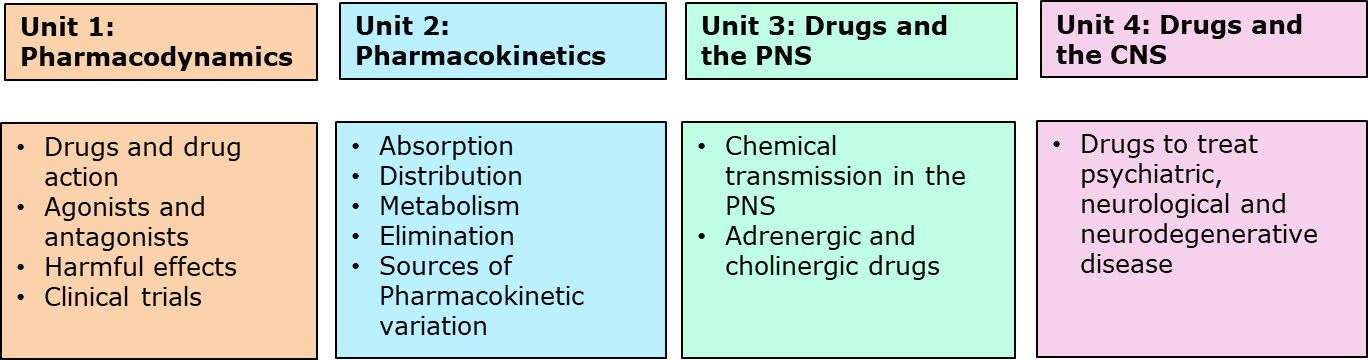
Figure 1. Design of MD214 module.
MD214 (Introduction to Pharmacology) is a second-year undergraduate medical education (UGME) 5 ECTS module. In the Academic Year 2025–2026, there were 203 registered students in MD214. The module consists of four units delivered over 12 weeks, with each unit lasting 3 weeks and including lectures, workshops, self-directed study, and question-and-answer activities (Figure 1). Learning content is provided in the first two weeks through the Canvas learning management system (LMS) and face-to-face lectures, with the third week culminating in a workshop and interim assessment. Since pharmacokinetics (PK) is introduced in the second unit of MD214, it was chosen for this research to give students sufficient experience with the pedagogical and curricular approach in the module, whilst also acknowledging the challenge this topic presents. Immediately following the unit's 2-week teaching period, a 1-week pilot implementation of the AI TA was conducted with a cohort of 35 second-year medical students. Of the 35 students, 23 (65.7%) voluntarily completed the post-pilot questionnaire. The quantitative Likert-scale questions were answered by all the participants (100%), whereas 21 students (91.3%) responded to the open-ended question for qualitative comments.
3.2. Supplementary Resource Identification, Screening, and Curation
Developing supplementary PK resources for use with the AI TA was conducted in accordance with the “Do No Harm” principles and the MD214 learning objectives. The content was determined by selecting materials from professional institutions and peer-reviewed journals, followed by screening protocols in which the materials were evaluated against a list of criteria focused on factual accuracy and consistency with pharmacology learning principles. The variety of content was also considered to address learning diversity and provide a framework for ideally achieving Universal Design for Learning outcomes, while content gaps were filled by creating original resources using the BioRender.com platform. All content resources were collected in an Excel-based database for reproducibility and transparency. The retrieved resources (25) included 12 diagrams, 3 graphics, 7 videos, and 3 web-based materials. These resources encompass the essential concepts in PK, including Absorption, Distribution, Metabolism, and Elimination (ADME) processes, drug administration routes, bioavailability, and basic PK parameters (Cmax, Tmax, etc.). After the inclusion criteria were met, all resources underwent curricular mapping and verification before being embedded in the AI TA to establish the PK knowledge used in the one-week pilot testing.
3.3. Developing a Course-Specific AI TA for MD214
We carefully preserved the original pedagogical design when developing the AI TA for MD214. Given the course’s hybrid, multimodal format, the AI TA was designed to provide timely, clear, and context-sensitive academic support for students working in both self-directed study and instructor-led sessions. Table 1 summarizes the MD214-specific development process, outlining the key phases, goals, and core features implemented at each step.
Table 1. AI TA Development for MD214 – Pharmacokinetics Unit
Step |
Objectives |
Key Components |
Step 1: Define AI TA Role & Scope |
Clarify the pedagogical function of the AI TA for MD214. |
Support lecture and workbook comprehension. Reinforce PK concepts. |
Step 2: Aggregate Core Module Content |
Compile essential course materials to establish the AI’s knowledge base. |
PK lecture slides. Unit-specific workbooks. Teaching schedule and rubrics. |
Step 3: Integrate Supplementary Learning Resources |
Enhance content richness and multimodal support through curated external materials. |
Systematically screened visual aids, videos, and peer-reviewed content. Materials aligned with the course and curricular goals. |
Step 4: Define Custom GPT Instructions |
Establish behavioral and pedagogical rules for AI TA responses. |
Prioritize module materials. Encourage concept-based dialogue. Reflect ethical and academic integrity policies |
Step 5: Build Student Interface |
Ensure accessible, intuitive access to AI TA via common platforms. |
Example prompts and guided interactions. Friendly onboarding messages and visual cues. |
Step 6: Implement Safeguards & Ethics Controls |
Ensure compliance with privacy, licensing, and academic integrity standards. |
Content bias minimization. Instructor oversight capability. |
Step 7: Pilot & Evaluate |
Deploy AI TA in a limited setting and collect feedback. |
Targeted pilot within the unit. Feedback from students and staff. Refinements based on usability, accuracy, and clarity. |
Step 8: Enable Continuous Improvement |
Ensure the AI evolves with course needs. |
Regular content updates. Integration of future pharmacology modules. Ongoing student input collection. |
4. Survey Results: Student Experience with the Course-Specific AI TA
4.1. Strong Learning Benefits for PK Self-Study and Concept Clarification (Q1-Q4)
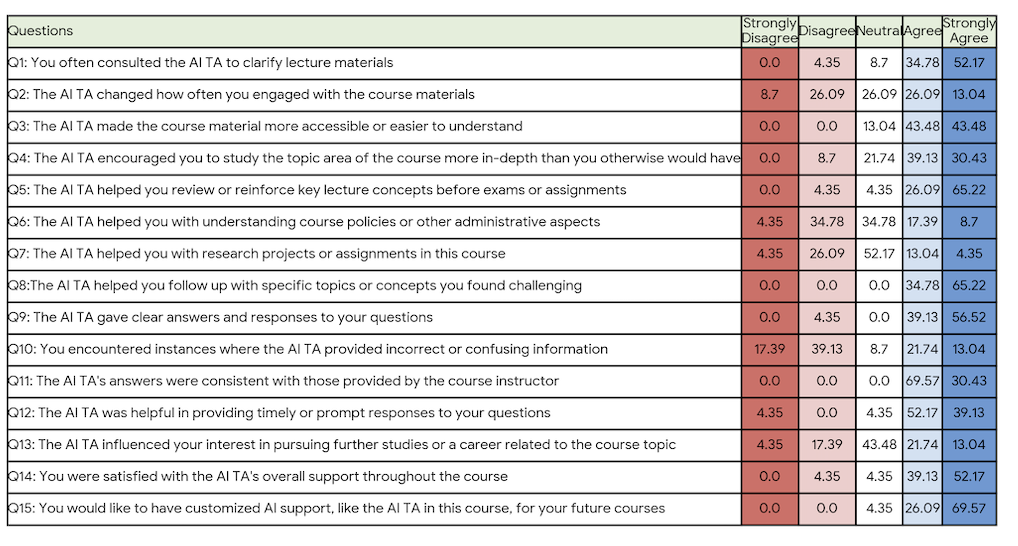
Figure 2. Student-reported learning support and satisfaction with a PK-focused AI TA
As shown in Figures 2 and 3, the survey questions and results indicated that the AI TA facilitated independent learning by clarifying material discussed during lectures and helping students understand some difficult PK concepts. Most of the respondents reported that they accessed the AI TA for clarification of class materials (86.95% Agree/Strongly Agree; Q1) and that the AI TA helped them to understand the content of the PK unit more easily (86.96% Agree/Strongly Agree; Q3). These responses suggest that the AI TA was successfully used as an on-demand explanatory resource. Most respondents also reported that the AI TA prompted them to explore PK topics more deeply than they otherwise would (69.56% Agree/Strongly Agree; Q4).
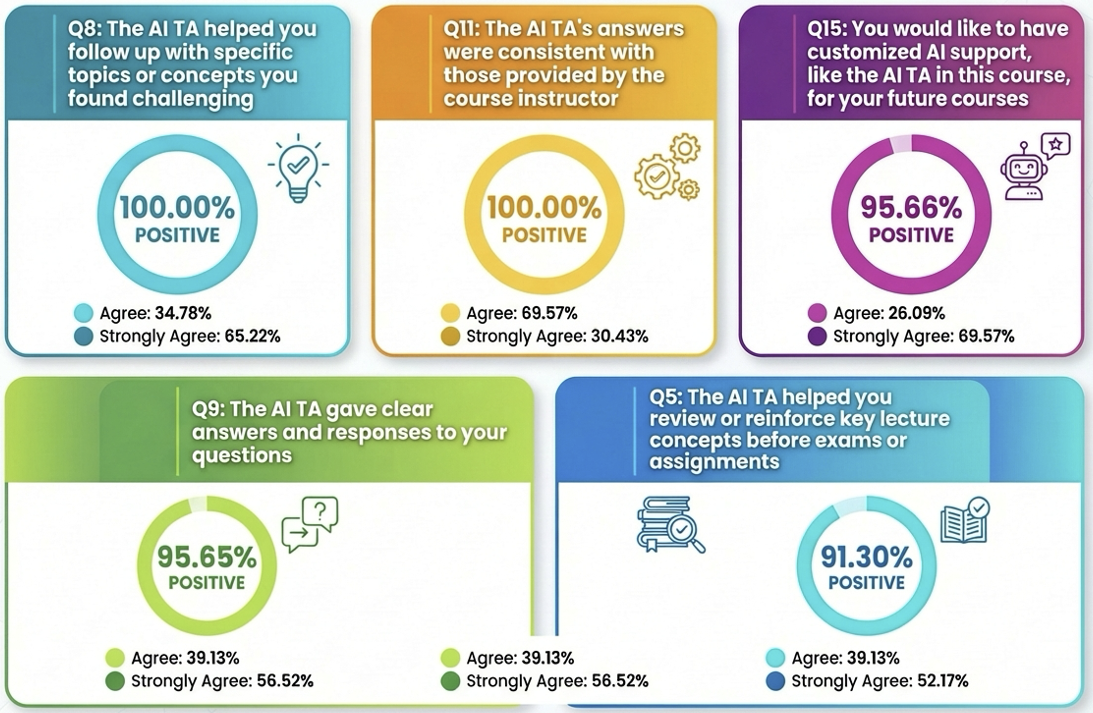
Figure 3. Top 5 most positive survey results
4.2. Effective Reinforcement and Specific Alignment with Intended Scope (Q5-Q8)
The role of the AI TA in assisting students’ learning of prerequisite knowledge (PK) received strong endorsement. Most students indicated that the AI TA application provided them with support in revisiting PK materials right before taking an exam or assessment (91.31% Agree/Strongly Agree; Q5), and in helping them track down issues that made certain PK topics difficult for them (100% Agree/Strongly Agree; Q8). These results verified the AI TA’s provision of just-in-time assistance to students. The lower ratings on Q6 (course policies/administrative aspects) and Q7 (research projects/assignments) are not surprising. For this experiment, we simply didn’t train the AI TA on those materials, because its main role was to support self-study of the class content. Therefore, for this evaluation, Q6 and Q7 are best viewed as outside the tool’s intended scope, not as major weaknesses. In our prior work, however, we demonstrated that when the AI TA is trained on policy and project resources, it can provide solid support in those areas too (Park, 2025a; Park, 2025b).
4.3. High Reliability, Instructor-Consistency, and Responsiveness (Q9-Q12)
High perceived reliability of the AI TA during PK self-study was rated by students. Most students believed that the AI TA gave unambiguous answers (95.65% Agree/Strongly Agree; Q9), and all respondents claimed that the answers provided by the AI TA were consistent with those of the course instructor (100% Agree/Strongly Agree; Q11). Students also experienced it as responsive (91.3% Agreed/Strongly Agreed; Q12) that it provided timely answers. This feedback suggests the AI TA was a reliable, instructor-aligned support for student learning.
4.4. Errors and Confusion Reported by Students (Q10)
Responses of Disagree/Strongly Disagree on Q10 were considered as a positive outcome. Most of the participants rated Disagree/Strongly Disagree (56.5%), followed by encountered incidents (34.8%) and Neutral (8.7%). Students reported difficulties with calculations, with explanations occasionally lacking sufficient step-by-step reasoning, and issues with the generation of practice questions that were sometimes perceived as misaligned with course content or contained incorrect answer options. Based on these survey results, we could improve the AI TA’s accuracy and alignment with the specific course materials by refining its custom instructions. Such improvements have already been validated in other courses.
4.5. Overall Satisfaction & Demand for Future Course-Specific AI Support (Q13-Q15)
Respondents were overall satisfied with the AI TA (91.3% Agree/Strongly Agree; Q14) and expressed overwhelming interest in specialized AI TA support in future courses (95.66% Agree/Strongly Agree; Q15). The AI TA did not significantly affect interest in future study, or career pathways (34.78% Agree/Strongly Agree; Q13), which is likely attributable to its short implementation and applied rather than professional scope.
4.6. Study Scope and Limitations
The course-specific AI TA was assessed in this study following a limited deployment in which students used the system to support independent learning in the PK aspect of the Introduction to Pharmacology (MD214) module. The AI TA was intentionally defined in scope to clarify lecture material, reinforce key PK concepts, and assist with follow-up on difficult lecture topics during independent study. The system was not intended to provide course administrative or logistical guidance throughout the semester (e.g., course policies, timelines, scheduling details) or to support research projects. The survey items pertaining to administrative/logistical or research assistance (e.g., Q6 and Q7) can be considered out of scope. Lower rates on those survey questions indicate adherence to system boundaries rather than underperformance.
This study evaluated a course-specific AI TA within a single module using student-reported perceptions, without objective measures of learning; findings are therefore exploratory. The small, self-selected sample (n = 23) and short deployment limit generalizability and preclude causal inference. System accuracy was not formally benchmarked; future work should include objective outcomes and systematic error evaluation.
5. Conclusions and Future Work
The results of this study show that a course-specific AI TA can provide useful supplementary support for students’ self-directed learning, particularly in clarifying concepts and improving accessibility. A key contribution of this study is a course-specific AI framework for designing, implementing, and assessing. Ultimately, an AI TA doesn’t have to be limited to a single course. It can be designed to support a group of related courses in the same area, providing broader, context-aware help (e.g., connecting concepts across prerequisites, the current course, and more advanced topics). This kind of “track-level” AI support could better guide students over time, strengthening their learning across the curriculum/academic program, supporting longer-term career development in that field.
References
Burgstahler, S.E. (2020). Creating inclusive learning opportunities in higher education: a universal design toolkit. Cambridge, MA: Harvard Education Press.
Dillenbourg, P. (2016). The evolution of research on digital education. International Journal of Artificial Intelligence in Education, 26(2), pp. 544–560.
Fasinu, P. S., & Wilborn, T. W. (2024). Pharmacology education in the medical curriculum: Challenges and opportunities for improvement. Pharmacology Research & Perspectives, 12(1), Article e1178.
Hallquist, E., Gupta, I., Montalbano, M. and Loukas, M. (2025). Applications of artificial intelligence in medical education: a systematic review. Cureus, 17(1), p. e79878.
Henderson, M., Selwyn, N. and Aston, R. (2017). What works and why? Student perceptions of "useful" digital technology in university teaching and learning. Studies in Higher Education, 42(8), pp. 1567–1579.
Luckin, R. (2018). Machine learning and human intelligence: the future of education for the 21st century. London: UCL Institute of Education Press.
Park, J. S. (2025a). Course-specific AI TA: Implementation and impact on student learning. In Proceedings of the 7th International Workshop on Artificial Intelligence and Education (WAIE), Yokohama, Japan.
Park, J. S. (2025b). Towards AI-augmented teaching for higher education. In Proceedings of the 6th International Conference on Artificial Intelligence in Education Technology (AIET), Munich, Germany.
Rani, S., Kumari, A., Ekka, S.C. and Chakraborty, R. (2025). Perception of medical students and faculty regarding the use of artificial intelligence (AI) in medical education: a cross-sectional study. Cureus, 17(1), p. e77514.
Reddy, S. (2024). Generative AI in healthcare: an implementation science-informed translational path on application, integration, and governance. Implementation Science, 19(1), p. 27.
Saroha, S. (2025). Artificial intelligence in medical education: promise, pitfalls, and practical pathways. Advances in Medical Education and Practice, 16, pp. 1039–1046.
Wang, A., Ruparel, R., Iurchenko, A., Jhun, P., Séguin, J.A., Strachan, P., Wong, R., Karthikesalingam, A., Matias, Y., Hassidim, A., Webster, D., Semturs, C., Krause, J. and Schaekermann, M. (2025). Generative AI for medical education: insights from a case study with medical students and an AI tutor for clinical reasoning. In Proceedings of the Extended Abstracts of the CHI Conference on Human Factors in Computing Systems. New York, NY: Association for Computing Machinery, Art. 303.