Designing Professional Identity: A Design-Driven Framework for Portfolio and Digital Branding in Fashion Design Education
A Design-Driven Framework for Portfolio and Digital Branding in Fashion Design Education
Designing Professional Identity: A Design-Driven Framework for Portfolio and Digital Branding in Fashion Design Education
Livia
Tenuta ,
Susanna Testa
Design Department, Politecnico di Milano, Italy.
How to cite: Tenuta, L.; Testa, S.(2026). Designing Professional Identity: A Design-Driven Framework for Portfolio and Digital Branding in Fashion Design Education. In: 12th International Conference on Higher Education Advances (HEAd’26). Valencia, 15-18 June 2026. https://doi.org/10.4995/HEAd26.2026.21657
Abstract
The transition from higher education to professional practice represents a critical phase for fashion design students, especially in the construction and communication of their professional identity. Portfolios and digital branding are often treated as final outputs with little attention to their educational value. This paper proposes a design-driven and competency-based educational framework developed in a third-year Bachelor's in Fashion Design course aimed at supporting the conscious construction of a professional profile. The framework is divided into four phases (Look In, Look Out, Synthesis, Application) integrating reflection, contextual analysis and design translation. Observations of the outputs reveal greater awareness, narrative coherence and selection skills offering a methodological approach transferable to design education.
Keywords: Fashion design education; professional identity; employability; portfolio-based learning; design-driven pedagogy; digital branding.
1. Employability, Professional Identity and Reflective Practice
Employability is generally understood not only as a set of technical or transferable skills but as a broader configuration that includes self-management skills, self-awareness and the ability to position oneself within specific professional contexts (Bridgstock, 2009). At the pedagogical level several contributions emphasize the importance of explicit alignment between learning objectives, teaching activities and assessment criteria to support the development of complex and observable skills including those related to professional identity and managing the transition to work (Biggs & Tang, 2011). This paper introduces a design-driven and competency-based educational framework developed within a third-year Bachelor of Fashion Design course addressing the construction of professional identity as an integral part of the design process and uses portfolios, resumes and digital branding tools as training tools through which choices, criteria and skills are made observable. Studies in higher education highlight how the development of employability is closely linked to students' ability to recognize, articulate and make visible their skills within specific disciplinary and professional contexts (Trede, Macklin, & Bridges, 2012; Jackson, 2016). Professional identity is therefore described as a dynamic configuration that integrates educational experiences, value references and positioning methods. Activities such as selecting content, organizing information and constructing a narrative of the educational journey directly impact the readability of the professional profile. Jackson (2016) introduces the concept of pre-professional identity to describe the phase in which students begin to develop an awareness of their emerging role and the expectations of the professional context. Reflective practice represents a consolidated theoretical framework for understanding these processes within design disciplines: Schön (1983) describes professional activity as a continuous interaction between action and reflection in which decisions are constantly reinterpreted, evaluated and reoriented. In the field of education design is often interpreted as a specific mode of knowledge production: Cross (2006) introduces the concept of “designerly ways of knowing” to indicate a form of thinking characterized by the ability to address complex problems through interpretation, synthesis and construction of meaning. Within this framework the portfolio plays a key role as a tool for learning, assessment and professional positioning. Tosh et al. (2005) highlight how its effectiveness is linked to the ability to integrate evidence, reflections and evaluation criteria within a coherent structure. In addition to its educational and evaluative functions, the portfolio plays a central role in professional presentation: Cambridge (2010) distinguishes between documentary portfolios oriented towards the collection of materials and strategic portfolios designed to communicate a specific professional profile through conscious choices of selection, organization and narration. In contemporary contexts recent studies on digital labour and platform-based economies highlight how self-presentation practices are increasingly shaped by visibility, platform logics and continuous identity construction processes (Poell, Nieborg, & van Dijck, 2019; Duffy, 2020).
2. Methodology: A Design-Driven Educational Framework
The Portfolio and Digital Branding course is part of the third year of the Bachelor's in Fashion Design at Politecnico di Milano and represents an advanced stage of the curriculum. Students possess consolidated operational skills including visual research, conceptual development and the use of graphic tools and layout software. At the same time they exhibit varying levels of awareness regarding their professional identity and the ways in which their work is presented outside of the academic context. The course is structured to address this dimension focusing on building a professional presentation based on materials already produced during the course. Teaching does not introduce new design content but focuses on the selection, organization and communication processes of existing projects. In this sense the course takes the form of a space for reworking where students are asked to revisit their work and identify coherences, recurrences and design directions. The learning objectives involve developing the ability to define and articulate a professional profile, select projects based on positioning and construct presentation tools that are coherent on a narrative and visual level. Attention is paid to the relationship between content, language and structure in order to clarify the link between project identity and communication methods. The outputs required at the end of the course include three main tools: a CV, a printed portfolio and a digital portfolio. The course adopts a competency-based approach focusing on the development of transferable and observable skills through the outputs produced rather than solely on the production of final papers. Within this framework portfolios and branding are treated as design tools used to convey skills, values and professional positioning. The methodological approach is consistent with constructive alignment models which advocate for consistency between learning objectives, teaching activities and assessment criteria in higher education (Biggs & Tang, 2011). The educational framework is organized into four interconnected phases (LOOK IN, LOOK OUT, SYNTHESIS and APPLICATION) distributed throughout the course. From a methodological perspective the framework is based on a design-driven approach in which the project is used as a cognitive and educational device. As observed by Dorst (2011) design thinking allows us to address complex situations through processes of framing, interpretation and synthesis. In the educational field this approach is used to address the construction of professional identity as an explicit design problem, addressable through design tools, methods and criteria. The LOOK IN phase is dedicated to individual work and is geared toward analyzing the student's emerging professional identity. In this phase attention is focused on exploring operational values, attitudes and design recurrences considered as structural elements of the professional profile. The work is organized around four main areas (working values, aesthetic identity, tone of voice and visual system) developed through successive collection, selection and formalization activities. Working values are approached as operational principles that guide choices, priorities and work methods rather than as abstract personality traits. Students conduct a guided exploration of the recurring conditions in their projects (themes, constraints, contexts of use, user types, development methods) identifying a limited number of values actually found in the materials produced. This phase includes controlled self-description exercises such as short statements, keywords, and conceptual pairs along with peer-to-peer discussions aimed at distinguishing declared values from observable values in design choices. Aesthetic identity is approached as a set of visual preferences and formal strategies attributable to the student's work rather than as a predefined style. The process begins with a comparative analysis of the materials already produced (drawings, renderings, silhouettes, color choices, treatment of details, page organization) through clustering and pattern recognition activities. This analysis is complemented by the structured "If I Were" exercise used to translate working values into an aesthetic vocabulary through controlled metaphorical associations (geometric figures, graphic styles, photographic languages, architectural references, brand or object typologies). The goal is to verbalize recurring perceptual and formal qualities which are subsequently traced back to verifiable design choices in the materials. This process allows for the construction of a synthetic map of visual references and attributes (shapes, materials, textures, palettes, image types) useful for defining a coherent visual lexicon for transfer into presentation tools. Tone of voice is a component of professional presentation involving the verbal and narrative dimension. Students work on structured micro-writings (such as short bios, project captions, and descriptions of roles and skills) through iterative revisions aimed at clarity and coherence. The work is supported by the use of semantic differentials which allow students to position their language along opposing axes (e.g., formal/informal, technical/emotional, concise/elaborate) and by the introduction of Jungian archetypal models used as interpretative tools to reflect on recurring communicative and narrative modalities. Archetypes are used as interpretative devices that help coherently define the relationship between content, language and positioning. The visual system concerns the definition of rules and constraints for organizing content and it includes the construction of a core set of graphic design decisions (grids, typographic hierarchies, spacing and alignment management, image processing and color use) and their application to controlled tests on one or more sample pages. This phase allows for the formalization of a replicable system capable of ensuring consistency across different outputs without introducing nonfunctional graphic complexity. Analytical tools such as semantic differentials, archetype models and visual synthesis tools (mood boards and structured reference boards) are used to support the entire process serving as tools for reflection and comparison. These are used to make often implicit perceptions explicit and translate them into design choices that can be justified in relation to the outputs. LOOK IN is configured as a scaffolded reflective process consistent with the concept of reflective practice proposed by Schön (1983) with the idea of design as a form of knowledge outlined by Cross (2006) and with reflective approaches to professional training (Korthagen, 2004). The LOOK OUT phase is aimed at developing awareness of the relevant professional and educational context through a structured process of observation, mapping and comparative analysis. The goal is to clarify the conditions for accessing professional or academic opportunities and to relate these conditions to the student's profile supporting informed reflection on their positioning. The first level is dedicated to identifying and mapping the target market. Students define a target sector consistent with their interests and aspirations which may involve industrial contexts (e.g., fashion, accessories, luxury, fashion tech, sustainability) or advanced training programs (master's degrees, postgraduate programs, academic internships). Target definition includes defining the geographic area and identifying specific professional roles or programs. This activity is accompanied by the drafting of a brief, reasoned introduction aimed at explaining the reasons for the choice. Starting from this initial definition students develop a comparative opportunity mapping, analyzing a selected set of companies or academic programs. The analysis highlights elements such as industry, positioning, required skills, application materials and useful contacts. The goal is to translate external context expectations into observable and comparable requirements. The second level of LOOK OUT deepens this understanding through the structured analysis of two brands. The first brand is selected within the mapping as a reference directly connected to the identified industry or role; the second is chosen outside the mapping, based on an inspirational or cultural relevance recognized by the student. This dual selection allows for a case directly linked to concrete opportunities to be paired with a reference capable of broadening the scope of observation. The brand analysis is organized according to a grid that allows for a systematic observation of the different components of identity avoiding impressionistic approaches. First the core identity is examined, analyzing the brand's purpose, vision, mission and values to understand the underlying logic behind its choices. This is followed by a competitive analysis which places the brand within its market segment highlighting its distinctive elements and positioning compared to direct and indirect competitors. A further level of observation concerns the target audience analyzed in terms of primary and secondary audiences, identified needs and relationship methods. Attention is paid to the consistency between the declared identity, design choices and communication strategies. The analysis extends to verbal identity including brand messaging, value proposition and brand voice. In this phase the use of Jungian archetypes is introduced as an interpretative tool to describe the brand's communicative personality and the type of symbolic relationship established with the public without attributing normative values. In parallel the visual identity is analyzed considering elements such as the logo and naming, color palette, typography and visual systems. The observation focuses on the system's internal coherence and its ability to maintain recognizability and continuity across different platforms and application contexts. The analysis concludes with a reasoned reflection on the motivations behind the brand choices and their relevance to the student's career path. Specifically students are invited to clarify similarities and differences between the observed identities and their emerging profile using the comparison as a tool to clarify their professional positioning. From an educational perspective LOOK OUT uses context mapping and brand analysis as tools for reflective comparison between external requirements and emerging identities. The goal is the development of the ability to read the context, recognize strategies and translate these observations into informed choices in the construction of one's own professional presentation tools. The SYNTHESIS phase focuses on the critical and selective reworking of the collected materials with the goal of making the student's professional identity explicit and well-argued. Students are guided in the synthesis of operational values, aesthetic references, communication methods and contextual coordinates transforming analytical and fragmented elements into a structured and legible system. This process is a design operation of intentional selection, requiring the establishment of priorities, hierarchies and relationships between the various elements that emerge. Particular attention is paid to the coherence between the declared identity, demonstrable skills and professional contexts, avoiding generic or self-referential constructions. The primary outcome of this phase is the creation of a Personal Branding Book, a tool for synthesis and alignment that collects in a structured format the main elements of the emerging professional identity including working values and design attitude, aesthetic identity and visual references, tone of voice and narrative modalities, visual system and graphic criteria, positioning indications with respect to professional roles and contexts. The Personal Branding Book serves as an internal design tool used to verify the consistency of subsequent choices and as a reference matrix for the development of applied outputs. The document performs a function similar to that of a brand manual in the professional context adapted to the individual scale and educational context. The APPLICATION phase translates the developed synthesis into concrete professional presentation outputs. Students develop three main tools: a CV, a printed portfolio and a digital portfolio. Each output is approached as an independent project with specific formal, structural and communication constraints but all are guided by the system defined in the Personal Branding Book. The CV is used as a tool for summarizing a professional profile. In line with European standards and readability and selection criteria, information, skills and experience are organized consistently with the chosen positioning, prioritizing clarity, hierarchy and relevance to the relevant professional context. The CV thus becomes an exercise in aligning identity, demonstrable skills and professional objective. The physical portfolio is developed as a complex project object in which narrative structure, project selection and visual choices make explicit the relationships between language, method and identity. Portfolio construction requires in-depth reflection on the relevance of the selected projects to the role and context of application, the coherence of the graphic language and the ability to render the design process and the final result legible. The digital portfolio represents the conscious adaptation of such content to online contexts. Students are guided to rethink the structure, pacing and consultation methods for digital platforms, taking into account aspects such as navigability, content conciseness and the relationship between text and image. The digital portfolio is therefore not a mere transposition of the paper version but a device with its own communication logic. From an educational perspective the APPLICATION phase allows us to observe how reflection on professional identity translates into verifiable project choices, subject to real constraints and explicit evaluation criteria. The final outputs are considered evidence of the skills developed during the course in line with portfolio-based approaches that integrate process, reflection and outcome (Barrett, 2007; Tosh et al., 2005). In this way professional presentation becomes an integral part of the training process and a tool for assessing the degree of alignment between identity, project and context.
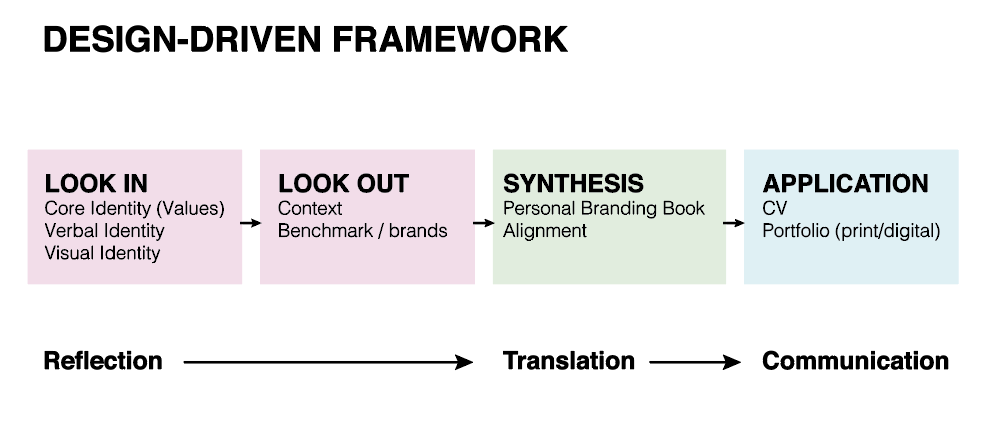
Figure 1. Design-driven framework for the construction of professional identity, showing the iterative relationship between reflection, contextual analysis, synthesis and applicationS
3. Outcomes and Educational Implications
The application of the framework has allowed us to identify specific implications for how students construct and communicate their professional identities. This section focuses on what the outputs make observable in terms of learning processes and positioning strategies. A first implication concerns the shift from implicit design attitudes to articulated forms of professional identity. At the end of the course students demonstrate a greater ability to recognize and articulate their design positioning making explicit their operational values, aesthetic orientations and directions of professional interest. This increased awareness emerges in the selection of content, the structuring of materials and the ability to critically interpret their own learning journey in line with the literature on professional identity development in higher education (Trede et al., 2012). This suggests that structured reflective activities can support students in making their positioning explicit transforming tacit design orientations into communicable professional identities. A second implication concerns the reconfiguration of the portfolio as a design device. The final portfolios demonstrate greater integration between content, structure and visual language with a more explicit relationship between the selected projects and the stated professional profile. Compared to the initial versions often characterized by a heterogeneous juxtaposition of materials, the final outputs present a more controlled narrative construction, suggesting a reworking of the portfolio as an intentional device. The portfolio is progressively understood as a design artifact through which identity is constructed and communicated. A third implication concerns the emergence of selection as a design skill. Throughout the activities, students were progressively guided to reduce the quantity of materials presented, prioritizing relevance over completeness. This shift from an accumulative to a selective approach highlights a greater awareness of selection criteria and recognizes synthesis as a central component of project communication. In this sense, the portfolio is progressively conceived as a flexible tool, adaptable to different presentation contexts rather than as a static final product of the course of study. This shift highlights the role of reduction and hierarchization as central components of project communication. Qualitative observations also highlight greater effectiveness in presenting one's professional profile. This improvement is evident in the clarity of information, consistency between CV, paper portfolio, and digital portfolio, and the differentiated use of language across different tools and contexts. Overall, greater readability of materials and a clearer recognition of the project's identity emerge. This suggests that consistency across different communication tools contributes to the overall readability and credibility of the professional profile. From an educational perspective these results indicate that integrating a design-driven framework into fashion design training can support the development of skills relevant to employability. Consistent with interpretations that emphasize its identity-building dimension (Jackson, 2016), structured work on portfolios, CVs and digital tools appears associated with a greater ability to recognize and articulate one's emerging role in the professional context, making explicit the relationship between project, identity, and communication. The framework also demonstrates potential transferability to other design fields. The structure, based on phases of reflection, contextual analysis, synthesis and application, is compatible with similar curricula, such as product, communication or interior design, although it requires adaptations related to disciplinary specificities and different presentation formats. At the same time it is necessary to acknowledge some limitations of the method. The course's short duration affects the depth with which certain phases, particularly synthesis and application, can be developed. Furthermore the diverse backgrounds of students require a constant balance between teaching structure and individual work. The framework also presupposes a consolidated level of design skills a condition that facilitates its implementation but limits its applicability. Finally the introduction of branding as an educational tool requires careful management. In the proposed framework branding is understood as a design and reflexive device and is used to support processes of awareness, selection, and positioning. This approach aims to maintain a balance between the construction of professional identity and the relationship with the work context avoiding a purely performative interpretation of self-presentation (Gandini, 2016).
References
Barrett, H. (2007). Researching electronic portfolios and learner engagement: The REFLECT initiative. Journal of Adolescent & Adult Literacy, 50(6), 436–449.
Biggs, J., & Tang, C. (2011). Teaching for quality learning at university (4th ed.). Maidenhead: Open University Press.
Bridgstock, R. (2009). The graduate attributes we’ve overlooked: Enhancing graduate employability through career management skills. Higher Education Research & Development, 28(1), 31–44.
Cambridge, D. (2010). Eportfolios for lifelong learning and assessment. San Francisco: Jossey-Bass.
Cross, N. (2006). Designerly ways of knowing. London: Springer.
Dorst, K. (2011). The core of “design thinking” and its application. Design Studies, 32(6), 521–532.
Duffy, B. E. (2017). (Not) getting paid to do what you love: Gender, social media, and aspirational work. Yale University Press.
Gandini, A. (2016). Digital work: Self-branding and social capital in the freelance knowledge economy. Marketing Theory, 16(1), 123–141.
Jackson, D. (2016). Re-conceptualising graduate employability: The importance of pre-professional identity. Higher Education Research & Development, 35(5), 925–939.
Korthagen, F. A. J. (2004). In search of the essence of a good teacher: Towards a more holistic approach in teacher education. Teaching and Teacher Education, 20(1), 77–97.
Poell, T., Nieborg, D., & van Dijck, J. (2019). Platformisation. Internet Policy Review, 8(4).
Schön, D. A. (1983). The reflective practitioner: How professionals think in action. New York: Basic Books.
Tosh, D., Light, T. P., Fleming, K., & Haywood, J. (2005). Engagement with electronic portfolios: Challenges from the student perspective. Canadian Journal of Learning and Technology, 31(3).
Trede, F., Macklin, R., & Bridges, D. (2012). Professional identity development: A review of the higher education literature. Studies in Higher Education, 37(3), 365–384.