Adapting design principles for creating digital self-regulated research ethics and integrity resources for higher education context
Adapting design principles for creating digital self-regulated research ethics and integrity resources
Adapting design principles for creating digital self-regulated research ethics and integrity resources for higher education context
Anu
Tammeleht
 ,
Mari-Liisa Parder
,
Kristi Lõuk
,
Kertu Rajando, Margit
Sutrop
Centre for Ethics, University of Tartu, Estonia.
How to cite: Tammeleht, A.; Parder, M.-L.; Lõuk, K.; Rajando, K.; Sutrop, M. (2026). Adapting design principles for creating digital self-regulated research ethics and integrity resources for higher education context. In: 12th International Conference on Higher Education Advances (HEAd’26). Valencia, 15-18 June 2026. https://doi.org/10.4995/HEAd26.2026.21700
Abstract
Research ethics and integrity (REI) education increasingly relies on self-guided resources, yet design principles that have been developed are mainly meant for facilitated or socially embedded learning contexts. This article examines how established design principles for online ethics education can be systematically adapted for a fully digital, self-regulated learning environment. Drawing on design-based research, the article revisits empirically grounded design principles and explicates how their underlying pedagogical functions, such as facilitation, collaboration, and scaffolding, can be translated into properties of content structure, pedagogical sequencing, and interface design. The adaptations are illustrated through a case study of an open-access, interactive digital REI textbook-workbook developed for beginner researchers, and which has been validated by two rounds of rigorous expert evaluations. The description demonstrates how self-guided digital resources can be designed to support development of ethical sensitivity, reasoning, and reflection.
Keywords: research ethics and integrity education; design principles; digital self-regulated resource; higher education
1. Problem setting and conceptual grounding
Higher education has increasingly shifted from printed textbooks toward digital and interactive learning resources. This process is driven by acceleration of social time (Rosa, 2010) and emerges in higher education through widespread access to mobile technologies and by the affordances of digital platforms for searchability, multimedia integration, and self-paced learning. While printed materials continue to support deep reading-learning and sustained attention, they are often costly, static, and slow to reflect developments in rapidly evolving fields (Cozart et al., 2021). These limitations are particularly salient in research ethics and integrity (REI), where normative expectations, regulatory frameworks, and ethical challenges expand over time and where learners represent diverse disciplines, career stages, and research cultures. Despite this, much existing REI training continues to rely on institution-specific, modular courses or closed training suites that are difficult to adapt, reuse, or embed flexibly within different educational contexts.
This situation points to the value of openly available, integrative digital resources that can be embedded within diverse training ecosystems and updated as the area evolves. This article presents a case study of the development of an open-access, digital, interactive textbook-workbook designed for beginner researchers and available in their native language (not English). Rather than proposing a new REI curriculum, the article contributes design knowledge by articulating the pedagogical approach and adapted design principles that guided the development of a self-regulated digital REI resource. The focus is on how ethics education can be designed to support value reflection (Sutrop, 2015) and ethical competence (Sutrop et al., 2025), which includes ethical sensitivity, reasoning, and reflection when learners engage with the material independently, without ongoing facilitation. Research on ethics and integrity education consistently demonstrates that lecture-based or rule-focused instruction alone is insufficient for developing meaningful ethical competence (Todd et al., 2017). Instead, learner-centred approaches that engage participants in analysing realistic cases, articulating justifications, and reflecting on their own decision-making processes are more effective in supporting ethical sensitivity and reasoning (Tammeleht et al., 2019; Todd et al., 2017). Case-based learning helps bridge abstract norms and everyday research practices, while structured reflection supports learners in recognising ethical dimensions, examining assumptions, and developing principled judgement (Sutrop et al., 2025). However, much of this research implicitly assumes facilitated learning environments in which instructors and peers play an active role in prompting reflection, challenging reasoning, and sustaining epistemic focus.
Design principles developed for online ethics resources have shown promise in addressing these pedagogical goals (Tammeleht, 2022). Drawing on a design-based research (DBR) framework, Tammeleht (2022) presents a set of empirically grounded design principles (11) for developing online ethics education that supports the gradual development of ethical sensitivity, reasoning, and decision-making across disciplines. Central to these principles are the use of lifelike cases, carefully structured tasks, scaffolded reflection, epistemic objects that sustain focus on shared problems, and collaboration with peers and experts. However, these design principles were developed and tested primarily in contexts where learning, although mediated by digital environments, remained socially embedded and at least partially facilitated. Facilitation and peer interaction play a significant pedagogical role in such settings: they support pacing, surface assumptions, address misunderstandings, and expose learners to alternative perspectives (Tammeleht et al., 2020). When ethics resources are used as standalone, self-guided digital courses or textbooks, these conditions change fundamentally. Learners must regulate their own engagement, interpretation, and progression, and the pedagogical functions normally carried out through interaction must be embedded directly into the design of the material itself.
This shift creates a clear need for a systematic adaptation of existing, empirically grounded principles to a self-regulated digital learning context. Consistent with the logic of design-based research, such adaptation does not involve the direct transfer of principles from one context to another, but rather a theoretically informed reinterpretation of their underlying pedagogical intentions. The present article addresses this need by outlining the original design principles proposed by Tammeleht (2022) and explicating how they were adapted for the development of a fully digital, self-regulated REI learning resource (a website). The adaptations are illustrated through examples from the design and implementation of an open-access digital REI textbook-workbook for beginner researchers (from now-on referred to as ‘REI resource’). The validation to the design has been provided via two rounds of rigorous expert reviews. As the REI resource is not available to learners yet, no empirical data has been collected on the effectiveness of the training, this will be done in the future studies.
2. Adapted design principles
The design principles proposed here are intended for creators of digital, self-regulated research ethics and integrity (REI) resources. The overarching pedagogical aim is to support the development of ethical sensitivity and decision-making, understood as the learner’s ability to recognise ethical dimensions of research situations, identify affected parties, and consider alternative courses of action (Rest, 1986; Caughron et al., 2011). Given the rapidly evolving nature of REI, the goal of such resources is not to provide fixed answers but to equip learners with transferable analytical capacities - “a fishing rod rather than a fish”. Each principle is presented by briefly recalling its original pedagogical function and outlining its adaptation for a fully digital, self-regulated learning context. Where relevant, original principles are merged to reflect overlapping functions.
2.1. Design Principle 1: Identifying the need, context, and scope
In facilitated ethics education, identifying the need, context, and scope primarily guides instructional design, while expectations and relevance are clarified dynamically through teaching and interaction. In a self-regulated digital context, these orienting functions must be made explicit within the resource itself. The material therefore needs to clearly articulate its purpose, target group, learning logic, and boundaries, enabling learners to understand how and why to engage with it independently. In the REI resource, this was operationalised through explicitly stated learning outcomes aligned with established educational frameworks (e.g. Fink’s taxonomy and the SOLO taxonomy) and through a consistent pedagogical structure adapting the Golden Circle approach (Sinek, 2009). Each module begins by addressing why the topic matters for research and for the learner personally, thereby foregrounding ethical relevance and motivation; it then proceeds to what learners need to understand, highlighting core concepts and offering optional pathways for deeper engagement; and finally moves to how this understanding can be applied through case analysis and interactive tasks. Together, these elements make the pedagogical intent, scope, and expectations of the resource visible, enabling learners to navigate the material purposefully and to engage with ethical questions in a self-directed yet structured manner.
2.2. Design Principle 2 and 3: Collaboration with practitioners and experts in building the conceptual framework
In facilitated settings, collaboration with practitioners and experts ensures authenticity of content while instructors help learners integrate professional perspectives. In a self-regulated digital context, expert collaboration must be translated into a visible and coherent conceptual framework that embeds professional knowledge directly into the structure of the resource. Rather than relying on live interaction, expertise is represented through curated topics, cases, and perspectives that make ethical themes and levels of analysis explicit. In the REI resource, this adaptation was realised through collaboration with a diverse group of contributing authors (38 in total) representing different areas of REI expertise, whose input informed the selection of topics, cases, and thematic emphases. To ensure coherence across contributions, all authors worked within a shared pedagogical framework, including a common didactic structure and received targeted support in ethics education principles. As a result, expert collaboration is materialised as a navigable and cognitively meaningful framework that supports learners’ metacognitive awareness, helps them situate individual cases within broader ethical patterns, and compensates for the absence of instructor-led integration while preserving autonomous ethical sense-making.
2.3. Design Principle 4: Supporting learning through a learner-owned epistemic object
Epistemic objects such as group reports, portfolios, or shared artefacts are used to sustain collective focus and support knowledge building around ethical problems. In a fully digital, self-regulated learning context, this principle must be adapted toward the construction of a learner-owned and platform-external epistemic object. Rather than coordinating group understanding, the epistemic object functions as a personal artefact that accumulates the learner’s ethical reasoning across tasks, cases, and modules. In the REI resource, learners are repeatedly prompted to articulate decisions, analyse cases, interpret visual material, and reflect on ethical challenges using structured questions and recurring analytical formats (e.g. decision tables or reflection prompts). Learners are encouraged to document these responses in a personal reflection log or workbook of their own choosing, which accompanies engagement with the resource over time. This longitudinal artefact supports continuity, comparison, and revision of ethical reasoning, enabling learners to monitor their own development in ethical sensitivity and judgement in the absence of external assessment or facilitation.
2.4. Design Principle 5, 6 and 7: Structuring chapter content through cases, tasks and layered support
In facilitated contexts, the pedagogical functions of cases, questions, and support materials are distributed between content and instructor-led interaction. In a self-regulated digital environment, these functions must be integrated into the structure of the learning materials themselves. Cases serve as the primary vehicle for ethical engagement and must be sufficiently rich and ambiguous to provoke independent reflection. Tasks are sequenced to prompt interpretation and decision-making before introducing ethical frameworks or expert perspectives, thereby protecting learners’ own reasoning processes. Support materials are made persistently available but deliberately positioned, allowing learners to access scaffolding when they perceive a need. Together, these elements form a pedagogical script that embeds facilitation into content design. In the REI resource, this principle was operationalised through editorial guidance that ensured each expert-authored chapter followed a shared pedagogical logic, combined authentic cases with interactive thinking tasks, and embedded layered support in a way that balances structure with autonomy. Example from the resource:
When a new topic is introduced, a clear and easily comprehensible visual is used. The visual is followed by an explanatory text, after which the reader is invited to reflect independently.
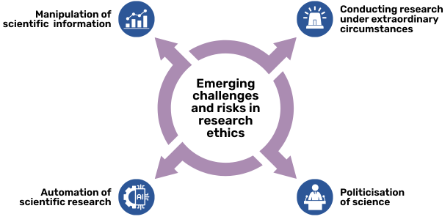
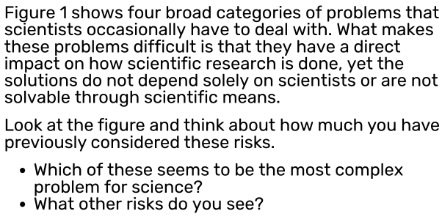
Figure 1. Design Principle 8: Digital interface design as pedagogical architecture.
In self-regulated digital ethics education, interface design functions as pedagogical architecture rather than a neutral delivery mechanism. Layout, navigation, and visual hierarchy guide attention, signal task expectations, and support progression through ethical problem-solving and reflection. Differentiating between immediately visible content and expandable support materials allows learners to control depth and timing of engagement while maintaining access to guidance. The REI resource is Wiki-based, so this principle was operationalised through a layered interface logic that distinguishes between what is immediately visible and what requires active opening by the learner. Core content, cases, interactive tasks, and visual materials (e.g. tables, diagrams, and structured summaries) are presented prominently on the page to invite engagement and foreground ethical problem-solving. Support materials, such as definitions, normative guidance, policy excerpts, or expert perspectives, are placed behind expandable elements (e.g. accordions or buttons), making scaffolding persistently available without imposing it. This visual and structural differentiation enables learners to control the depth and timing of support, while the use of visual representations enhances readability, coherence, and cognitive orientation. Examples from the resource: Left figure: Principles of the Ethics Committee’s Operation. Right figure: Opportunities, Limitations, and Ethical Risks in Text Analysis.
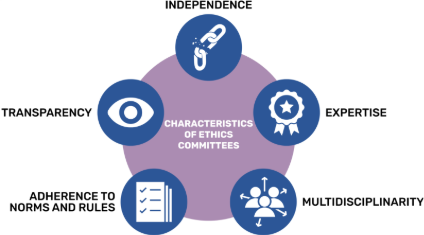
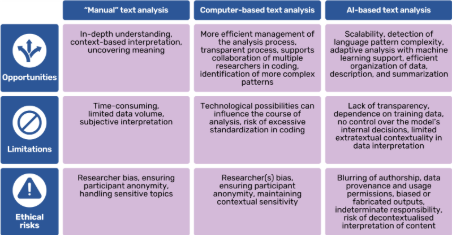
Figure 2. Design Principle 9 and 10: Simulating dialogic engagement and facilitation through design.
While peer interaction and facilitation cannot be assumed in self-regulated digital contexts, their pedagogical functions remain essential. These functions are preserved by embedding dialogic and facilitative logic into task design, sequencing, and prompts. Ethical plurality is introduced through contrasting perspectives and role-based questions, while facilitation is realised through anticipatory prompts, pacing cues, and reflective pauses at key decision points. Rather than replicating social interaction, these design strategies sustain ethical dialogue and prevent premature closure by challenging learners’ interpretations from within the material itself. Example from the resource:

While embedded dialogic prompts and anticipatory facilitation can guide learners’ ethical engagement, they cannot provide the responsive feedback traditionally offered by peers or instructors. As a result, opportunities for learners to examine, evaluate, and recalibrate their own ethical reasoning must be built into the learning process itself. In a self-regulated digital environment, this function is primarily realised through structured reflection.
2.5. Design Principle 11: Reflection as the primary feedback mechanism
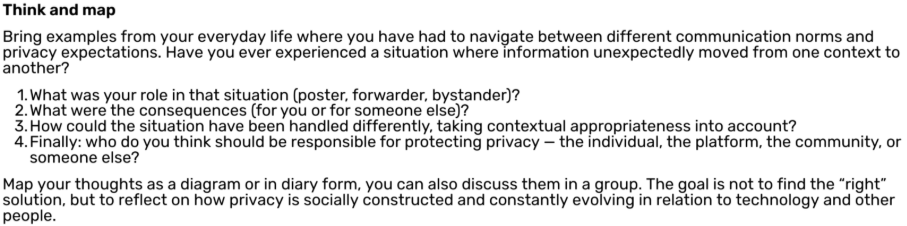
In the absence of instructor or peer feedback, structured reflection becomes the primary mechanism through which learners evaluate and regulate their ethical reasoning. Positioned as a cumulative process across cases and tasks, reflection consolidates ethical sensitivity and judgement and compensates for the lack of external formative feedback in self-regulated digital ethics education. Structured self-reflection prompts – such as SOLO-based grids, guided journaling, or recurring reflective questions – enable learners to assess the depth, coherence, and limits of their ethical judgements over time. By encouraging learners to revisit earlier decisions, recognise changes in their reasoning, and articulate remaining uncertainties, reflection functions as a cumulative and developmental process that consolidates ethical sensitivity and judgement in the absence of external assessment. Example from the resource:
3. Discussion and conclusions
This article set out to examine and exemplify how empirically grounded design principles for facilitated online REI education can be systematically adapted for a fully digital, self-regulated learning context. The article contributes adapted design principles which demonstrate that the developmental and reflective aims of ethics education can be preserved without relying on live instruction or peer interaction, provided that key pedagogical functions are deliberately embedded into the design of the learning materials themselves. Rather than proposing new principles, the contribution lies in making explicit how facilitation, collaboration, and scaffolding can be translated into properties of pedagogical architecture, content structure, and interface design.
Across the adapted principles, learner autonomy emerges not as the absence of guidance, but as a capacity that is actively supported through design. Orientation is strengthened by clearly articulated scope, learning logic, and pedagogical structure; expert knowledge informs both content and framework without hindering learners’ own sense-making; and ethical engagement is sustained through internally rich cases, carefully sequenced tasks, and layered support that remains available without being imposed. Interface design further reinforces this logic by distinguishing between immediately visible elements that foreground ethical problem-solving and expandable support materials that learners can access when needed. Together, these design choices enable learners to engage independently with complex ethical questions in ways that mirror the conditions of professional practice, where ethical judgement is typically exercised without immediate feedback or facilitation.
At the same time, adapting design principles for self-regulated digital ethics education involves important trade-offs. There is a risk of over-structuring learning pathways to the point where ethical reasoning becomes procedural rather than exploratory, or of introducing expert perspectives too early and thereby narrowing learners’ interpretive space. Similarly, while dialogic engagement and facilitation can be partially approximated through contrasting perspectives, anticipatory prompts, and task sequencing, these design strategies cannot fully replicate the responsiveness and unpredictability of social interaction. Without careful attention to progression, cognitive load, and the timing of scaffolding, self-guided resources may overwhelm learners or encourage superficial engagement. These risks highlight the importance of treating design principles as guiding heuristics rather than prescriptions, requiring ongoing calibration and contextual sensitivity.
As external feedback and peer comparison may be limited, reflection becomes the primary mechanism through which learners monitor the development of their ethical sensitivity and reasoning. Also, prior studies indicate that self-reflections can be accurate and display development of understanding (Tammeleht & Löfström, 2024). By encouraging learners to document decisions, revisit earlier judgements, and articulate remaining uncertainties across tasks and cases, reflection consolidates learning over time and compensates for the absence of facilitation. Positioned as a cumulative and learner-owned process, reflective practices align both with the epistemic object principle and with the broader aim of supporting ethically responsible researchers capable of self-directed judgement.
The adapted design principles illustrate how self-guided digital REI resources can be developed. The compilation of our REI resource shows that expert collaboration, pedagogical scripting of content, and deliberate interface design can be combined to create structured yet flexible learning environments that respect learner autonomy while sustaining ethical engagement. At the same time, design principles do not function as templates to be implemented uniformly, but as generative frameworks that must be interpreted, tested, and refined in relation to specific institutional, disciplinary, and technical contexts. Making these adaptations explicit contributes to the growing body of design knowledge on digital ethics education and provides a transferable basis for educators seeking to develop open, self-regulated REI learning resources suited to their own contexts.
Acknowledgements
We would like to thank all the contributors of the REI resource.
This work was created as a blend of human and AI contributions. AI was used to make stylistic edits, such as changes to structure, wording, and clarity. AI was prompted for its contributions, and AI-generated content was reviewed and approved. The following model(s) or application(s) were used: Consensus, ChatGPT EDU.
References
Caughron, J. J., Antes, A. L., Stenmark, C. K., Thiel, C. E., Wang, X., & Mumford, M. D. (2011). Sensemaking Strategies for Ethical Decision Making. Ethics & Behavior, 21(5), 351–366. doi: 10.1080/10508422.2011.604293.
Cozart, D. L., Horan, E. M., & Frome, G. (2021). Rethinking the traditional textbook: A case for open educational resources (OER) and no-cost learning materials. Teaching & Learning Inquiry, 9(2).
Rest, J. R. (1986). Moral development: Advances in research and theory. Praeger.
Rosa, H. (2010). Alienation and acceleration: Towards a critical theory of late-modern temporality. Aarhus University Press.
Sinek, S. (2009). Start with why: How great leaders inspire everyone to take action. Penguin.
Sutrop, M.; Harro-Loit, H.; Tammeleht, A.; Lilles-Heinsar, L.; Nummert, M.-L. (2025). OECD High Performing Systems for Tomorrow Conceptual Framework Education for human flourishing: towards policy and practice Ethical reasoning or moral competence? pp. 47−61.
Tammeleht, A.; Rodríguez-Triana, M. J.; Koort, K.; Löfström, E. (2019). Collaborative case-based learning process in research ethics. International Journal for Educational Integrity, 15(6). doi: 10.1007/s40979-019-0043-3.
Tammeleht, A.; Rodríguez-Triana, M. J.; Koort, K.; Löfström, E. (2020). Scaffolding Collaborative Case-Based Learning during Research Ethics Training. Journal of Academic Ethics, 19, 1−24. doi: 10.1007/s10805-020-09378-x.
Tammeleht, A. (2022). Design principles for developing online ethics resources – the outcome of holistic DBR process. EDeR Educational Design Research, 6(1), 1−22. doi: 10.15460/eder.6.1.1713.
Tammeleht, A., & Löfström, E. (2024). Learners’ self-assessment as a measure to evaluate the effectiveness of research ethics and integrity training: can we rely on self-reports?. Ethics & Behavior, 34(8), 575-596.
Todd, E. M., Torrence, B. S., Mulhearn, T. J., Watts, L. L., Connelly, S., & Mumford, M. D.(2017). Effective practices in the delivery of research ethics education: A qualitative review of instructional methods. Accountability in Research, 24, 297–321.