Teaching Circularity Through Product-Centered Workshops: A Modular Approach in Engineering Education
Teaching Circularity Through Product-Centered Workshops
Teaching Circularity Through Product-Centered Workshops: A Modular Approach in Engineering Education
Simone Syhre
 ,
Elisabeth Eppinger
School of Culture and Design, University of Applied Science and Economics Berlin, Germany.
How to cite: Syhre, S.; Eppinger, E. (2026). Teaching Circularity Through Product-Centered Workshops: A Modular Approach in Engineering Education. In: 12th International Conference on Higher Education Advances (HEAd’26). Valencia, 15-18 June 2026. https://doi.org/10.4995/HEAd26.2026.21705
Abstract
Higher education has to prepare students for applied sustainability and circularity requirements. Graduates are expected to make informed design and development decisions while managing inherent goal conflicts. A modular, product-centered workshop format designed to address key aspects of circularity in product development, such as recyclability, repairability, maintenance, and increased use or modularity can address this. In this format, undergraduate students collaboratively analyze real products, using repairability as an illustrative example, and reflect on concrete design and construction decisions. The evaluation of this teaching format has shown positive perceptions in terms of clarity, relevance, and applicability for future professional practice. The findings indicate that short, low-threshold, product-centered workshops can effectively support applied and interdisciplinary learning in higher education.
Keywords: higher education; sustainability education; circular economy; apparel product development; product-based learning; workshop-based teaching
1. Introduction
Higher education institutions increasingly face the challenge of preparing students for sustainability-related requirements that extend beyond disciplinary knowledge and require applied, decision-oriented competencies (Avelar et al., 2023; Amorós Molina et al., 2023). Graduates are expected to make informed decisions regarding materials, construction, product lifespan, repair strategies, and end-of-life options, while simultaneously considering functional, economic, aesthetic, and regulatory constraints, such as emerging European Ecodesign Requirements (European Commission, 2024). Although sustainability and circularity have become established topics in higher education, translating these concepts into concrete product development decisions remains challenging for many students (Amorós Molina et al., 2023; Underwood et al., 2025). Circular approaches do not rely on single optimal solutions but involve navigating trade-offs between durability, repairability, recyclability, performance, and design. For students, these interdependencies often remain abstract, especially when teaching formats focus primarily on theoretical principles or isolated aspects of sustainability. From an educational perspective, this points to a recurring gap between academic instruction and professional practice. While universities of applied sciences emphasize practice-oriented education, teaching is often structured along disciplinary lines. Apparel design, clothing technology, material selection, and sustainability considerations are frequently addressed separately, whereas professional product development requires their close interrelation (Underwood et al., 2025; Avelar et al., 2023). As a result, students have limited opportunities during their studies to experience how design and engineering decisions interact in concrete product situations and how goal conflicts can be negotiated in practice.
Research in higher education consistently highlights the limitations of traditional lecture-based teaching approaches in fostering applied and transferable competencies, particularly in contexts that require systems thinking, interdisciplinary collaboration, and reflective decision-making (Lönngren & Van Poeck, 2021; Kozanitis & Nenciovici, 2023; Underwood et al., 2025;). In contrast, active and experiential learning formats have been shown to support deeper understanding and improve students’ ability to apply knowledge in complex and uncertain situations (Kozanitis & Nenciovici, 2023; Sundman et al., 2025; Freeman et al., 2014). For sustainability-oriented education, scholars emphasize the importance of learning environments that engage students with real-world and practice-oriented contexts and allow them to reflect on the consequences of concrete design and development decisions (Underwood et al., 2025; Sundman et al., 2025). Product-centered and collaborative learning approaches offer a promising way to address these challenges. By working with products, students are required to consider materials, construction details, usage scenarios, and potential failure points simultaneously, rather than treating sustainability aspects in isolation. Collaborative settings further enable students to articulate different perspectives, negotiate priorities, and reflect on trade-offs between competing requirements, activities that closely resemble professional practice in product development. In the following, the product-based workshop format developed within the research project HoliTexCycle at a university of applied sciences is presented. In section 2, the workshop design and its pedagogical rationale is explained. Section 3 and 4 report findings from a short evaluation conducted with participating students, contributing empirical insights into practice-oriented and interdisciplinary teaching approaches for sustainability in higher education. Section 5 provides a discussion an implications and section 6 concludes on implementing the workshop format in higher education curricula.
2. Teaching format: Product-centered workshop design
This section describes the design and implementation of the workshop format. It outlines the context and objectives, the overall structure of the workshops, and details the learning activities using the repairability module as an illustrative example. It further clarifies how the workshop supports interdisciplinary learning and reflective engagement circular principles.
2.1. Educational context, objectives and modular workshop concept
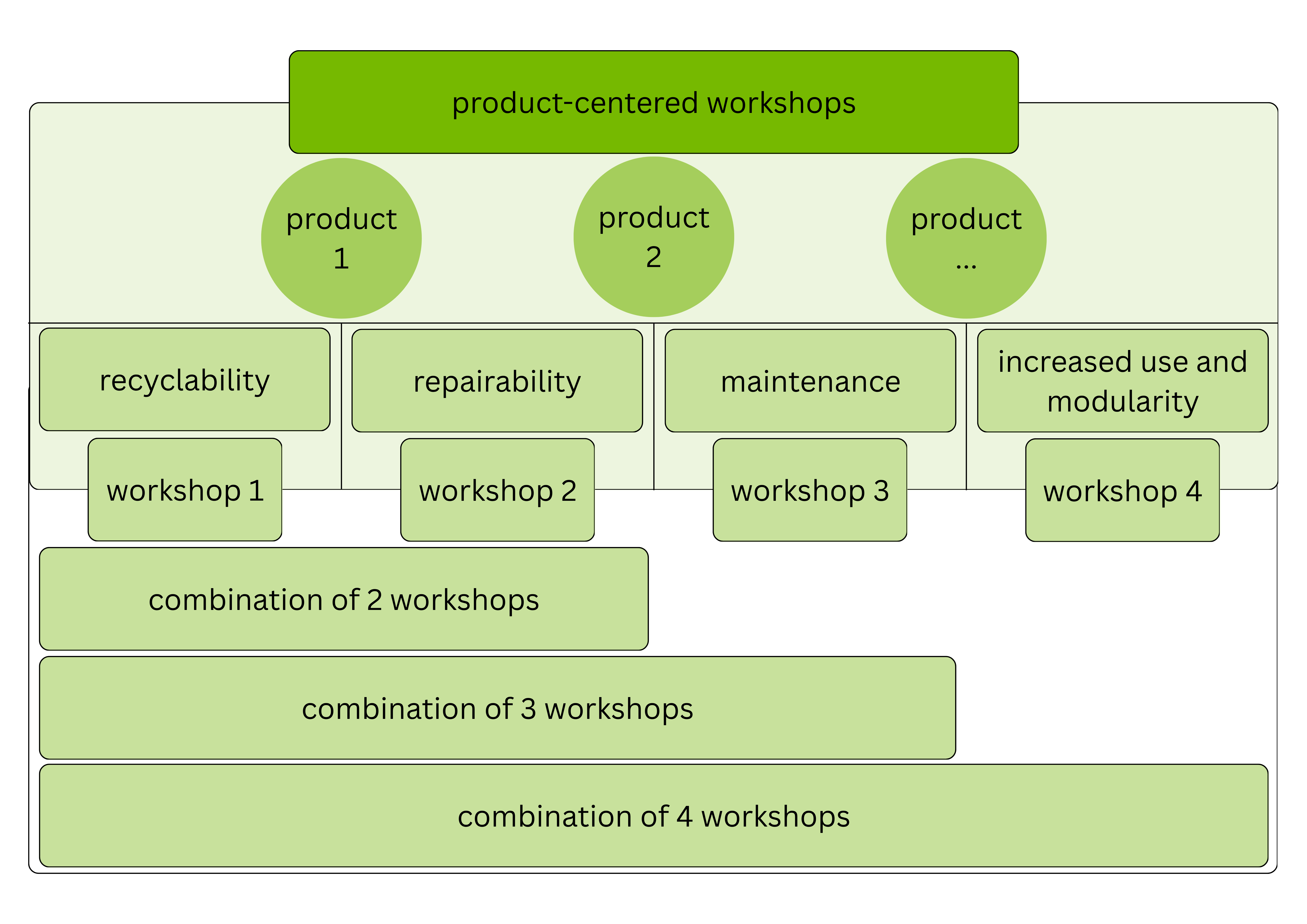 The
overall aim of the teaching concept is to support undergraduate
students in developing applied competencies for circular product
development. Rather than addressing circularity as a single, abstract
topic, the concept is structured around four interrelated focus
areas: recyclability, repairability, maintenance, and increased use
and modularity. Each workshop addresses one of these aspects,
according to the same didactic structure, allowing the format to be
adapted to different objectives and contexts (see Figure 1).
Figure 1. Modular product-centered workshop concept addressing key aspects of circularity
The workshops are designed for students in practice-oriented programs such as apparel engineering, clothing technology, fashion design, and related design and development fields. While these programs emphasize technical feasibility and product realization, students often have limited opportunities to explore how sustainability-related criteria interact across disciplinary boundaries. In professional practice, product development requires close collaboration between design, engineering, material selection, and sustainability considerations. The workshop format addresses this gap by creating a structured learning environment in which students actively analyze real products and reflect on the interdependencies between design and engineering decisions. Across all modules, the primary learning objectives are to enable students to (1) identify design and construction decisions that influence circularity-related aspects, (2) recognize interdependencies and goal conflicts between different product requirements, and (3) translate observations into concrete and actionable design criteria in a collaborative setting. The workshop can be conducted in formats ranging from 45 to 90 minutes. Depending on the duration and number of participants, the number of products, thematic depth, and degree of comparison can be adjusted. In extended formats or larger groups, different workshop modules (e.g., repairability and recyclability) can be combined to explicitly address goal conflicts between circularity strategies within the same product.
2.2. Workshop structure and learning activities of the repairability module
The modular structure allows individual workshops to be implemented independently or combined within a course, depending on available time, group size, and curricular focus. While the overall concept encompasses multiple circularity-related aspects, the part presented here focusses on the repairability workshop as an illustrative example. Repairability was selected because it provides a tangible entry point for discussing circularity in apparel product development and highlights typical tensions between durability, performance, construction complexity, and long-term use. In its basic format, the repairability workshop is conducted with three product types: T-shirts, trousers, and outdoor jackets, which represent different levels of constructional complexity and usage demands. The workshop is organized into three groups, with two to five students per group, each working on one product. The concept is intentionally flexible and can be extended to additional product groups if required.
The group work phase is structured into two consecutive analytical sections, guided by questions displayed on a pinboard. In the first section, students focus on identifying relevant product characteristics and repair-related aspects. Guiding questions include:
(1) Which design or construction decisions determine whether a product can be repaired effectively?
(2) Which product details or components stand out during analysis, and why might they be problematic or exemplary from a circularity perspective?
(3) How do materials, construction methods, and components influence the repairability of the product, and how can these observations be translated into actionable design criteria?
In the second section, students are encouraged to reflect explicitly on goal conflicts and trade-offs. Guiding questions address, for example:
(1) Where do potential tensions or conflicts between different product requirements emerge?
(2) Which criteria are, in the students’ view, indispensable for circularity, even if they constrain other goals such as repairability, performance, or functionality?
Students document their observations on cards, which are collected on a pinboard. This visual approach supports comparison across products and makes differing priorities and interpretations visible. The sequence of learning activities and the allocation of time across the different phases of the repairability workshop are summarized in Figure 2, illustrating how the format can be implemented within both shorter and extended teaching sessions.
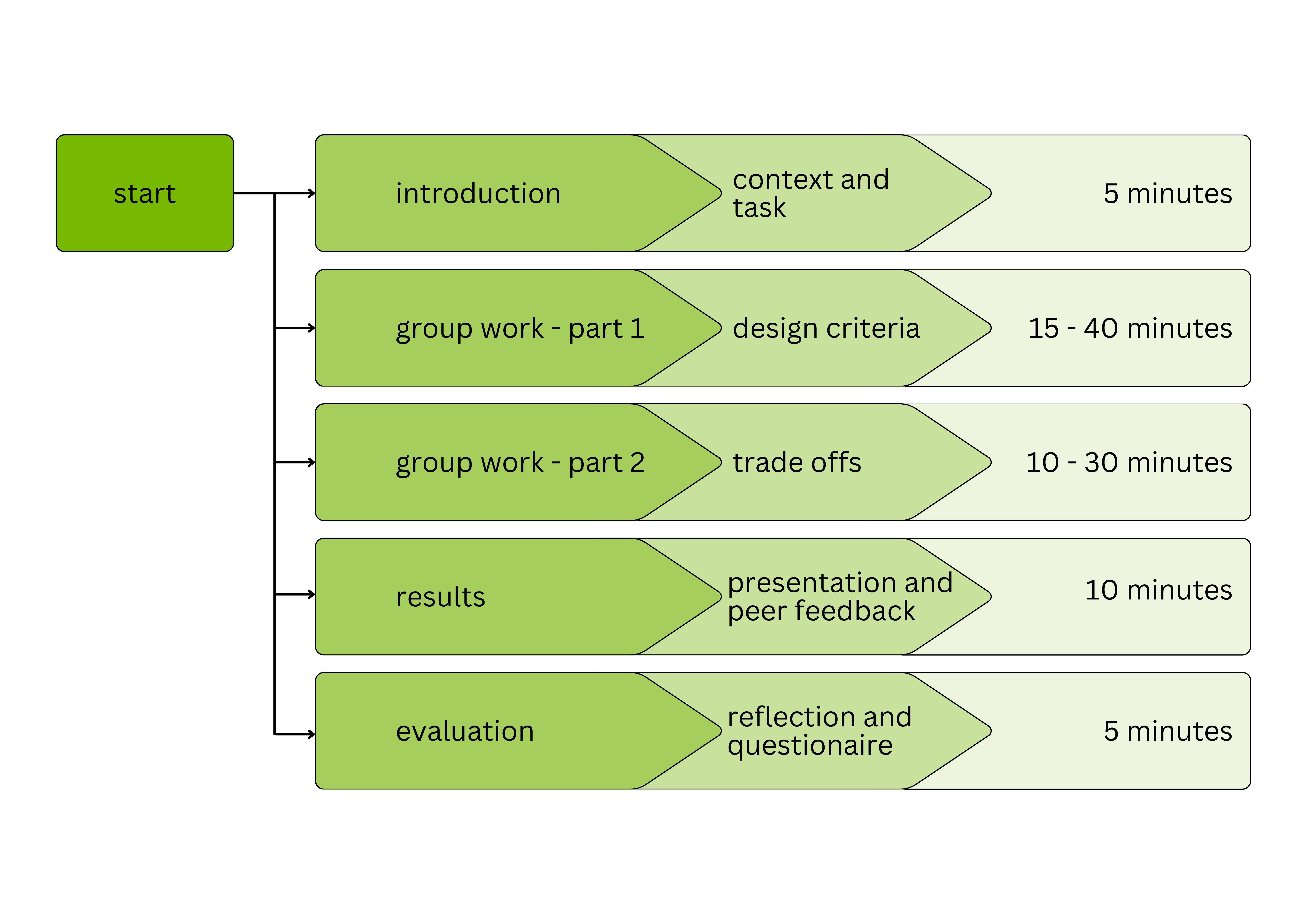
Figure 2. Structure and sequence of the repairability workshop
2.3. Peer exchange, reflection, and instructor role
In the presentation phase, each group briefly presents its key findings, while other groups add comments, questions, or additions directly to the pinboard. This format ensures active engagement of all participants and facilitates peer-based reflection on differing perspectives. The workshop concludes with a short reflection phase in which groups review the feedback received and discuss which aspects they found surprising, convincing, or transferable to future product development tasks. A short evaluation is conducted at the end of the session to capture students’ perceptions of the workshop format.
Across all modules, the role of the instructor is primarily that of a facilitator. Rather than providing predefined solutions, the instructor supports the process by clarifying tasks, prompting reflection, and ensuring that students consider not only materials but also construction, use scenarios, and product context. Learning materials are intentionally kept minimal and consist mainly of real products, guiding questions, and basic moderation tools, emphasizing analytical and reflective learning over instruction.
3. Methodology of the teaching format evaluation
The study follows an exploratory, practice-based evaluation approach focusing on students’ perceptions of learning outcomes, relevance, and applicability of the workshop format. The evaluation was embedded in the regular course context at a university of applied sciences and conducted immediately after the workshop sessions. Given the short duration and formative character of the intervention, the study does not measure learning gains longitudinally but captures initial insights into the educational value of the workshop design. To ensure a time-efficient and consistent evaluation, a short and standardized questionnaire was developed. It was designed to be completed within five minutes. The instrument consisted of Likert-scale items assessing clarity of objectives, perceived learning gains, methodological suitability, practical relevance, and applicability to future professional contexts. An open-ended question invited students to reflect on key insights or surprising aspects of the workshop.
Participants were undergraduate students enrolled in apparel-related study programs, including apparel engineering, clothing technology, and fashion design. Students took part in the workshop as part of their regular coursework. Participation in the evaluation was voluntary and anonymous. The sample size varied between three and 20 students depending on course and workshop implementation. The evaluation was conducted in paper-based form at the end of each workshop session. Quantitative data were analyzed descriptively. Responses to the open-ended question were reviewed and thematically grouped to identify recurring patterns and illustrative statements. In addition to the questionnaire data, the workshop generated qualitative data in the form of cards documenting students’ observations and design criteria developed during the group work. The pinboards were photographed after each session, and the collected materials were archived. These artefacts were not subjected to formal qualitative coding within the scope of evaluating the workshop but were reviewed to contextualize the evaluation results and to inform the ongoing development of design criteria for circular apparel products.
4. Results of the evaluation
Given the exploratory nature of the study and the short duration of the intervention, the findings focus on descriptive trends in students’ responses rather than on generalizable effects.
4.1. Perceived learning outcomes and relevance
Overall, students reported positive in terms of learning outcomes and relevance. The majority agreed that the format supported their understanding of how design and construction decisions influence circularity-related aspects such as repairability. They emphasized that working with real products helped them to better connect abstract concepts to concrete product features. Responses further indicate that students perceived the workshop as relevant for their future professional practice. Many participants agreed that the criteria discussed during the workshop could be transferred to future design or product development tasks and that the format supported a more differentiated understanding of circularity in apparel development.
4.2. Evaluation of the workshop format
The methodological design of the workshop was evaluated positively by most participants. Students indicated that the combination of group work, product analysis, and short presentations supported their learning process. The collaborative setting was frequently mentioned as helpful for comparing perspectives and reflecting on different priorities within product development.
In addition, students rated the workshop format as suitable for integration into educational and professional training contexts. Several respondents indicated that similar formats could be useful for onboarding or further training of designers and product engineers in industry settings, particularly in relation to emerging sustainability and regulatory requirements. Common themes of the open question included increased awareness of construction details, components, and usage-related aspects that influence repairability, and heightened sensitivity to trade-offs between different product requirements. Some students reported being surprised by how small design decisions could have significant implications for circularity outcomes.
5. Discussion and Implications
The findings of this study suggest that short, product-centered workshop formats can meaningfully support learning processes related to circular product development in engineering higher education programs. Students’ positive perceptions of learning outcomes and relevance indicate that the workshop design was successful in making abstract circularity concepts tangible and relatable through direct engagement with real products. This supports existing research emphasizing the value of active and experiential learning approaches for addressing complex sustainability challenges in higher education. A central contribution of the workshop lies in its focus on concrete design and construction decisions rather than on abstract principles alone. By analyzing real products, students were required to consider materials, construction details, components, and usage scenarios simultaneously. This appears to have supported a more integrated understanding of circularity, in which repairability, functionality, performance, and long-term use are not treated as isolated criteria but as interdependent aspects of product development. Accordingly, the workshop responds to a common gap in curricula, where sustainability topics are often addressed separately from design and engineering practice.
The collaborative structure of the workshop further contributed to learning by enabling students to articulate and negotiate different perspectives. Peer exchange and shared reflection made goal conflicts visible and encouraged students to justify their criteria and priorities. Such processes resemble professional product development contexts, in which interdisciplinary collaboration and negotiation are essential. The results therefore suggest that the workshop format can contribute not only to subject-specific knowledge but also to broader competencies relevant for professional practice, such as systems thinking, communication, and decision-making. Several limitations of the study should be acknowledged. The evaluation is based on self-reported student perceptions and was conducted immediately after the workshop, which limits conclusions about long-term learning effects. The sample size varied across implementations, and the findings are context-specific to apparel-related programs at a university of applied sciences. Future research could include longitudinal designs, comparative studies across institutions, or more systematic analysis of the artefacts generated during the workshops.
6. Conclusion
Overall, the results indicate that product-centered, collaborative workshops represent a promising approach for addressing the challenges of teaching circularity in engineering higher education. By combining practice-oriented learning with structured reflection and evaluation, such formats can support the development of applied competencies while remaining feasible within existing curricular constraints. Future work may build on this approach by extending the evaluation to longitudinal settings, comparing different workshop modules, or systematically analyzing the materials generated during the sessions. Overall, the workshop format demonstrates a feasible and adaptable approach for addressing applied circularity competencies in higher education.
References
Amorós Molina, Á., Helldén, D., Alfvén, T., Niemi, M., Leander, K., Nordenstedt, H., … Biermann, O. (2023). Integrating the United Nations sustainable development goals into higher education globally: a scoping review. Global Health Action, 16(1). https://doi.org/10.1080/16549716.2023.2190649
Avelar, A.B.A., da Silva O., K.D. & Farina, M.C. (2023). The integration of the Sustainable Development Goals into curricula, research and partnerships in higher education. Int Rev Educ 69, 299–325. https://doi.org/10.1007/s11159-023-10013-1
European Commission (2024). Regulation (EU) 2024/1781 of the
European Parliament and of the Council of 13 June 2024 establishing a
framework for the setting of ecodesign requirements for sustainable
products. Brussels.
ELI:
http://data.europa.eu/eli/reg/2024/1781/2024-06-28
Freeman, S.; Eddy, S. L.; McDonough, M.; Smith, M. K.; Okoroafor, N.; Jordt, H.; Wenderoth, M. P. (2014). Active learning increases student performance in science, engineering, and mathematics. Proceedings of the National Academy of Sciences, 111(23), 8410–8413. https://doi.org/10.1073/pnas.1319030111
Kozanitis, A., Nenciovici, L. (2023). Effect of active learning versus traditional lecturing on the learning achievement of college students in humanities and social sciences: a meta-analysis. High Educ 86, 1377–1394. https://doi.org/10.1007/s10734-022-00977-8
Lönngren, J., & Van Poeck, K. (2021). Wicked problems: a mapping review of the literature. International Journal of Sustainable Development and World Ecology, 28(6), 481–502. https://doi.org/10.1080/13504509.2020.1859415
Sundman, J., Feng, X., Shrestha, A., Johri, A., Varis, O., & Taka, M. (2025). Experiential learning for sustainability: a systematic review and research agenda for engineering education. European Journal of Engineering Education, 1–31. https://doi.org/10.1080/03043797.2025.2532591
Underwood, J., Van Amber, R., Brown, S., & Junior, R. M. (2025). Authenticating the integration of the SDGs into a higher education fashion program. Environmental Education Research, 31(8), 1601–1615. https://doi.org/10.1080/13504622.2025.2466109