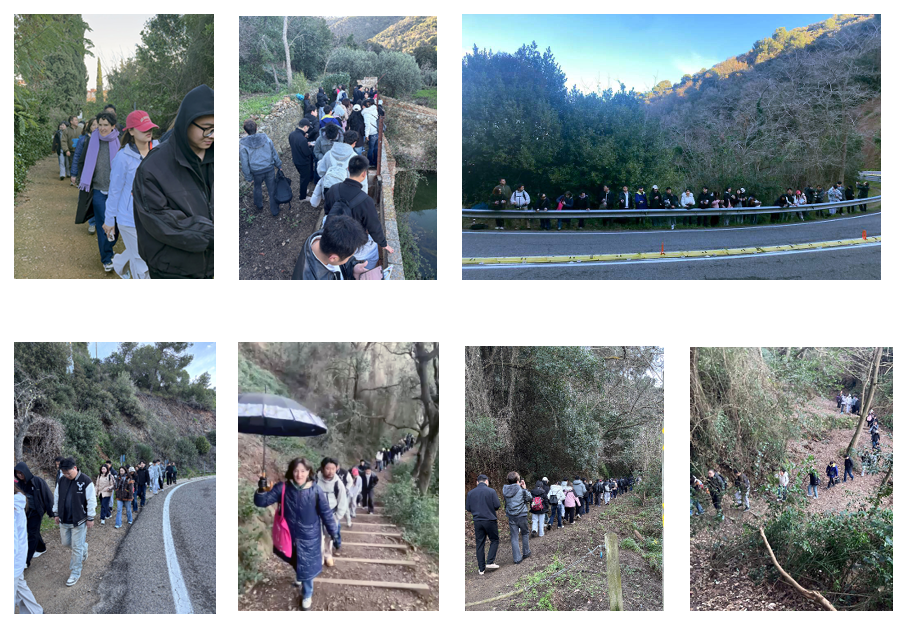
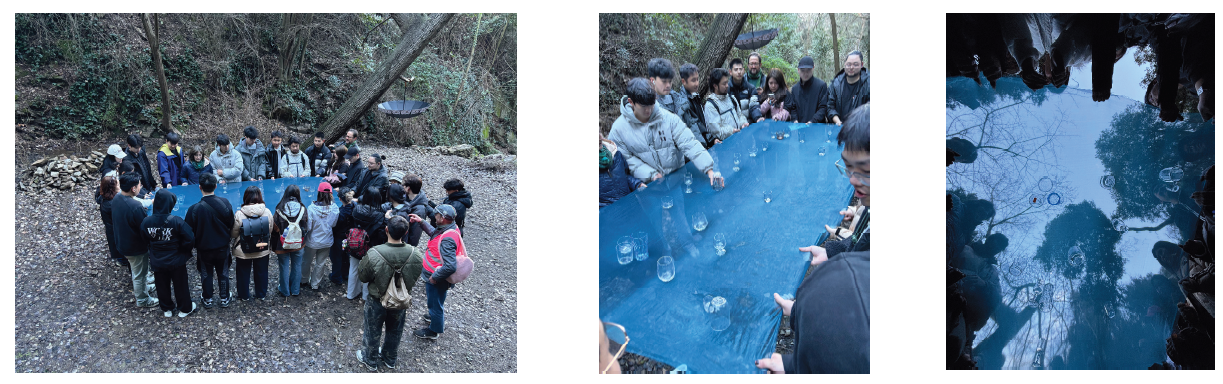
Walkshop: Embodied Resilience Thinking Through Theory, Practice, Intuition, and Sharing
Walkshop: Embodied Resilience Thinking Through Theory, Practice, Intuition, and Sharing
Rafael
De Balanzo Joue1,2,3
 ,
Tània Costa1
,
Francesc Magrinya4
,
Catie De Balmann1,
Elvira Pujol1,
Joan Vila-Puig1
1EINA Department, Universitat Autonoma Barcelona, Spain, 2Math & Science/GCPE Departments, Pratt Institute, USA, 3Department of Economics, CUNY, USA, 4Department Enginyeria Civil i Ambiental, Universitat Politecnica de Catalunya, Spain.
How to cite: De Balanzo Joue, R.; Costa, T.; Magrinya, F.; De Balmann, C.; Pujol, E.; Vila-Puig, J. (2026). Walkshop: Embodied Resilience Thinking Through Theory, Practice, Intuition, and Sharing. In: 12th International Conference on Higher Education Advances (HEAd’26). Valencia, 15-18 June 2026. https://doi.org/10.4995/HEAd26.2026.21710
Abstract
This paper presents the resilience thinking walkshop as an innovative experiential learning tool that engages pluriverse ways of knowing socio-ecological systems. Applied to Barcelona’s Collserola forest, the methodology combines walking-based field prospecting with Holling’s adaptive cycle framework to transform abstract resilience theory into tangible, embodied knowledge. The walkshop traces water heritage from urban wells to natural springs, enabling participants to experience adaptive cycles characterizing urban-nature boundaries while recognizing multiple ontologies embedded in the landscape. Through collaborative movement across challenging terrain, learners develop understanding of how human and natural systems co-evolve through phases of growth, conservation, release, and reorganization, acknowledging diverse knowledge systems beyond Western scientific frameworks. The methodology demonstrates significant pedagogical value as outdoor learning that integrates physical engagement, collaborative inquiry, systems thinking, and pluriverse perspectives, offering a replicable model for higher education programs seeking to enhance student understanding of complex socio-ecological dynamics through place-based, experiential learning.
Keywords: Pluriverse, Walkshop, Resilience Thinking, Placed-base pedagogy, Experiential Learning
1. Introduction
Contemporary higher education faces the challenge of preparing students to address complex socio-ecological problems—the entangled crises of urban expansion, biodiversity loss, and climate change—that transcend traditional disciplinary boundaries and single explanatory frameworks. Understanding the relationship between urban systems and natural environments requires pedagogical approaches that move beyond classroom-based theoretical instruction, enabling students to engage embodied, experiential, and multivalent ways of knowing real-world complexity (Kagan, 2015). This paper examines the resilience thinking walkshop as an innovative learning tool combining peripatetic pedagogy (structured walking as a method of philosophical and experiential inquiry), systems thinking frameworks, and pluriverse perspectives (the recognition that multiple valid worldviews and knowledge systems coexist) to facilitate deep understanding of how human and natural systems interact across temporal and spatial scales. We write from a specific position that requires acknowledgment upfront. This walkshop was designed and facilitated by professors of EINA School of Design and Art, within the historically complex territory of Barcelona City and its territory such the Collserola mountains. Spain played a central role in the colonization of Latin America, and Catalonia itself occupies a politically and linguistically contested space within that history. Yet the pluriverse framework we employ draws primarily on Latin American decolonial thought, especially the work of Colombian scholar Arturo Escobar. The structure of the paper follows by Section 2 establishes the theoretical framework, beginning with pluriverse epistemologies before introducing resilience thinking and walking-based pedagogies. Section 3 presents the Collserola resilience thinking walkshop design and implementation, with concrete examples of activities and discussion questions. Section 4 reports observed learning outcomes. Section 5 offers discussion and broader implications for higher education.
2. Theoretical Framework
2.1. Pluriverses Approaches to Socio-Ecological systems Learning
The pluriverse concept, as articulated by Escobar (2018) and rooted in Latin American decolonial thought, challenges the universalizing assumptions of modernity by affirming that multiple worlds, with their distinct ontologies (theories of what exists and how), epistemologies (theories of how we can know it), and practices coexist and deserve equal validity. In the context of environmental education, pluriverse approaches recognize that Western scientific ecology represents one knowledge tradition among many, not a privileged or complete understanding of human-nature relationships. Applying pluriverse thinking to resilience thinking walkshops requires acknowledging that landscapes hold multiple, sometimes contradictory meanings. Collserola's water systems can be understood through scientific hydrology, traditional water management knowledge, urban planning history, contemporary conservation discourse, and the lived experience of current inhabitants. Rather than seeking a single "correct" interpretation, pluriverse pedagogy creates space for these diverse understandings to coexist and enrich each other. This approach has profound implications for facilitation. Rather than expert-led transmission of authoritative knowledge, facilitators become conveners of dialogue among multiple knowledge systems. Participants are invited to contribute their own ways of knowing—whether based in professional training, cultural background, personal experience, or intuitive sensing—with equal legitimacy alongside scientific frameworks. The goal shifts from mastering a framework to developing capacity for navigating complexity by drawing on diverse epistemologies. This pluriverse orientation is especially important given the power dynamics of academic institutions, which historically have marginalized indigenous, community, and non-Western knowledge systems. We acknowledge that our own pedagogy, however intentionally pluriverse, operates within those same institutions.
2.2. The adaptive cycle approach from resilience science
Resilience thinking provides a framework for understanding how systems persist, adapt, and transform in the face of change (Walker & Salt, 2012). Central to this approach is Holling's adaptive cycle, which describes how socio-ecological systems move through four interconnected phases:
Growth/exploitation: rapid resource accumulation, high connectivity, and expansion.
Conservation: maturity and stability, with high connectivity but reduced flexibility. Example: a dense, mature forest canopy where diversity is lower but biomass is high and the system is resistant to minor disturbances.
Release/creative destruction: breakdown of established structures through disturbance—fire, disease, economic collapse, or policy change. Example: the fourteenth-century plague in Catalonia, which caused a rapid demographic collapse and the abandonment of agricultural terraces, releasing nutrients and allowing forest recovery. A forest regenerating after disturbance, with pioneer species spreading quickly and occupying open ground.
Reorganization: an experimental period where new configurations can emerge—or where the system tips into a different state entirely. Example: twentieth-century urban expansion into Collserola, which reorganized human-forest relationships around conservation discourse and legal protection rather than agricultural use.
However, the adaptive cycle represents one particular way of conceptualizing change, rooted in Western systems ecology, among multiple valid frameworks. Indigenous and traditional knowledge systems often employ cyclical models emphasizing reciprocity, regeneration, and relationship rather than phases of growth and collapse. Mediterranean agricultural traditions understood landscape cycles through seasonal rhythms, generational knowledge transfer, and practices of care that differ from scientific resilience concepts. A pluriverse approach recognizes the adaptive cycle as a useful heuristic while remaining open to alternative conceptualizations of how socio-ecological systems change over time. This cyclical perspective proves particularly valuable for educational purposes: it provides students with a dynamic framework for interpreting complex historical and contemporary socio-ecological systems relationships. The educational challenge lies in making these abstract concepts tangible through direct experience.
2.3. Walking as Pluriversal Experiential Learning Practice
Walking-based learning represents a longstanding pedagogical tradition recognizing movement through space as fundamental to knowledge construction. Strohmayer (2023) describes peripatetic phenomenological pedagogy as an approach that treats the landscape itself as teacher, where learning emerges through embodied engagement with place rather than abstract contemplation. This methodology acknowledges that understanding socio-ecological systems requires more than intellectual comprehension; it demands sensory experience, physical challenge, and direct observation of how natural and human systems interact in specific locations. From a pluriversal perspective, walking constitutes a practice that different cultures and knowledge traditions have employed to build relationship with land and transmit ecological wisdom across generations. Indigenous practices of walking the land, pilgrimage traditions, transhumance routes, and peasant knowledge of territory all represent ways of knowing through movement that predate and exceed academic frameworks. The walkshop methodology seeks to honour these diverse traditions by creating space for multiple forms of knowing to emerge simultaneously, scientific observation, embodied sensation, historical memory, emotional response, and collective meaning-making. The walkshop format extends traditional walking practices by incorporating structured collaborative inquiry, systems thinking frameworks, and explicit attention to pluriversality. Unlike passive observation or individual exploration, walkshops create temporary learning communities that navigate challenging terrain together, generating shared experiences that support collaborative knowledge construction. Participants bring diverse backgrounds, disciplinary perspectives, and cultural knowledges; the walkshop provides structure for these multiple ways of knowing to enrich rather than compete with each other.
3. The Collserola Walkshop: Design and Implementation
3.1. Geographic and Historical Context: Multiple Narratives
The Collserola mountain range forms Barcelona's natural backdrop, representing a critical interface between urban development and ecological conservation. From a pluriversal perspective, this landscape holds multiple histories and meanings simultaneously: it is ancestral territory of pre-Roman inhabitants whose relationships with water remain largely undocumented; site of Roman colonial infrastructure imposing Mediterranean agricultural models; medieval commons supporting peasant livelihoods through diverse traditional practices; object of modernist urban planning imposing rationalized resource management; protected natural park under contemporary conservation paradigms; and living place for current communities maintaining evolving relationships with the land. The region's water system provides an ideal case study for examining socio-ecological adaptive cycles through pluriversal lenses. Historical records themselves representing only one form of knowledge, privileging literate documentation over oral tradition and material practice document repeated cycles of growth, crisis, and reorganization: Roman colonization establishing early water infrastructure, medieval agricultural expansion, fourteenth-century demographic collapse and forest recovery, modern industrialization driving new water demands, and contemporary conservation efforts seeking sustainable management (Tello & Garrabou, 2007). However, these documented cycles represent primarily the perspective of dominant political and economic powers; subsistence practices, women's water management knowledge, and marginalized communities' adaptive strategies remain less visible in official histories. This layered history creates a landscape where different temporal scales, knowledge systems, and ontologies of adaptation remain visible simultaneously. Ancient wells, nineteenth-century water mines, modernist infrastructure, and protected natural springs coexist within a compact area traversable on foot. The walkshop methodology invites participants to read this palimpsest through multiple interpretive lenses rather than imposing a single authoritative narrative. Scientific analysis, historical documentation, traditional ecological knowledge, aesthetic appreciation, spiritual connection, and political-economic critique all offer valid entry points for understanding the landscape's socio-ecological dynamics.
3.2. Walkshop Structure and Pluriversal Learning Activities
The walkshop comprises integrated learning activities designed to honor pluriversal ways of knowing. Pre-walk orientation introduces the adaptive cycle framework explicitly positioned as one way of knowing among many, with participants invited to bring their own frameworks. Site-based inquiry at key locations poses open-ended questions inviting diverse forms of observation — scientific analysis, historical investigation, aesthetic response, embodied sensation, and ethical reflection all constitute legitimate modes of engagement. Collaborative observation in diverse small groups encourages contribution of different knowledge systems, with facilitators actively valuing epistemic diversity. The demanding terrain functions as equalizing pedagogy, disrupting conventional academic hierarchies where embodied experience matters more than formal credentials. Reflective synthesis at protected springs guides discussion exploring how different interpretive frameworks complement rather than compete. Core pedagogical principles include place-based learning with epistemic humility, temporal layering revealing how diverse communities have understood the same resources across time, embodied cognition connecting to knowledge traditions that center embodiment over abstraction, and social constructivism with attention to power dynamics.
4. Learning Outcomes and Pedagogical Value
Implementation demonstrates several significant outcomes validating the methodology’s pedagogical value. Participants develop enhanced systems thinking with epistemic flexibility, recognizing interconnections while understanding different frameworks reveal different aspects of socio-ecological reality. Historical consciousness acknowledging multiple narratives cultivates appreciation for how past adaptations shape present conditions while recognizing different communities experience these histories differently. Place attachment through multiple modes of knowing fosters emotional connections motivating environmental concern through intellectual analysis, aesthetic appreciation, physical experience, and emotional resonance. Collaborative capacity across difference builds trust and skills for working across epistemological differences. The walkshop offers distinct advantages over conventional classroom learning: concrete experience transforms abstract concepts into observable reality; multi-sensory engagement activates knowledge traditions that center embodiment; authentic complexity resists reduction to single narratives; and disruption of academic hierarchies creates space for marginalized knowledges. Extended learning through collaborative development of virtual guide-maps documenting locations through diverse interpretive lenses provides educational material modeling pluriversal approaches.
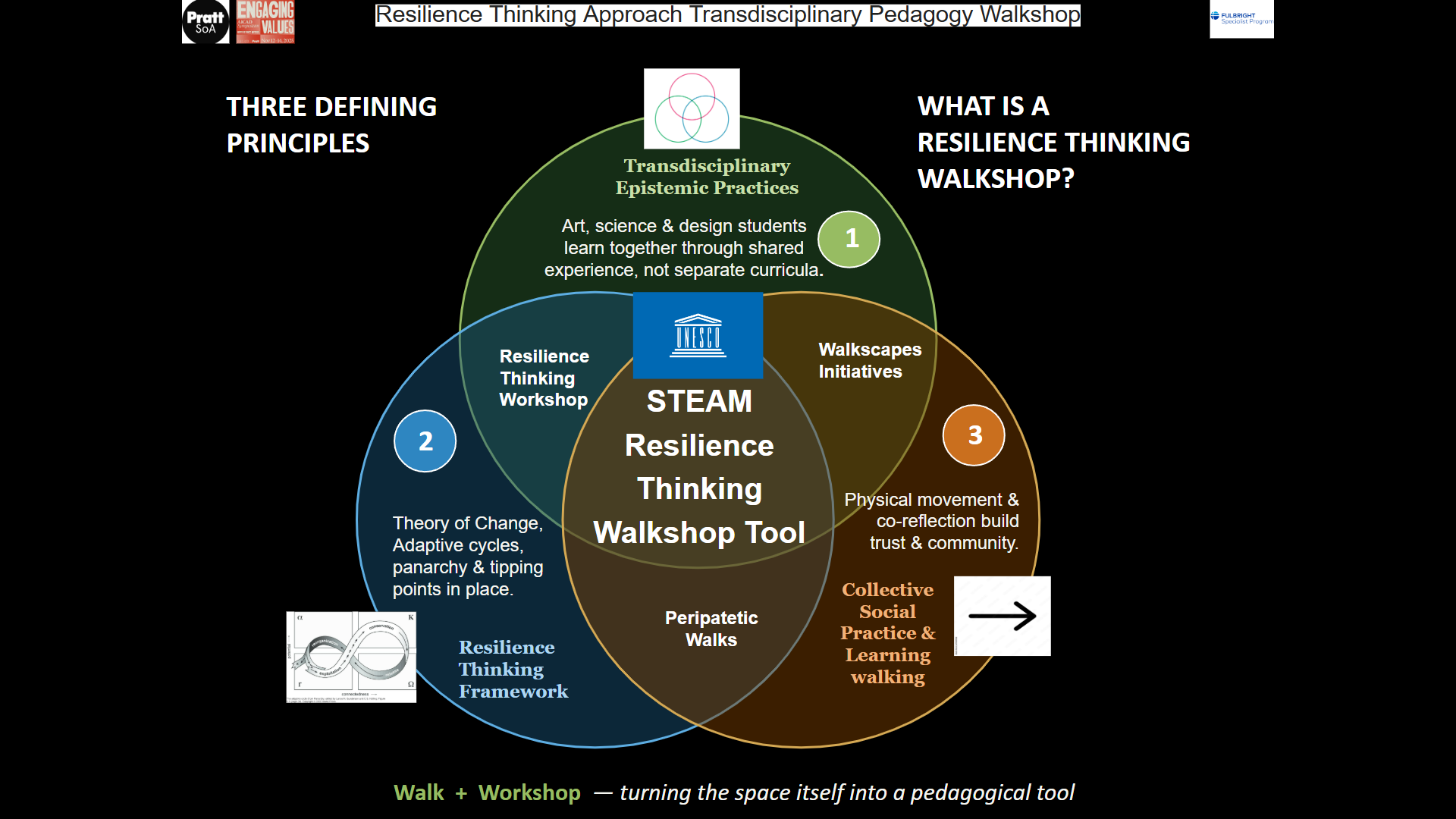
Figure 1.
5. Discussion and Implications for Higher Education
The resilience thinking walkshop addresses fundamental pedagogical challenges in teaching complex systems while addressing epistemic violence of universalizing Western frameworks. By moving learning outside institutional walls and creating space for multiple ways of knowing, the methodology generates distinctive educational value aligned with calls for decolonizing environmental education (Tuck & McKenzie, 2015). The approach recognizes that addressing environmental challenges requires technical knowledge, emotional engagement, collaborative capacity across difference, and respect for diverse ontologies of human-nature relationship (Westley et al., 2013; Escobar, 2018). Several implications merit consideration for higher education. Outdoor experiential learning with pluriverse commitments deserves recognition with appropriate resources for community partnerships and compensation for non-academic knowledge holders. Assessment in pluriverse contexts requires alternatives to traditional examinations, reflective portfolios, collaborative projects with community knowledge holders, and demonstrated capacity to translate across knowledge systems.
6. Conclusion
The resilience thinking walkshop represents an innovative pedagogical tool addressing critical needs: developing students’ capacity to understand complex socio-ecological systems through experiential, place-based learning honoring multiple ways of knowing. The Barcelona-Collserola application demonstrates how combining peripatetic pedagogy, systems thinking frameworks, and pluriversal commitments creates powerful learning experiences transcending conventional classroom limitations while challenging epistemic dominance of Western academic knowledge. As climate change, biodiversity loss, and urban expansion create unprecedented challenges, educational institutions must develop pedagogies preparing students for complexity, uncertainty, multiplicity, and interdependence. Future research should examine long-term impacts on participants’ capacity for pluriversal practice, explore methods for meaningfully including marginalized knowledge systems, and investigate how institutional structures enable or constrain pluriversal pedagogy. The fundamental insight, that landscapes themselves function as teachers holding multiple meanings when approached through frameworks enabling diverse interpretations offers promising direction for innovative higher education practice that honors the pluriverse of ways humans understand and relate to places sustaining life.
References
Escobar, A. (2018). Designs for the pluriverse: Radical interdependence, autonomy, and the making of worlds. Duke University Press.
García-Arias, J., & Guardiola, J. (2025). Pluriverso. In Ó. Carpintero (coord.), Economía Inclusiva. Conceptos Básicos y Algunos Debates. Madrid: Catarata, FUHEM y Universidad de Alcalá.
Gunderson, L. H., & Holling, C. S. (2002). Panarchy: Understanding transformations in human and natural systems. Island Press.
Kagan, S. (2015). Artistic research and climate science: Transdisciplinary learning and spaces of possibilities. Journal of Science Communication, 14(1), C07.
Strohmayer, U. (2023). Beyond the flâneur: Urban walking as peripatetic phenomenological pedagogy. GeoHumanities, 9(1), 78–101.
Tello, E., & Garrabou, R. (2007). La evolución histórica de los paisajes mediterráneos: algunos ejemplos y propuestas para su estudio. In V. Paül i Carril & J. Tort i Donada (coords.), Territorios, paisajes y lugares: trabajos recientes de pensamiento geográfico (pp. 19–64).
Tuck, E., & McKenzie, M. (2015). Place in research: Theory, methodology, and methods. Routledge.
Walker, B., & Salt, D. (2012). Resilience thinking: Sustaining ecosystems and people in a changing world. Island Press.
Westley, F. R., Tjornbo, O., Schultz, L., Olsson, P., Folke, C., Crona, B., & Bodin, Ö. (2013). A theory of transformative agency in linked social-ecological systems. Ecology and Society, 18(3).