Motivation, Absenteeism, and Academic Performance
Motivation, Absenteeism, and Academic Performance
Motivation, Absenteeism, and Academic Performance
David
Leiva1
 ,
Rumen Manolov1
,
Albert Sanchez-Niubó1
,
Montserrat Yepes-Baldó1
,
Maribel Peró-Cebollero1
,
Ruth Dolado1
,
Jose Navarro1
,
Rita Berger1
,
Marina Solé2
,
Xavier Triadó-Ivern3
1Department of Social Psychology and Quantitative Psychology, Faculty of Psychology, University of Barcelona, Spain, 2Department of Economics, Faculty of Law, University of Barcelona, Spain, 3Department of Business, Faculty of Economics and Business, University of Barcelona, Spain
How to cite: Leiva, D.; Manolov, R.; Sanchez-Niubó, A.; Yepes-Baldó, M.; Peró-Cebollero, M.; Dolado, R.; Navarro, J.; Berger, R.; Solé, M.; Triadó-Ivern, X. (2026). Motivation, Absenteeism, and Academic Performance. In: 12th International Conference on Higher Education Advances (HEAd’26). Valencia, 15–18 June 2026. https://doi.org/10.4995/HEAd26.2026.21719
Abstract
This study examines how motivational trajectories and absenteeism relate to academic performance in higher education. Using a 14-week longitudinal field design, we repeatedly assessed academic motivation, combined self-reported and QR-based attendance data, and tracked perceived performance across the semester. Longitudinal k-means clustering identified two profiles: a more self-determined group with higher intrinsic and internalized motivation, and a more amotivated group. Compared with the latter, self-determined students reported higher perceived performance and lower absenteeism, although final grades did not differ significantly. These findings underscore the value of person-centered longitudinal approaches for understanding academic functioning and suggest that early identification of motivational-risk profiles may help guide interventions to reduce absenteeism and support student engagement.
Keywords: Motivational profiles; absenteeism; academic performance; higher education; longitudinal design; person‑centered methods.
1. Introduction
Academic motivation has been conceptualized within Self-Determination Theory (SDT) as a continuum from intrinsic motivation to amotivation, with qualitatively distinct forms of extrinsic regulation in between (Ryan & Deci, 2017).
A large body of research links different motivational regulations to achievement and persistence, but most studies rely on variable-centered, cross-sectional designs that mask individual heterogeneity (Litalien et al., 2019). Person-centered methodologies better capture subpopulations with distinct patterns across multiple variables, enabling more nuanced inferences, particularly in longitudinal settings where trajectories carry theoretical meaning (Morin et al., 2018).
Absenteeism is a growing concern in higher education, with substantial prevalence and negative consequences for learning and satisfaction (Credé et al., 2010). In our institutional context, surveys report sizeable non-attendance (Triadó-Ivern et al., 2020). Measurement approaches range from self-reports and registry-based attendance to novel sensor-based methods (e.g., Wi-Fi or Bluetooth tracking) (Zhao et al., 2022).
Motivation is also an antecedent of absenteeism, yet joint, dynamic analyses remain uncommon (Triadó-Ivern et al., 2013).
Most evidence on absenteeism and academic performance in higher education is based on cross-sectional or static designs, which provide limited information about how motivation and attendance unfold over time. Yet both constructs are dynamic and may vary across the semester as students respond to course demands, teaching practices, and their own self-regulatory resources.
To address this gap, the present study adopts an intensive longitudinal, person-centered approach to examine how motivational trajectories are associated with absenteeism and academic performance in a naturalistic university context. More specifically, we aimed to determine whether distinct motivational profiles emerge across the semester and whether students with more self-determined motivational trajectories show lower absenteeism and more favorable subjective and objective performance indicators than students characterized by more amotivated trajectories.
2. Method
Design and participants
We conducted an intensive longitudinal study with 14 weekly waves across a semester of the academic course 2024-2025. Participants were students enrolled in Psychology and Food Sciences courses at the University of Barcelona. A total of 202 students volunteered to participate.
Procedure
Weekly surveys were administered via Qualtrics between September and May. To encourage retention, weekly reminders were sent and participation was incentivized through a raffle of three monetary prizes among students who reached at least 70% response rate.
Measures
We used the Multidimensional Scale of Academic Motivation (EMMA; Navarro et al., 2024), adapted from established SDT measures, to assess six dimensions: intrinsic motivation, identified regulation, introjected regulation, extrinsic regulation—material and social—and amotivation.
Attendance was registered via a QR‑based system integrated in Moodle for each session, allowing a cumulative estimate per student. Self‑reported weekly absenteeism (0–3 missed sessions) was also recorded; when a value of 1 or more was indicated, the Reasons for Absenteeism questionnaire was administered (Triadó‑Ivern et al., 2013).
Subjective performance was measured weekly using three 7‑point Likert items previously used in related studies (Leiva et al., 2020; Wietrak, 2022). Objective performance was the final numeric course grade (0–10 scale).
Data preparation and analysis
Intermittent missingness was addressed using Copy-Mean imputation (Genolini & Jacqmin-Gadda, 2013). To model heterogeneity in motivational development across the semester, we adopted a person-centered longitudinal clustering strategy based on repeated motivational assessments. Longitudinal k-means clustering (Genolini et al., 2015) was used to identify subgroups of students characterized by distinct motivational trajectories rather than static motivational levels, exploring solutions from 2 to 6 clusters with multiple random starts to reduce the risk of local optima. This approach was selected because it allows the detection of temporally patterned configurations across motivational dimensions in an intensive longitudinal design. To assess the implications of profile membership for academic functioning, we estimated mixed-effects models predicting weekly perceived performance from motivational profile, time, and their interaction, thereby distinguishing stable between-profile differences from within-semester change. Finally, linear models were used to examine whether profile membership was associated with end-of-course objective performance.
3. Results
A total of 202 students participated, representing 17% of the 1,181 students invited to take part in the study. The sample comprised students enrolled in Research Methods (38%), Statistics (13%), Organizational Psychology (35%), and Biostatistics/Applied Mathematics (14%).
The longitudinal clustering analysis identified two motivational profiles across the semester. The first profile (Group A, n = 126) was characterized by comparatively higher intrinsic motivation and more internalized forms of extrinsic motivation, whereas the second profile (Group B, n = 76) showed comparatively higher amotivation (Figure 1). This pattern suggests that students were not simply distributed along a single continuum of motivation, but rather organized into qualitatively different motivational configurations with distinct behavioral implications.
These profiles were meaningfully associated with students’ academic behavior and experience throughout the semester. Compared with Group B, students in Group A displayed significantly lower absenteeism and consistently higher levels of perceived academic performance (Table 1). In contrast, students in the more amotivated profile reported higher scores on absenteeism reasons related to learning methodology and course planning. No significant differences were found for final objective grades.
Table 1. Summary of group comparisons for performance and absenteeism variables.
|
Group A |
Group B |
|
95% CI |
|||
|
M |
SD |
M |
SD |
t(df); p |
LB |
UB |
Objective performance |
6.47 |
1.84 |
6.65 |
1.68 |
-0.68 (189); 0.50 |
-0.71 |
0.35 |
Perceived performance |
4.06 |
1.11 |
3.64 |
1.20 |
2.45 (149); <0.05 |
0.08 |
0.75 |
Absenteeism |
9.72 |
11.92 |
14.87 |
14.15 |
-2.66 (137); <0.01 |
-8.98 |
-1.32 |
Planning |
1.19 |
0.27 |
1.18 |
0.32 |
0.19 (83); 0.85 |
-0.11 |
0.13 |
Teaching methodology |
1.27 |
0.56 |
1.52 |
0.81 |
-1.51 (45); 0.14 |
-0.57 |
0.08 |
Learning methodology |
1.72 |
0.67 |
2.00 |
0.67 |
-2.14 (87); <0.05 |
-0.55 |
-0.02 |
Course planning |
1.20 |
0.41 |
1.66 |
0.85 |
-2.54 (30); <0.05 |
-0.83 |
-0.09 |
External factors |
1.22 |
0.29 |
1.63 |
0.73 |
-2.95 (36); <0.01 |
-0.68 |
-0.13 |
The longitudinal analyses further showed that perceived performance declined over time in both groups, but students in the more self-determined profile remained consistently above those in the more amotivated profile across the semester. Taken together, these findings indicate that motivational profile membership was more clearly reflected in process indicators of academic functioning than in final achievement outcomes alone.
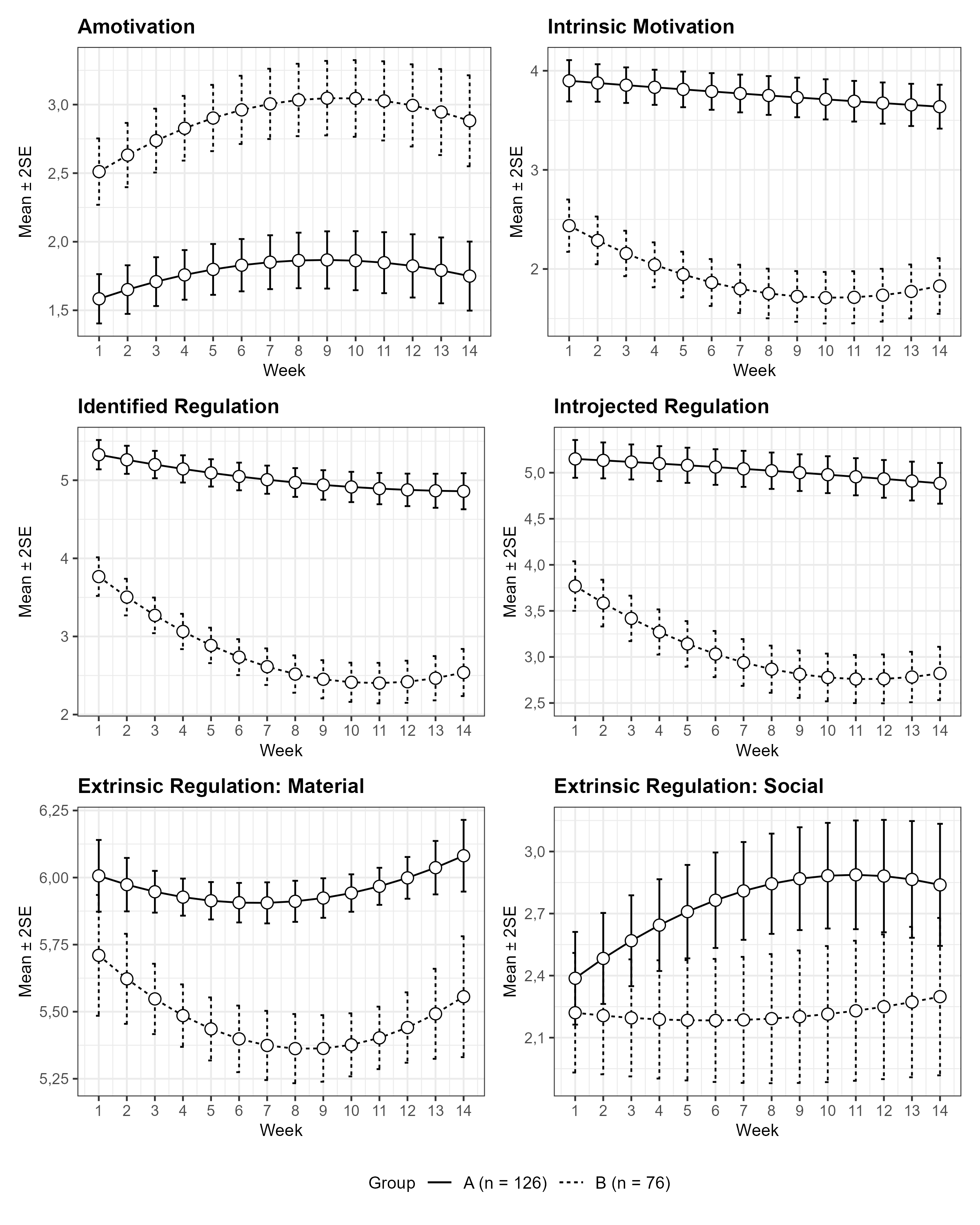
Figure 1. Motivational profiles obtained via longitudinal k‑means clustering.
4. Discussion
The present study sought to examine how motivational trajectories and absenteeism patterns are associated with academic performance in higher education using an intensive longitudinal, person-centered design. The two-profile solution identified in the data is consistent with recent research showing that students tend to cluster into distinct motivational constellations rather than differing only in degree along a single dimension (Guay et al., 2021; Wietrak, 2022). In the present case, the most salient contrast was between a more self-determined group, characterized by higher intrinsic and internalized motivation, and a more amotivated group.
This distinction was not merely theoretical, as profile membership was meaningfully associated with students’ day-to-day academic functioning. Students in the more self-determined profile reported lower absenteeism and higher perceived performance throughout the semester, which is in line with Self-Determination Theory propositions that autonomous motivation supports sustained engagement and adaptive academic behavior (Ryan & Deci, 2017). These findings also converge with prior evidence linking class attendance to academic adjustment and performance (Credé et al., 2010), while extending that literature by showing that absenteeism may be better understood when examined together with students’ motivational development over time.
A noteworthy finding is that profile differences were clearer for process-related indicators, such as perceived performance and absenteeism, than for final grades. This suggests that motivational differences may be expressed more strongly in students’ ongoing academic experience than in endpoint achievement measures alone. Final grades may aggregate compensatory strategies, assessment structures, or contextual constraints that attenuate the observable impact of motivational differences. In this sense, the present results support the idea that academic functioning should be assessed not only through final outcomes but also through repeated indicators that capture how students experience and navigate the semester.
From an applied perspective, the findings suggest that absenteeism should not be treated solely as a disciplinary or compliance issue, but also as a potential indicator of motivational risk. Because the more amotivated profile showed persistently higher absenteeism and lower perceived performance, higher education institutions may benefit from implementing early monitoring systems capable of identifying students whose motivational trajectories place them at greater academic risk. In practice, this could involve short repeated check-ins during the semester, combined with attendance monitoring and brief screening of perceived learning difficulties.
The pattern of absenteeism reasons observed in the more amotivated group also indicates that interventions should not focus exclusively on students as individuals. Some of the factors associated with absenteeism were linked to learning methodology and course planning, suggesting that modifiable instructional features may contribute to avoidable non-attendance. Accordingly, universities and instructors may consider actions such as improving course organization, clarifying workload pacing, diversifying teaching methods, and promoting classroom experiences that strengthen students’ sense of autonomy, relevance, and competence.
Several limitations should be acknowledged. First, the sample cannot be considered fully representative of the broader student population invited to participate, as the response rate raises the possibility of self-selection bias. Second, although longitudinal k-means was appropriate for detecting trajectory-based subgroups in this context, alternative latent variable approaches such as growth mixture modeling or latent profile analysis may reveal additional nuances in motivational development. Future research should replicate these findings with larger samples and complementary modeling strategies, while also examining whether early profile detection can be translated into effective preventive interventions.
5. Conclusions
This study shows that motivational trajectories across the semester are meaningfully linked to absenteeism and students’ perceived academic functioning in higher education. By adopting an intensive longitudinal and person-centered approach, the study moves beyond static descriptions and highlights how motivation develops over time in a naturalistic university setting.
The findings indicate that students with more self-determined motivational profiles tend to report lower absenteeism and better perceived performance, whereas more amotivated students appear to be at greater academic risk during the semester. Although these differences were not reflected in final grades, they were clearly visible in process indicators that capture students’ ongoing academic experience.
From a practical standpoint, the results suggest that absenteeism prevention may be strengthened by combining attendance monitoring with early identification of motivational-risk profiles. Interventions should address not only students’ individual engagement, but also modifiable aspects of course design, teaching methodology, and academic planning that may contribute to avoidable non-attendance.
References
Credé, M., Roch, S. G., & Kieszczynka, U. M. (2010). Class attendance in college: A meta‑analytic review of the relationship of class attendance with grades and student characteristics. Review of Educational Research, 80(2), 272–295. https://doi.org/10.3102/0034654310362998
Gabriel, A. S., Podsakoff, N. P., Beal, D. J., Scott, B. A., Sonnentag, S., Trougakos, J. P., & Butts, M. M. (2019). Experience Sampling Methods: A discussion of critical trends and considerations for scholarly advancement. Organizational Research Methods, 22(4), 969–1006. https://doi.org/10.1177/1094428118802626
Genolini, C., & Jacqmin‑Gadda, H. (2013). Copy Mean: A new method to impute intermittent missing values in longitudinal studies. Open Journal of Statistics, 3(04A), 26–40. http://dx.doi.org/10.4236/ojs.2013.34A004
Genolini, C., Alacoque, X., Sentenac, M., & Arnaud, C. (2015). kml and kml3d: R packages to cluster longitudinal data. Journal of Statistical Software, 65(4), 1–34. https://doi.org/10.18637/jss.v065.i04
Leiva, D., Wietrak, E., & Navarro, J. (2020). Longitudinal clustering of motivational trajectories: A non‑parametric person‑centered approach. Proceedings of the 9th European Congress of Methodology, Valencia. https://adeit‑estaticos.econgres.es/20_EAM/Posters/47655_DavidLeiva.pdf
Litalien, D., Gillet, N., Gagné, M., Ratelle, C. F., & Morin, A. J. (2019). Self‑determined motivation profiles among undergraduate students: A robust test of profile similarity as a function of gender and age. Learning and Individual Differences, 70, 39–52. http://doi.org/10.1016/j.lindif.2019.01.005
Morin, A. J. S., Bujacz, A., & Gagné, M. (2018). Person‑centered methodologies in the organizational sciences: Introduction to the feature topic. Organizational Research Methods, 21(4), 803–813. https://doi.org/10.1177/1094428118773856
Navarro, J., Wietrak, E., & Leiva, D. (2024). Escala Multidimensional de Motivación Académica (EMMA). Working paper, University of Barcelona.
Ryan, R. M., & Deci, E. L. (2017). Self‑determination theory: Basic psychological needs in motivation, development, and wellness. New York, NY: Guilford Press. http://doi.org/10.1521/978.14625/28806
Triadó‑Ivern, X. M., Aparicio‑Chueca, P., Guàrdia‑Olmos, J., Peró‑Cebollero, M., & Jaría‑Chacón, N. (2013). Empirical approach to the analysis of university student absenteeism: Proposal of a questionnaire for students to evaluate the possible causes. Quality & Quantity, 47, 2281–2288. https://doi.org/10.1007/s11135-011-9654-3
Triadó‑Ivern, X., Aparicio‑Chueca, P., Elasri‑Ejjaberi, A., Maestro‑Yarza, I., Bernardo, M., & Presas Maynegre, P. (2020). A factorial structure of university absenteeism in higher education: A student perspective. Innovations in Education and Teaching International, 57(2), 136–147. https://doi.org/10.1080/14703297.2018.1538896
Wietrak, E. (2022). Trajectory‑based motivational profiles and performance: Evidence from the academic context (Doctoral dissertation, University of Barcelona). http://hdl.handle.net/10803/689221
Zhao, Z., Deng, P., & Zhou, J. (2022). Identifying longitudinal attendance patterns through student subpopulation distribution comparison. Proceedings of the 15th International Conference on Educational Data Mining, 640–646. https://doi.org/10.5281/zenodo.6853034