Beyond Classrooms: Key Drivers of Civic Engagement among University students
University students’ social responsibility and civic engagement
Beyond Classrooms: Key Drivers of Civic Engagement among University students
Aya Taloaie1,
Hind Lebdaoui1
 ,
Youssef Chetioui1,2
,
Oumaima Banani1
1School of Business Administration, Al Akhwayn University in Ifrane, Morocco, 2University of Salento, Lecce, Italy.
How to cite: Taloaie, A.; Lebdaoui, H.; Chetioui, Y., Banani, O. (2026). Beyond Classrooms: Key Drivers of Civic Engagement among University students. In: 12th International Conference on Higher Education Advances (HEAd'26). Valencia, 15-18 June 2026. https://doi.org/10.4995/HEAd26.2026.21721
Abstract
The current research aims to examine the antecedents of civic engagement and social responsibility among Moroccan university students. Based on the social learning theory, an integrated model incorporating the key drivers of civic engagement among university students was developed. Data from 182 students from heterogeneous socioeconomic and cultural backgrounds, and the conceptual model was analyzed using the Partial Least Squares Structural Equation Modeling (PLS-SEM). Results reveal that academic performance, motivation, economic citizenship, social norms, and community connectedness influence civic engagement and social responsibility. Parental civic education, and student civic education were on the other hand not irrelevant. These results highlight the crucial role that prosocial norms play in fostering civic behaviors among emerging leaders. Higher education institutions seeking to promote civic engagement should consider leveraging high-achieving students as role models and peer influencers.
Keywords: Civic Engagement; civic education; Prosocial Norms; parental norms.
1. Introduction
Innovative programs that promote civic involvement and social responsibility are being offered by universities all around the world. These initiatives cover presidential directives, curriculum changes and the culture of the campuses, which all work towards rediscovering the main purpose of higher education which is to produce graduates that are responsible citizens, able to lead and contribute positively to their communities and workplaces (Jacoby et al., 2009). These efforts are a good indication of a new institutional effort towards enhancing students’ civic-mindedness and civic participation. Educational institutions have long been recognized as critical platforms of development of civic spirit and movement as the pillars of growth of an informed and active citizen realm.
Prior literature has emphasized the importance of formal education about civics and student engagement in both curriculum and extra-curriculum activities in the establishment of civic outcomes (Reichert and Print, 2017). Without inculcation of civic engagement values, students are not able to obtain understanding and grasp skills that empower them in responding to demands of the society (Owusu Agyeman & Fourie Malherbe, 2019). Students can recognize social responsibility when they participate in charitable events and volunteer activities and it is the concept that is predominantly based on business and organizational research but has grown in relevance concerning the study of higher education in recent times (Berei, 2020). The social responsibility has been explained as a foundation of economic, environmental and social sustainability, which in effect impacts general societal welfare and livelihood (Fonseca et al., 2020). This duty is a part of behaviors and personality of responsible citizens and it helps create the stable and cohesive society. The question of civic engagement among Generation Z students cannot be properly understood without analyzing their general civic trends in this generation. Although the role of this population has increased significantly, the literature on the topic of generation Z and civic behavior is rather scarce, which poses an acute gap in the literature. Social responsibility and civic engagement, although closely related, represent distinct constructs.
Social responsibility refers to an internalized moral disposition characterized by a sense of duty, ethical concern, and commitment to societal well-being. In contrast, civic engagement reflects the behavioral expression of these values through active participation in community service, volunteering, and civic or political activities. In this study, social responsibility is conceptualized as an antecedent psychological disposition that facilitates civic engagement as observable social action. To address the previously mentioned gaps, the current study examines the key determinants of economic citizenship and civic participation among the students of the university of Moroccan Generation Z. In particular, the paper will analyze the functions of civic education, social responsibility, motivation, and connectivity and also check the mediating role of the peer norm, academic performance, and provision of support. Accordingly, this research seeks to address the following questions:
RQ1: What drives students’ social responsibility behavior in higher education in Morocco?
RQ2: Does students’ social responsibility behavior translate into greater civic engagement?
The subsequent sections of this paper are structured in the following manner: section 2 provides an overview of the literature and the development of hypotheses, section 3 describes the research methodology, section 4 analyzes the findings and section 5 the practical implications.
2.Literature review
2.1. Theoretical foundations
This study integrates Social Learning Theory (SLP) (Bandura, 1977) with Self-Determination Theory (Deci & Ryan, 2000) to develop a comprehensive conceptual framework. Accordingly, civic behaviors develop primarily through observational learning and social reinforcement rather than through formal instruction. This theoretical perspective may allow us to test whether prosocial friend norms contribute the civic engagement as a substitute or complement to civic values taught within the classroom, as students only adopt those behaviors they see rewarded in the immediate social circumscription. The Self-Determination Theory or SDT (Deci and Ryan, 2000), which is an extension of SLT, assumes that learners are more involved when their intrinsic needs of autonomy, competence and relatedness are met. This dimension is often completely overlooked by the current emphasis on traditional civic education. In this light then we would argue that the need to foster the intrinsic motivation of students should be pre-empted.
Taken together, SLT and SDT provide complementary explanations of civic behavior development. SLT explains how civic norms and prosocial behaviors are acquired through observation, modeling, and peer influence, whereas SDT explains why these behaviors are sustained when students experience autonomy, competence, and relatedness. The integration of both theories therefore allows civic engagement to be understood as simultaneously socially learned and intrinsically motivated.
2.2 Hypotheses development
Academic achievements lead to the greater socioeconomic development based on the development of skilled human capital (Kumar et al., 2021). It is shown that the higher the academic achievement, the greater the personal and social responsibility (Carbonero et al., 2015) and civic engagement (Ramdass and Zimmerman, 2022). Volunteer involvement and extra-curricular activities in undergraduate education have been attributed to lifetime benefits in academic and career paths, including higher education and attendance at graduate-school (Rosenbaum, 2020). All these studies imply that civic engagement has a strong connection with academic achievement. As a result, the hypothesis below is postulated:
H1. Academic performance affects students’ social responsibility
Civic education is widely acknowledged as fundamental to cultivating social responsibility, active citizenship, and democratic values in students (Lanyohan, 2025). It encompasses formal education and informal learning experiences based on active citizenship and supporting democratic values (Pietrzyk, 2013). College institutions have been escalating their focus on opportunities of civic engagement as part of undergraduate studies so as to develop leadership skills and raise socially responsible erudite citizens of the world (Whitley & Yoder, 2015). One of the most notable approaches is with credit carrying service-learning courses where students are exposed to organized community service programs. Experiences allow the participants to enhance their understanding of course content, enhance the disciplinary outlook, and crowdfirm personal values and a sense of civic responsibility (Coelho and Menezes, 2021). Universities are increasingly recognized as institutions responsible not only for knowledge transmission but also for the cultivation of democratic citizenship. Recent discussions highlighted by Times Higher Education emphasize that universities owe society the preparation of graduates capable of ethical reasoning, civic participation, and responsible leadership (Times Higher Education, 2023a; 2023b). While substantial literature acknowledges the role of education in shaping responsible citizens, empirical evidence remains limited in the context of Moroccan Generation Z students, thereby justifying the need for the present research. Therefore, we presume that :
H2. Civic education positively influences students’ social responsibility.
The community connectedness refers to the personal sense of belonging and relatedness among individuals to their local community (Lenzi et al., 2025). Whereas the definition of communities might differ depending on the situation, the current research assumes a very broad and inclusive approach to the definition of communities, where a community is a similarity between the group members.Recent scholarship has expanded the concept of resilience to encompass multiple socioecological levels, including individuals, families, and communities (Bowling et al., 2020). Contemporary socioeconomic realities profoundly influence how young people comprehend global challenges, prepare for economic participation, and fulfill their social responsibilities (Harris, 2014). Hence :
H3. Community connectedness positively influences students’ social responsibility.
Economic citizenship focuses on the social and civic entitlements that are associated most generally with economic independence (Brodkin, 2014). Civic literacy and civic education have at their core, the concept of citizenship to include what citizens should know and be able to do. However, the concept of effective citizenship is subjective and oftentimes implies a wide variety of beliefs and components. Citizenship can be operationalized through three distinct frameworks: personally-responsible citizenship emphasizes rule compliance and altruistic behavior; participatory citizenship involves active engagement in democratic processes such as voting and political advocacy; and justice-oriented citizenship calls for critical examination of social issues to identify areas requiring reform (Bentahar & O'Brien, 2019).This brings us another perspective that leads to our next hypothese:
H4. Economic citizenship positively influences students’ social responsibility.
Van Matre et al., (2025) argue that's aligning civic education with students’ psychological needs for competence, autonomy, and relatedness can gradually transform extrinsic motivations into more substantive, ethically driven engagement. By participating in a Service-learning program, students’ prosocial behavior can be nurtured once they are appropriately motivated and supported (Lai & Hui, 2020). Therefore, the following hypothesis has been developed :
H5. Student’s motivation moderates the relationship between students’ social responsibility and civic engagement, such that the relationship is stronger when student motivation is high.
Numerous studies have shown that youth who indicate a high civic engagement level are also most likely to have their parents, with a higher civic engagement level (White and Mistry, 2015). This fact highlights the great role of family in the social responsibility of the students as well as indicating that the impact of the family might not always bring positive results. In some situations, familial socialization may have negative impact on the civic participation of youth; families with high socialization are more inclined to raise lowly socialized children. People who are highly reliant on the family with all their needs are thus unlikely to engage in political or socially oriented activities (Whitley and Yoder, 2015). Individual Social responsibility (ISR) is to be seen as an attitude and not a simple respect towards rules (Rodrigo-Gonzalez and Caballer-Tarazona, 2015). Besides, among adolescents, higher rates of local responsibility are also observed among those whose parents record greater rates of local civic responsibility (Lenzi et al., 2025). The hypothesis is therefore the following:
H6. Parent civic engagement positively influences students’ social responsibility.
Social norms are shared rules and expectations that guide individuals’ behavior and define what is considered acceptable within a society. Beliefs about social responsibility are “a set of prosocial values representing personal commitments to contribute to community and society” (Pastor et al., 2024) and are shaped by social environments, including family, peers, educational institutions, and culture. Social norms strongly influence since individuals are not only driven by personal interests, but also by the need to act accordingly to meet the expectations of their society, thus enhancing acceptance or avoiding punishment (Siu et al., 2012). In the framework of tertiary education, students are presented with the references of norms stemming out of peer interaction, school ethos and extra-curricular activities that helps to sustain civic-minded attitudes. As such, whereby social responsibility is proactively being advocated in the environment in which a student is situated in, people will have an increased likelihood to internalize the said norms and convert it into responsible behaviors. Consequently:
H7. Prosocial friend norms positively influence students’ social responsibility.
The operationalization of social responsibility is based on internalized ethics to behave in the manner that enhances other and societal wellness (Yildirim et al., 2001). This construct is the expression of the moral responsibility of a person and his or her responsibility towards social, economic, and civic problems. In the context of higher education, social responsibility is developed in both formal and informal learning processes that make the students reflect upon societal issues and their future attempts in alleviating them. It has been empirically established that the overall civic education results in the strengthening of the sense of social responsibility in students (Lanyohan, 2025). Students engaged in civic-oriented curricula and experiential learning demonstrate higher levels of community engagement, ethical awareness, and active citizenship. These experiences provide knowledge of societal issues and cultivate values, attitudes, and skills that promote responsible, prosocial behavior. Therefore, civic education is expected to positively influence students’ internalization of social responsibility, leading to the following hypothesis:
H8. A student’s social responsibility positively influences their civic engagement.
Based on the above, the current research suggest the conceptual model in Figure 1.
3. Methods
A Structured questionnaire was distributed to the students of different Moroccan universities and 182 responses were valid and used. The sample included both female and males (59.9 % Female and 40.1 % Male). Regarding the age, the range of 20 - 21 years old was the most frequent (42.9 %), followed by 22 - 23 years old (26.9 %), then 18 - 19 years old (17.6 %), then 24 years old or older (11.5 %) and younger than 18 years old (1.1 %). Most frequent responses were from students who are involved in business administration (56.59 %), followed by science and engineering students (17.03 %), then human and social sciences students (14.84 %), then medical studies students (6.04 %), and law and/or Political science students (5.49 %).
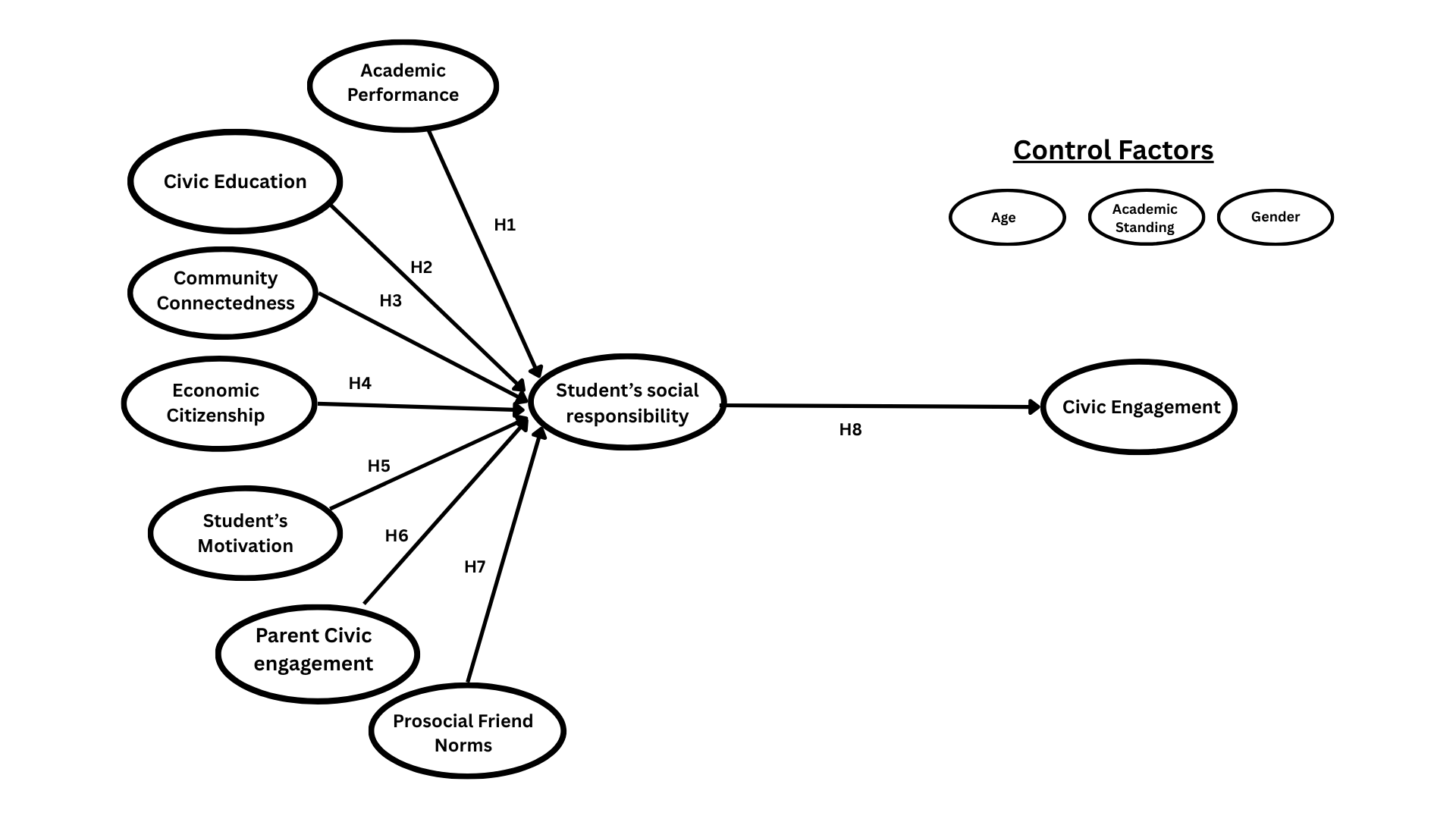
Figure 1 Conceptual model
4. Measurement Model
4.1. Assessments of a measurement model
This study employed structural equation modeling (SEM) as the study aims to explore predictive relationships within a complex conceptual framework involving multiple latent constructs and moderating effects. Beyond its robustness to non-normal data distributions commonly observed in Likert-scale responses, PLS-SEM is particularly appropriate for exploratory theory development and prediction-oriented research designs. Initially, we evaluated the measurement model to determine the measurement reliability of the indicators, construct reliability, convergent validity, and the discriminant validity. We then hypothesized the structural relationships.
The measurement model was assessed by examining indicator reliability, internal consistency reliability, convergent validity, and discriminant validity. Internal consistency reliability was supported by Cronbach’s alpha and composite reliability values indicating satisfactory reliability across all constructs (Henseler et al., 2009). Convergent validity was confirmed through Average Variance Extracted (AVE) values indicating that each construct explains a substantial proportion of variance in its indicators (Haji-Othman & Yusuff, 2022). Discriminant validity was further evaluated using the Heterotrait–Monotrait (HTMT) ratio, with results supporting clear differentiation among constructs. Overall, these findings provide evidence that the measurement model exhibits satisfactory psychometric properties and is suitable for subsequent structural model analysis. Detailed factor loadings, AVE values, and HTMT matrices are available from the authors upon request.
4.2. Assessments of the structural model
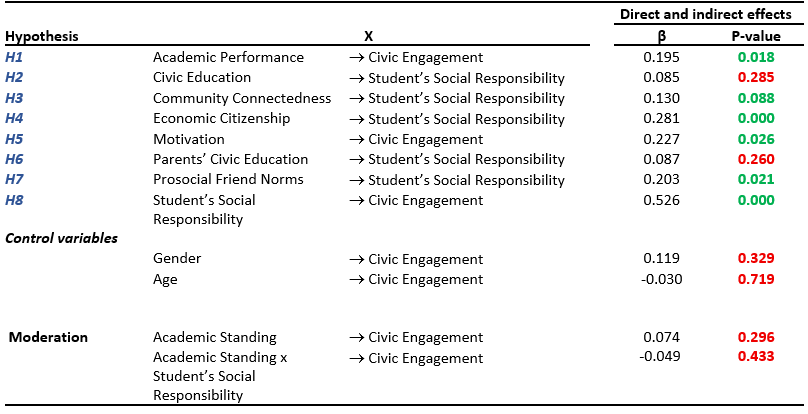
The coefficient of determination (R²) was also evaluated, where values above 0.33 indicate moderate explanatory power (Chin, 1998). The structural model explains 36.8% of the variance in students’ social responsibility and 55.3% of the variance in civic engagement, indicating satisfactory explanatory power of the proposed model. Consistent with prior literature, academic performance positively and significantly predicted students' civic engagement (β = 0.195, p < 0.05), supporting H1. Unexpectedly, civic education exhibited a positive but statistically non-significant relationship with social responsibility (β = 0.085, p > 0.1), failing to support H2. This suggests that formal civic education alone may be insufficient to foster social responsibility among students. Results show that there is a positive and significant relationship between the student’s sense of community connectedness and student’s social responsibility (ß = 0.130; p<0.05), which supports H3. Students with a sense of economic citizenship have a positive and a significance relationship with the student’s social responsibility (ß = 0.281; p < 0.005), supporting H4. With regards of the student’s motivation and its relationship with their behavior towards civic engagement is proved to be positive and significant (ß=0.227, p < 0.05), supporting H5. This concludes that the more the student has, either supported by themselves or due to external factors, the more likely they are willing to participate civically. Surprisingly, the relation between parents’ civic education and the student’s social responsibility is proved to be not significant (ß=0.087; p>0.1), not supporting H6. Some researches argue that if a child does not have a close relationship with parents, it can be identified with family values that are more vulnerable to peer pressure, which negatively influences the child (Saputri & Marzuki, 2021), which can prove why H6 is not significant. Prosocial peer norms is found positively affect students’ social responsibility (β = 0.203; p < 0.05), supporting H7.Finally, students with higher sense of social responsibility tend to have engage in civic engagement (ß = 0.526; p <0.005), supporting H8. Gender, age, and academic standing were included as control variables. Gender and age showed significant effects, whereas academic standing demonstrated only a marginal positive association.
Table 1 Direct and indirect effects
5. Discussions & conclusion
The proposed research builds some relevant theoretical contributions to higher education, civic engagement and social responsibility scholarship, especially in the whole Global South region and in emergent economies. Civic education should be more useful as complementary, but not as a direct factor, behind the social responsibility, and should be integrated as lived civic experience. Conversely, the deep-rooted ramifications of community connectedness, peer prosocial norms and economic citizenship help to shed light on how the social learning and embeddedness of civic orientations get built in terms of their contextual basis. Economic citizenship enhances the current theory of civic engagement by preempting financial confidence and economic agency as yet under-researched antecedents of social responsibility. Civic-engagement triggers need to be more directly getting the economic aspect as well as social and moral considerations. Importance of social responsibility and civic engagement provides the empirical support of structural sequence models, where social responsibility is a key mediating construct mobilizing the values that people have into civic action.
These findings carry several practical implications for higher education institutions seeking to enhance civic engagement. First, given the limited impact of formal civic education, institutions should consider integrating civic learning into experiential, community-based, and peer-led activities. Service-learning programs, community service initiatives, and student organizations may prove more effective in cultivating social responsibility. Universities may operationalize these findings through concrete institutional initiatives such as integrating service-learning modules into disciplinary curricula, establishing peer-mentoring programs that promote civic participation, supporting student-led community engagement projects, and embedding reflective civic learning components within academic courses. Rather than relying exclusively on standalone civic education courses, institutions may benefit from experiential and peer-driven learning environments that encourage active participation and community connectedness. Second, more inclusive campus cultures must be created to encourage a sense of belonging, cooperation, and common civic ideals and that universities should fund mechanisms of developing student groups, mentoring individuals by their peers, and fostering civic engagement. Third, inclusion of financial literacy and economic empowerment programs to the development of a student as economic literacy can stimulate social responsibility and citizenship. last, academic achievement and civic activity should be conceived as complementary, institutions must support and encourage civic participation with credit-caring activities, awards, or even through learning outcomes.
This study is subject to several limitations. First, the cross-sectional design limits the ability to draw causal inferences between variables. Second, the reliance on quantitative survey data may not fully capture the complex, contextual, and experiential nature of civic engagement and social responsibility. These constructs are often shaped by lived experiences and institutional environments that may not be fully reflected in structured questionnaires. Future research could address these limitations by employing longitudinal designs and incorporating qualitative approaches to provide deeper insights into how civic attitudes and behaviors evolve over time.
References
Bandura, A. (1977). Social learning theory. Englewood Cliffs, NJ: Prentice Hall.
Bentahar, A., & O’Brien, J. L. (2019). Raising students’ awareness of social justice through civic literacy. Journal of Social Studies Education Research, 10(1), 193–218.
Berei, E. B. (2020). The social responsibility among higher education students. Education Sciences, 10(3), 66.
Bowling, J., Barker, J., Gunn, L. H., & Lace, T. (2020). “It just feels right”: Perceptions of the effects of community connectedness among trans individuals. PLoS ONE, 15(10), e0240295.
Brodkin, K. (2014). Work, race, and economic citizenship. Current Anthropology, 55(Supplement 9), S116–S125.
Carbonero, M. A., Martín-Antón, L. J., Monsalvo, E., & Valdivieso, J. A. (2015). School performance and personal attitudes and social responsibility in preadolescent students. Anales de Psicología / Annals of Psychology, 31(3), 1069–1076.
Coelho, M., & Menezes, I. (2021). University social responsibility, service learning, and students’ personal, professional, and civic education. Frontiers in Psychology, 12, Article 617300.
Chin, W. W. (1998). The partial least squares approach for structural equation modeling. In G. A. Marcoulides (Ed.), Methodology for business and management: Modern methods for business research (pp. 295–336). Lawrence Erlbaum Associates.
Deci, E. L., & Ryan, R. M. (2000). The "what" and "why" of goal pursuits: Human needs and the self-determination of behavior. Psychological Inquiry, 11(4), 227-268.
Fonseca, I., Bernate, J., Betancourt, M., Barón, B., & Cobo, J. (2020). Developing social responsibility in university students. Proceedings of the 11th International Conference on Education Technology and Computers (pp. 215–218).
Haji‑Othman, Y., & Yusuff, M. S. S. (2022). Assessing Reliability and Validity of Attitude Construct Using Partial Least Squares Structural Equation Modeling (PLS‑SEM). International Journal of Academic Research in Business and Social Sciences, 12(5), 378–385.
Harris, A. (2014). Fostering Global Citizenship and Global Competence: Discussion Paper 2a. International Education Association of Australia. Retrieved from IEAA website.
Henseler, J., Ringle, C.M. and Sinkovics, R.R. (2009), "The use of partial least squares path modeling in international marketing", Sinkovics, R.R. and Ghauri, P.N. (Ed.) New Challenges to International Marketing (Advances in International Marketing, Vol. 20), Emerald Group Publishing Limited, Leeds, pp. 277-319.
Jacoby, B., Musil, C. M., Brown, D. A., & Battistoni, R. M. (2009). Civic engagement in higher education: Concepts and practices. In B. Jacoby (Ed.), Educating students for personal and social responsibility: Civic learning and democratic engagement (pp. 31–48). Association of American Colleges and Universities.
Lenzi, M., Scatolon, A., Carraro, L., Guidetti, M., & Carfora, V. (2025). Civic engagement and prosocial behavior: The role of adolescents' moral, identity, and motivational processes. Current Opinion in Psychology, 65, 102047.
Owusu-Agyeman, Y., & Fourie-Malherbe, M. (2019). Students as partners in the promotion of civic engagement in higher education. Studies in Higher Education.
Pastor, Y., Pérez-Torres, V., Thomas-Currás, H., Lobato-Rincón, L. L., López-Sáez, M. Á., & García, A. (2024). A study of the influence of altruism, social responsibility, reciprocity, and the subjective norm on online prosocial behavior in adolescence. Computers in Human Behavior, 154, 108156.
Ramdass, M., & Zimmerman, A. (2022). Organized civic and non-civic activities as predictors of academic outcomes in adolescence. Journal of Youth and Adolescence.
Reichert, F., & Print, M. (2017). Civic participation of high school students: The effect of civic learning in school. Educational Review, 70(3), 318–341.
Rodrigo-González, A., & Caballer-Tarazona, M. (2015). A model to assess students’ social responsibility behavior within a classroom experiment. Science Direct.
Saputri, R. M., & Marzuki, M. (2021). The role of parents and society in value education and civic education. Jurnal Civics: Media Kajian Kewarganegaraan, 18(2), 268–275.
Siu, A. M. H., Shek, D. T. L., & Law, B. (2012). Prosocial norms as a positive youth development construct: A conceptual review. The Scientific World Journal, 2012, 1–7.
Times Higher Education. (2023a). Universities owe it to society to produce good citizens. https://www.timeshighereducation.com/campus/universities-owe-it-society-produce-good-citizens.
Times Higher Education. (2023b). The best way to market a university is to start with its students. https://www.timeshighereducation.com/campus/best-way-market-university-start-students.
Van Matre, J. C., de Wit, A., & Demeijer, F. (2025). Can business students become responsible citizens? Enhancing civic motivation through need-supportive design of civic education. Journal of Business Ethics.
White, E. S., & Mistry, R. S. (2015). Parent civic beliefs, civic participation, socialization practices, and child civic engagement. Applied Developmental Science, 20(1), 44–60.
Whitley, C. T., & Yoder, S. D. (2015). Developing social responsibility and political engagement: Assessing the aggregate impacts of university civic engagement on associated attitudes and behaviors. Education, Citizenship and Social Justice, 10(3), 217–233.