Strategic presence? Factors students weigh when deciding on lecture attendance
Strategic presence? Factors students weigh when deciding on lecture attendance
Strategic presence? Factors students weigh when deciding on lecture attendance
Marian Hurley1
 ,
Deirdre Casey2
1Department of Marketing and International Business, Munster Technological University, Ireland, 2Department of Mathematics, Munster Technological University, Ireland.
How to cite: Hurley, M.; Casey, D. (2026). Strategic presence? Factors students weigh when deciding on lecture attendance. In: 12th International Conference on Higher Education Advances (HEAd’26). Valencia, 15-18 June 2026. https://doi.org/10.4995/HEAd26.2026.21722
Abstract
This paper presents findings from a project conducted at an Irish university with the aim of understanding and initiating responses to the reported crisis of learner engagement in Higher Education. Here, we focus on both quantitative and qualitative data on learners’ views on the importance of attending lectures. We further evaluate qualitative data focussed on the factors learners may weigh when deciding whether or not to attend a lecture. We find that attendance is considered to be highly valuable in theory, but that pragmatic and pedagogical matters may act as blocks to being present at lectures. We argue that responding to declining on-campus engagement will necessitate comprehensive re-evaluation of the traditional “shape” of Higher Education programmes, but also of the nature of scheduled learning events.
Keywords: Student engagement; lecture attendance; decision-making; interaction.
1. Introduction
Since September 2024, we have been conducting research on what has been characterised across scholarship and media alike as a crisis of learner engagement in Higher Education. Funded by the Higher Education Authority’s National Forum for the Enhancement of Teaching and Learning under its Strategic Alignment of Teaching and Learning Enhancement (SATLE) fund, our ongoing study is being conducted at Munster Technological University, Ireland, and aims to uncover the socio-cultural, socio-political, socio-economic, and other factors currently shaping learners’ concept of ‘being-a-student’ and how these influence their levels of attendance at and engagement in their programmes of study.
During the pilot phase of our work (2024-25), we employed multiple methods to learn about students’ concepts of the ‘role’ of student and about how they enact this role. We elected to use time devoted to learning, study and assessment activities as a conceptual frame for this measurement, and devised research instruments which addressed (1) time spent in lectures; (2) time spent on independent study outside of the university timetable; and (3) usage of time between scheduled lectures. These instruments were a 36-item survey comprising both quantitative and qualitative questions and a semi-structured interview guided by nine prompts. In the cases of both research instruments, an invitation to participate was shared with all students of the university via email. 390 students completed the survey and 18 were interviewed, with interview participants selected using convenience sampling according to a demographic profile of the entire university population.
Here, we evaluate data gathered in relation to the first of these time types. The paper aims to elucidate contemporary students’ strategic thinking in relation to which lectures should be attended and which might not, and to situate these decision-making processes in their socio-cultural context rather than as simple functions of economic or pragmatic constraints. Although the work is anchored by quantitative insights, our approach is fundamentally phenomenological and interprets learner data through the lens of the social theory of technologically mediated temporal acceleration. We show that while a majority of students report believing that attendance at lectures is important and has compelling benefits, a range of barriers can prevent them from doing so. Additionally, our interview data show an emerging trend toward strategic weighing of the relative importance of different lectures and/or modules. We argue that these insights – to be augmented in the second phase of our project – can provide timely strategic guidance on reimagining the campus experience for a changing cohort.
2. Methods
Conducted with the approval of our university’s Human Research Ethics Committee (MTU-HREC-MR-24-046-A), our pilot project aimed to yield both quantitative and qualitative insights into contemporary learners’ experiences of inhabiting the ‘occupation’ of student. Our survey was administered and our interviews were conducted in early 2025 and analysis took place over the remainder of the 2024-25 academic year.
The survey comprised 25 quantitative items and 11 qualitative ones, with all items targeting learners’ views on one of the three study time types outlined above. The nine-question frame which guided semi-structured interviews featured three prompts related to each of the time types. As such, we have been able to establish a robust overview of various paradigms of contemporary studenthood. Importantly, all five of the university’s faculties were represented in both the survey and the interview data.
All qualitative data was analysed using reflexive thematic analysis. Both authors completed data familiarisation and first coding independently before convening to reconcile first-draft codes. Intercoder similarity was sufficiently high that final code frames were constructed at this point. Both coders reapplied the agreed frames and a close-to-identical application was found in their second comparison. On the basis of the reapplied coding frames, and in relation to both sets of data, a set of themes encompassing multiple themes each was identified.
3. Literature review
The phenomenon of declining lecture attendance has been attributed to a range of factors, perhaps most notably to the disruption of “class as usual” by the Covid-19 pandemic. However, it is unlikely that this temporal disruption alone adequately explicates the downward trend in on-campus engagement. For instance, Oldfield et al. (2019) have highlighted the role of a growing sense of anonymity among Higher Education learners as a block to their formation of a sense of belonging. It can reasonably be surmised that the proliferation of asynchronous and despatialised elements such as the ubiquitous Learning Management System (LMS) may weaken the “pull” of campus significantly.
Indeed, a consensus appears to be emerging that we have, to date, overestimated the significance of factors such as paid employment and travel times and distances, although these certainly do feature prominently among our students’ stated attendance barriers. Sloan et al. (2020) have found little causative connection between these factors and learners’ campus engagement. In fact, a minority trend in the literature calls for the university to provide on-campus employment options for students in order that word-related barriers could be minimised (Remenick & Bergman, 2021).
While our study supports the previous findings reported above, one area in which our data contrast with existing literature is the impact of the availability of learning materials via the LMS. Although Grabe et al. (2004) highlighted a link between this availability and lower attendance, Sloan et al. (2020), in their more recent work, find the two phenomena to be largely independent of each other. Our qualitative data, in particular, would appear to support the hypothesis that access to materials via the LMS is afforded significant weight in students’ decision-making regarding lecture attendance.
That the “any-time” accessibility enabled by the LMS has a negative impact on lecture attendance is further supported by critiques of the concept of flexibility in Higher Education. Bunn et al. (2019) have critiqued the individualisation which attends this flexibility, recalling the growing sense of alienation from and anonymity within the learning experience of contemporary students.
Generative artificial intelligence (GenAI) was not frequently raised by our respondents and interviewees as a significant factor in their lecture (non-)attendance; however, given its frequent characterisation as a time-saving and efficiency-enhancing device, it would be naïve to overlook its impact on declining university attendance, especially since this latter is a decidedly temporal matter. Hou (2025) has aptly observed that GenAI effectively collapses the temporal gaps between beginning to learn something and ultimately knowing or understanding it. This implies a cultural valorisation of the instantaneous, which can only disincentivise participation in time-intensive learning events. If we heed a freshly relevant social theory of time, however, we will recognise that the drive to speedy (even instant) results precipitates overwhelm and, consequently, inertia (e.g. Virilio, 1998; Rosa, 2016).
4. Findings
Both our quantitative and qualitative survey findings indicate that students believe attendance at lectures to be important. Figure 1 captures learners’ responses to a quantitative item requiring them to indicate, on a Likert scale spanning “strongly agree” to “strongly disagree”, their reactions to the statement “it is important to attend all your scheduled lectures.” Strikingly, 85% of responses tend to agreement, with just 15% residing on the disagreement side of the scale.
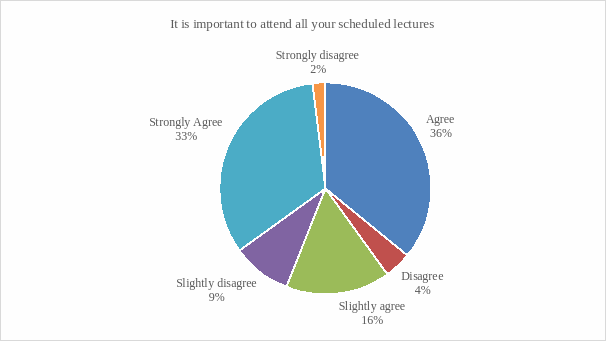
Figure 1. Student responses on how important they believe it is to attend all scheduled lectures
This strong belief that lecture attendance is important is borne out by our classification into themes of qualitative survey data on its benefits. Table 1 shows the five codes connected to the theme of attendance benefits. For each, an indicative response has been included. Perhaps the most critical observation from this grouping of codes is that the primary advantages are social and interactions with peers and lecturers make the strongest argument for in-person engagement. Notably, even the ‘learning and focus’ code, which arguably diverges somewhat from the social theme, does point to value derived from active learning.
Table 1. Key narratives regarding benefits of face-to-face lecture time, based on qualitative survey data, and with an indicative response per theme.
Engagement and Interaction |
Asking Questions |
Rapport and Connection |
Learning and Focus |
Social |
“I feel more engaged…I like being in a class physically with other students” |
“If u have a questions [sic.] it’s the quickest way to get an answer right there and then” |
“I think the real benefit of face to face is the lecturer having a connection with you and understanding your level of understanding” |
“Learning is more active / helps you realise what you don't understand or remember. Prevents getting left behind content wise.” |
“It allows you to interact with peers and helps us all socially.” |
The situation is not straightforward. Figure 2 shows answers to a qualitative survey question on common reasons why students might miss a lecture. While this is not evidence of an attendance crisis, it does demonstrate the variety of factors that could disincentivise attendance.
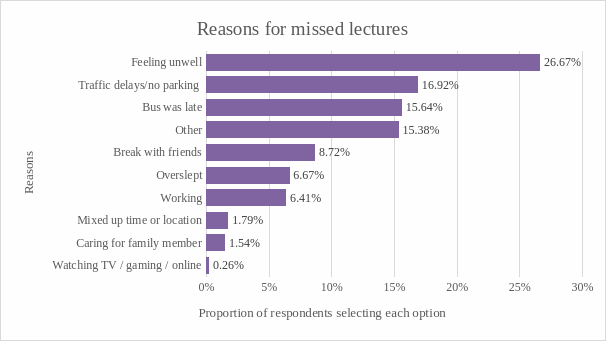
Figure 2. Student responses on typical reasons why they might miss lectures.
Notably, the most common response to this item relates to feeling unwell. The proportion of respondents choosing this option is surpassed only by commuting-related issues, and it dwarfs work commitments, recalling the problematisation of simplistic explanations for low attendance noted in the literature review. It is important to note that we did not ask students to differentiate between physical and mental wellbeing here, and this was an unanticipated design flaw which will be addressed in a second iteration of the data collection process to be carried out in 2026.
Table 2. Interview responses on strategic decision-making regarding lecture attendance by sub-theme (number of responses per sub-theme indicated between parentheses).
Being ‘smart’ about attendance (2) |
And a lot of them told us, “Oh no, you don't need to go to class because you have all the notes online so it's just a waste of time to go to class and listening to a teacher just reading the PowerPoint.” And yeah, their favourite sentence was “it's just about being smart.” I have some friends…they have, like, two jobs so it's difficult for them to attend class so they try to go to the ones that they think are the most important or they don't have all the content on Canvas. |
The class is too easy to merit attendance (2) |
So either if a class is perceived as “that's too easy now, I won't…I won't need to attend that, I can…I can catch up on my own” or if the lecturer doesn't have a very kind of interactive style, people just skip the class altogether, right? I go to nearly every lecture, but [some people] would think that they don't need to… If it was up on Canvas that some teachers just read it off the board so you can do that yourself at home. |
Doing assignments or exam prep for other modules (2) |
Sometimes if there's, like, a big assignment on a day then some people might take a class off to get that assignment done. I would say around exam time…when we have something more…like an exam would take priority, you know, over the lecture, so we'd go study instead of attending the lecture. |
Not liking the class / module and lecturer engagement level (4) |
Maybe they didn't like the class or something. A lot of modules…it depends on what the…topic might be. People find that…a bit less interesting. If I were to make a recommendation from a student perspective…I’d increase the engagement in lectures if possible. If…there was a criteria [sic.] that had to be met or something similar. I never missed those lectures because I thought that they were actually really engaging, really beneficial. And if you if you weren't there, you would fall behind in a kind of a sense, if you understand what I mean. |
While the qualitative data on non-attendance suggests a range of common barriers to on-campus engagement, interview data provides a more nuanced understanding of the decision-making process which students can engage in when weighing whether or not to attend a lecture. It also illustrates the conceptual gap between the intention indicated by figure 1 and the translation of that intention to action. Above, we have collated interview responses which point to common reasons why students elect not to attend a lecture. It is notable that in all cases, interviewees comment on the tendencies of other students not to attend for strategic reasons. Nonetheless, the observations are framed as behaviours they have observed among their peers.
It is clear that the LMS is a significant influencing factor in this decision process, particularly where external pressures are already at play. However, consonant with table 1, the data collated in table 2 point to the social and interactional quality of the lecture as a key indicator of the value or necessity of attending. “Engaging” lectures are clearly considered a higher value proposition than those involving passive learning.
Notwithstanding this, pragmatic balancing of competing demands is not insignificant in the decision-making process. This is particularly evident from those responses that acknowledge that lecture attendance may sometimes need to be sacrificed to accommodate assignment completion. This points to a possible need to re-envision the Higher Education degree programme such that account is taken at the programme level of the number, weight, and timing of assessment events.
5. Discussion and conclusions
Our findings suggest that it may now be apt to consider how we as educators view the intrinsic value of presence at scheduled learning events such as lectures and laboratory sessions. While it is not in doubt that growing financial precarity and the social challenges to which it gives rise are a considerable block to learners’ full engagement with their on-campus learning activities, it is also increasingly clear that prevailing socio-cultural norms are reshaping how students think about the value of these activities. Our qualitative data, in particular, point to a trend toward isolated and individualised study, driven by ubiquitous asynchronous learning non-places (Augé, 1992). Furthermore, the cultural shift toward instantaneity poses an additional challenge to incentivising the temporal persistence required to engage fully in the events of a full lecture timetable. Sectoral responses to declining attendance will undoubtedly require systemic change, but in the interim, it would appear that module-level change might best be led by pedagogically foregrounding interaction and engagement.
Perhaps more importantly, though, if we are to identify paths forward which preserve the centrality of the in-person learning event to the Higher Education environment while accommodating socio-cultural change, we may need to ask more fundamental questions regarding the nature and construction of our programmes. As we have highlighted above, contemporary students appear constantly to be weighing benefit against perceived cost, making trade-offs between lectures and, for instance, competing assignments or other priorities. Noting, again, the ubiquitous wish for active engagement will be of particular value in determining how the perceived benefits can come to outweigh the perceived costs. Additionally, our qualitative data suggest that balancing presence against independent tasks including assessment may be pivotal. As such, system(at)ic attention to the implementation of programme-level assessment and the management of over-assessment is likely merited.
It is imperative to note that we do not advocate for capitulation to the demands of high-speed consumer society. To accommodate such developments could only further alienate learners from their learning, their peers, and their universities. Instead, we highlight the emphasis placed by our survey respondents and interviewees on the social and interactional benefits of lecture attendance, and their resounding agreement that, in theory at least, attendance is valuable and important. While acceleration may be inevitable until it is no longer sustainable, modelling human(e) capacities in critical and social learning environments is more fundamentally important than it has ever been. The ultimate challenge may reside in making presence a realistic possibility both a realistic possibility and an attractive proposition.
References
Augé, M. (2023, 1992). Non-Places: An Introduction to Supermodernity, John Howe (trans.). London and New York: Verso.
Bunn, M., Bennett, A., & Burke, P. J. (2019). In the anytime: Flexible time structures, student experience and temporal equity in higher education. Time and Society, 28(4), 1409–1428. https://doi.org/10.1177/0961463X18787649
Grabe, M., Christopherson, K., & Douglas, J. (2004). Providing introductory Psychology students access to online lecture notes: The relationship of note use to performance and class attendance. In Journal of Educational Technology Systems, 33(3), 295-308. https://doi.org/10.2190/G5RF-DMWG-WV1G-TMGG
Hou, Y. (2025). What’s the rush? Temporality, anxiety, and the pursuit of immediacy with generative AI. In Teaching in Higher Education, 1-11. https://doi.org/10.1080/13562517.2025.2571914
Oldfield, J., Rodwell, J., Curry, L., & Marks, G. (2019). A face in a sea of faces: exploring university students’ reasons for non-attendance to teaching sessions. Journal of Further and Higher Education, 43(4), 443–452. https://doi.org/10.1080/0309877X.2017.1363387
Rosa, H. (2016). Social Acceleration: A New Theory of Modernity, Trejo-Mathys, J. (trans.). New York: Columbia University Press.
Sloan, D., Manns, H., Mellor, A., & Jeffries, M. (2020). Factors influencing student non-attendance at formal teaching sessions. Studies in Higher Education, 45(11), 2203–2216. https://doi.org/10.1080/03075079.2019.1599849
Virilio, P. (1998, 1990). Polar Inertia, Camiller, P. (trans.). London, Thousand Oaks and New Delhi: Sage.