Investigating Affordances of Immersive Virtual Reality for Student Learning and Engagement in Science
Investigating Affordances of Immersive Virtual Reality for Student Learning and Engagement in Science
Investigating Affordances of Immersive Virtual Reality for Student Learning and Engagement in Science
Margaret J. Wegener1
 ,
Stefan Zeppetzauer1
,
Timothy J. McIntyre1
,
John Debs2
1School of Mathematics and Physics, The University of Queensland, Australia, 2Research School of Physics, The Australian National University, Australia.
How to cite: Wegener, M.J.; Zeppetzauer, S.; McIntyre, T.J., Debs, J. (2026). Investigating Affordances of Immersive Virtual Reality for Student Learning and Engagement in Science. In: 12th International Conference on Higher Education Advances (HEAd’26). Valencia, 15-18 June 2026. https://doi.org/10.4995/HEAd26.2026.21733
Abstract
Immersive virtual reality (VR) is an emerging digital technology that offers novel educational affordances in the form of representation and interaction. Our work investigates the effects of immersive VR simulations both in terms of subjective reception of participants as well as quantifiable learning benefits. In particular, we report a mixed‑methods evaluation of VR-based learning activities implemented across multiple university science courses involving over 550 students. These activities generated high student engagement, positive perceptions of helpfulness for learning, and some measurable conceptual gains. We compare immersive VR and comparable flat-screen interactive simulations and find that both types of simulations prompt immediate learning gains on specific conceptual questions. Group‑based implementation of VR supported peer interaction and practice in use of disciplinary-specific language. No disproportionate advantage for students based on prior VR experience or gender was found, supporting immersive VR as an engaging and inclusive learning tool.
Keywords: Immersive virtual reality; VR; simulation; visualisation; conceptual understanding; student engagement.
1. Introduction
Student engagement sits at the heart of successful learning, but the way students engage is changing. Today’s undergraduate university students are not successfully engaged by textbooks and traditional didactic teaching; they increasingly turn to lecture recordings rather than in-person attendance, to online resources, and assessment‑driven study, often at the risk of failing to engage in deep learning. In response, many universities - including ours - have embraced active learning approaches such as flipped classrooms and inquiry-based laboratories. Active learning can be aided by digital resources such as interactive simulations, where students can visually implement concepts, and observe how a system changes when varying key parameters. However, these approaches are limited to the capabilities of two-dimensional screens, and the student is always observing from outside the system.
“Immersive VR” (VR) opens up exciting new possibilities. With Immersive VR, the user is fully immersed in a three-dimensional, real-time and interactive simulation. This can be used to build understanding by linking theory and equations to the phenomena that they describe, through visceral experience and kinesthetic learning. There is an added benefit in that it is possible to present abstract concepts that we usually don’t see, or are very challenging to visualise (e.g. electric and magnetic fields). There is also the opportunity to explore scales ranging from the very small to the very large. In short, students can access otherwise-unfeasible experiences. A truly novel application is that VR can enable students to experience unphysical worlds that manifest their misunderstanding, and thus VR can aid in correcting a student’s conceptual model.
In terms of representations, communicating subject matter, and interactions, immersive VR is fundamentally different in what it can enable the user to do, compared to previous educational aids. Hence, novel benefits to students, in terms of learning outcomes, could be expected, and are beginning to be verified (Acevedo 2024, Antonopoulos 2024, Yu and Xu 2022).
Here we investigate learning in physics using activities centred on immersive virtual realities. Learners can find challenging the abstract and complex nature of some physics concepts, for example, an entity that is invisible, is spread out through space, and varies over time. VR’s dynamic and immersive representations suit addressing such difficulties in understanding.
We ask how immersive VR supports student learning in practice, how it compares with established digital learning tools of flat-screen interactive simulations, and whether its benefits extend across diverse student cohorts.
2. Educational Contexts
Simulation‑based activities were implemented and evaluated across multiple courses, involving more than 550 students. These courses included a core disciplinary course, a service course specifically for students from other disciplines, and a course for pre‑service science teachers. Student participants had varied educational aspirations, backgrounds, prior knowledge, and experience with digital technologies.
Immersive VR was implemented with head-mounted displays and hand controllers. Two VR simulations, developed for the Meta platform at the Australian National University (Debs 2021), were used in this study. The varied characteristics of these simulations are summarised in Table 1. Critically, in both simulations, students have agency and make choices. Both simulations harness elements of gamification. A screenshot from each simulation is shown in Figure 1.
The “Dissonance VR” simulation is designed to enable students to explore forces. It asks students to play with a basketball and decide which of the following forces act on it - gravity, drag from the wind, and also a forward force corresponding to a misconception that a force continues to act on the ball once it has left the thrower’s hand. Students are presented with the world that represents their choice. It therefore can manifest their misconceptions, creating an experience dissonant with the real world, which provokes attention. The activity is voice directed, with students guided towards understanding which forces are truly acting on the ball in the air.
The “Fields VR” simulation provides users with a visualisation of electric and magnetic fields. These abstract concepts are represented by arrows in three-dimensional space. Virtual electric charges can be released at will into the fields to explore their trajectories. This sandbox-style simulation is unguided, with users having access to various electric charge and electric current elements in order to explore a variety of arrangements and their consequences.
Table 1. Characteristics of the VR simulations used in this study.
VR simulation |
Dissonance VR |
Fields VR |
Physics representation |
Realistic + unrealistic (+ misconception)
|
Realistic |
Structure |
Some voice guidance Branching at presented decision points + free play |
Variety of virtual objects available Free play |
|
|
|
Gamification |
Implicit challenges & rewards |
“Shooter” game |
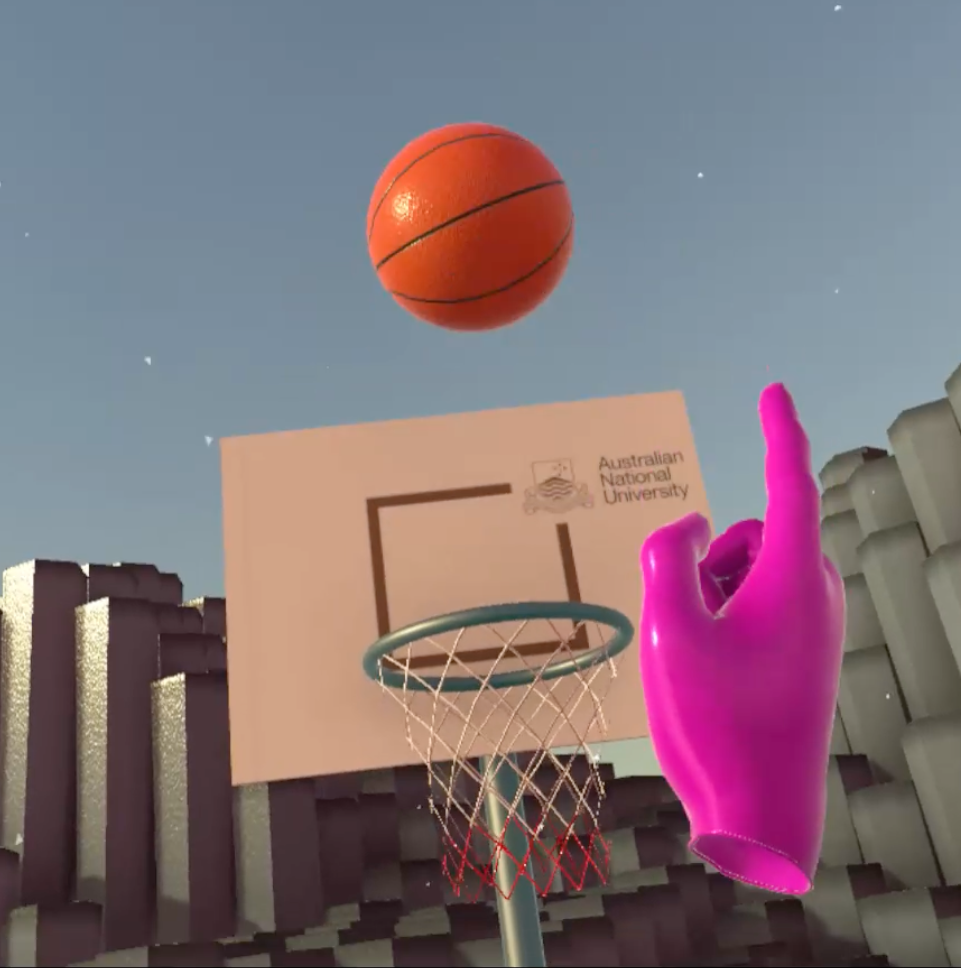
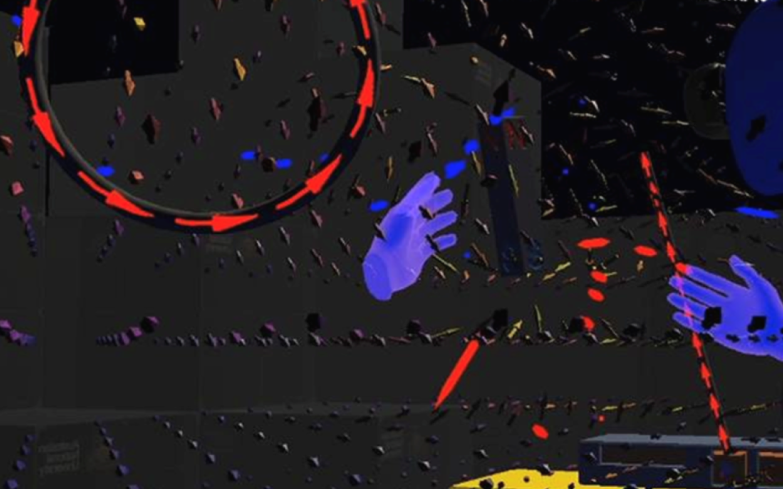
Figure 1. Screenshots from immersive VR simulations: Dissonance VR (left) showing user throwing virtual basketball, Fields VR (right) showing user “shooting” electric charges in magnetic field.
3. Evaluation
To evaluate the learning activities, a mixed‑methods approach was used combining pre‑ and post‑activity concept testing, classroom observations of students, surveys, and reflections of staff. A measure of learning gain was made by comparing the performance of students on concept tests (Physport) immediately before and after use of the simulations. Students were randomly allocated to either using a VR simulation or a two-dimensional interactive simulation. This enabled comparison of the “Dissonance VR” and “Fields VR” simulations with comparable established two-dimensional (2D) interactive simulations - PhET “Projectile Motion” (Wieman et al 2008) and UQ SciMS “Moving Charge” (UQ SciMS), respectively. Some basic demographic information about students and their relevant educational background was gathered via questionnaire. Free-text responses were analysed for recurring themes.
4. Results and Discussion
VR-based activities have been used over multiple semesters. Evaluation results were consistent across repeated iterations. Here we present general findings from our study.
4.1. Student experience
We found, as anticipated, that students were generally excited and interested to use VR. High levels of student engagement with VR activities were consistently observed across all contexts. Engagement was indicated by time on task and by manner.
Students widely reported that they enjoyed the VR activities. In all cohorts, approximately 75% or more of students agreed that the VR format was pleasant to use. This positive affect is notable particularly for the service teaching context, where intrinsic motivation of students is not a given.
The VR simulations that we used prompted social interactions in different ways. The Dissonance VR simulation incorporates voice guidance with a specific goal for students to attain. This activity was completed on an individual basis and students sometimes ‘conversed’ with the simulation or expressed their thoughts out loud. For the Fields VR simulation, students worked in small groups; the student wearing the headset regularly engaged with their peers in discussing their VR experiences.
Negative experiences using VR were rare. The safety of the VR user was assisted by a dedicated physical space of approximately two square metres for the user to move around in, combined with a virtual boundary set up within the simulation. Adverse events - motion sickness, and prescription glasses not fitting inside the headset - occurred at a level of about 1 in 100 participants; nevertheless, they indicate that backup strategies need to be considered.
4.2. Student learning
In all cohorts, a significant majority of students agreed that the VR activity was helpful for their learning.
As well as positive perceptions of learning with immersive VR, measurable gains in understanding were identified. Student performance on concept tests indicated some immediate learning gains following simulation‑based activities in both immersive virtual reality and two‑dimensional (2D) simulations. Both 2D and VR simulations transform abstract formalisms into visual experiences. Differences emerged between VR and 2-D conditions. Statistically significant learning gains occurred on concept questions directly aligned with and visually similar to the simulated scenarios. For example, for a question about the misconception that the Dissonance VR simulation targets, the proportion of students who could answer correctly increased statistically significantly if they had used VR, but not if they’d used the 2D simulation. In contrast, for a question whose scenario is a close visual match to the 2D simulation, the proportion of students who could answer correctly increased statistically significantly if they had used the 2D simulation, but did not increase significantly if they’d used VR. These results confirm that use of VR can effectively target learning of particular concepts. They also show that transfer to immediate learning gains is shaped by the correspondence between simulation experiences and assessments. The longer-term impact of these learning activities is harder to infer. However, the increased engagement of students can be expected to have a positive impact on learning.
To identify features valued by students, they were asked “What was the best thing about the VR activity?” Their answers, categorised into themes, are illustrated in Figure 2. Students frequently attributed the helpfulness of the VR activities for their learning to enhanced visualisation of abstract concepts, and opportunities to explore and experiment. Immersive VR invites exploratory, discovery-style learning. The characteristics of visualisation and experimentation are intrinsic to VR, and hence positive student reactions cannot be attributed simply to novelty. This shows that VR offers unique aspects of value that cannot be created with other learning methods.
An unexpected outcome was the way that VR can promote collaborative sense‑making when activities are conducted in small groups. Verbal interactions between the student using the headset and other group members about what they (might) see give practice using language relevant to the topic of the simulation, helping students develop fluency in disciplinary-specific communication. This arose as a consequence of immersion – the individual experience of the headset-wearing student, and the blocking of all visuals other than the simulation.
An ethical concern when introducing an educational technology is whether it advantages some students over others. Most students in this study had limited or no previous experience using VR. Student responses and statistical similarity of learning gains indicate that, for students without experience of VR, the unfamiliar genre and controls did not impede the effectiveness of the learning experience.
Physics has historically been male-dominated, and a gender gap favouring men in performance on tests of physics conceptual understanding is well-documented (Madsen et al 2013), so the possibility that VR could reinforce pre-existing advantage was a concern. Generally, men and women students had similar reactions in terms of rating how pleasant and helpful the VR learning experience was. Notably, in the core physics course, women reported and demonstrated slightly greater benefit - women were statistically slightly more likely than men to agree that VR helped their understanding better than other approaches, a perception that correlated with greater concept-test improvement by women after using VR. These findings signify that VR can be an ethically responsible tool that does not confer disproportionate advantage to particular categories of students and may modestly benefit those traditionally under-represented in physics.
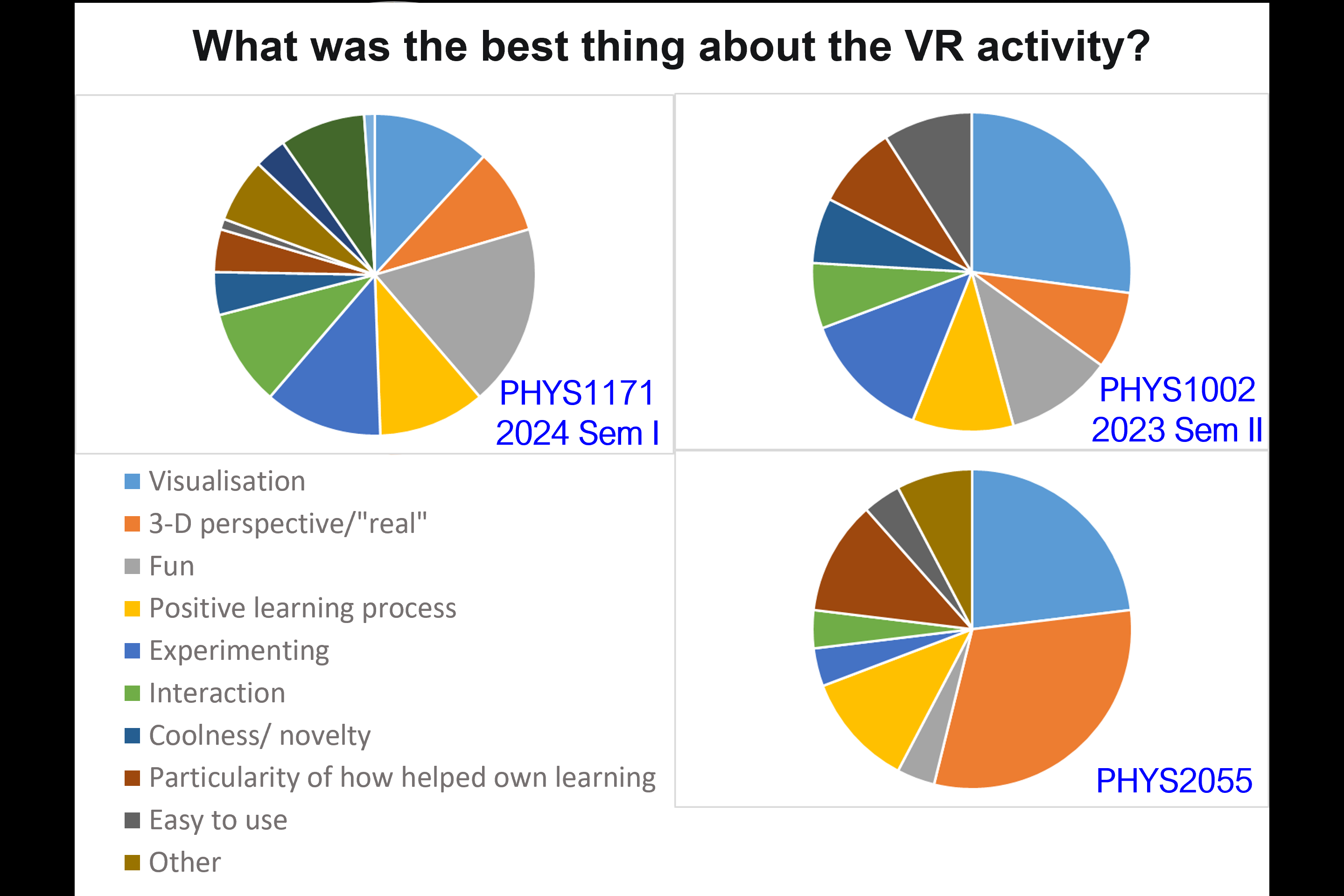
Figure 2. Students’ perceptions about the best aspects of the VR activity. PHYS1171 – service physics course, PHYS1002 – core first-year physics course, PHYS2055 – core second-year physics course.
4.3. Implementation of VR for educational activities
There are technical considerations for implementers as well as student users. Instructors in this project, who were initially novice VR users, found the technology manageable. The VR hardware is relatively expensive consumer equipment. (An equipment pool, that gets refreshed with equipment updates, could be prudent.) To ensure affordable cost, hardware was shared, with students taking turns to use it. Classroom logistics of time and space need to be managed. There is a human resource cost in operating the activities. Our activities ran in teaching laboratories, tutorial spaces or large flat-floor rooms, with 25-50 people at a time.
Besides practicalities, the design of VR-based learning activities requires consideration. In our pilot investigations, students were simply free to use the VR as they chose (for up to a certain time). Later, we designed learning activities that incorporated use of the VR simulations. The designed learning activities used through most of this study have three phases:
1. Explore the simulation to familiarise
2. Complete a task that requires making choices and observations
3. Relate observations to the targeted concepts.
Visual immersion restricts the usability of lengthy written activity instructions and makes extended note-taking difficult. Therefore, written communication inputs and outputs for the activity are optimised for use in short bursts.
Our learning activities had a conceptual emphasis – precise numerical measurement is not the aim of these particular simulations. This focus helps maintain visual simplicity; minimising the user’s sensation of optic flow as a visually-busy scene moves as they move their head. This may help avoid issues of VR-induced motion sickness. If quantitative learning outcomes are desired from immersive VR, the simulation needs to be thoughtfully designed for it.
5. Conclusions
From implementations of immersive Virtual Reality in a range of higher‑education contexts, the affordances and constraints of immersive VR for learning have been clarified.
Student reactions were generally positive, and there are immediate learning gains where simulations are tightly aligned with targeted concepts. Differences observed between learning through VR and 2D simulations have enhanced our understanding of what and how students learn via simulations.
VR suits three-dimensional, dynamic, and even physically impossible scenarios. The availability of relevant simulations is a current limitation that could be addressed by further work to build a broader suite of simulations across a wider range of topics. Beyond physics, immersive VR offers promise for science disciplines where learning depends on visualisation of the abstract and conceptual (eg: chemistry), interpreting three‑dimensional spatial information (eg: geology), or engaging with experiential scenarios (eg: veterinary science). The unique experiential nature of VR also offers promise to support learning in an even broader range of disciplines (eg: humanities).
In harnessing the potential of immersive VR to enhance learning, careful deliberation should be made about alignment between learning aims, simulation design and associated learning activities, and about appropriate guidance both within and alongside the simulation. Our work prompts reconsideration of the individual versus social nature of learning with VR. Our research has allayed some equity concerns, indicating that immersive VR can be deployed responsibly without disproportionately advantaging particular student groups.
Together, our findings underscore the importance of using immersive VR strategically - using it where its distinctive characteristics of rich spatial visualisation, embodied interaction, and experiential access offer clear pedagogical value - and offer practical insights to inform educators and institutions considering investment in immersive technologies.
References
Acevedo, P., Magaña, A. J., Benes, B., & Mousas, C. (2024). A systematic review of immersive VR in STEM education: Advantages and disadvantages on learning and user experience. IEEE Access, 12, 189359–189386. https://doi.org/10.1109/ACCESS.2024.3489233
Antonopoulos, P., Fokides, E. & Koutromanos, G. (2025). ). Understanding learning and learning experience in immersive virtual reality. Tech Know Learn, 30, 1771–1800 https://doi.org/10.1007/s10758-024-09764-z
Debs, J.E., Scalable and Effective Use of Virtual Reality for Physics Education (2021). Proceedings of The Australian Conference on Science and Mathematics Education.
Madsen, A., McKagan, S. B., & Sayre, E. C. (2013). Gender gap on concept inventories in physics: What is consistent, what is inconsistent, and what factors influence the gap? Physical Review Special Topics – Physics Education Research, 9(2), 020121. https://doi.org/10.1103/PhysRevSTPER.9.020121
PhET Interactive Simulations. (n.d.). Projectile motion. University of Colorado Boulder. https://phet.colorado.edu/sims/html/projectile-motion/latest/projectile-motion_all.html
Physport. (n.d.). Assessment. American Association of Physics Teachers.
https://www.physport.org/Assessment.cfm
UQ SciMS. (n.d.). Moving charge. The University of Queensland. https://teaching.smp.uq.edu.au/scims/index.html#course=fields&lecture=movingcharge
Wieman, C. E., Adams, W. K., & Perkins, K. K. (2008). PhET: Simulations that enhance learning. Science, 322(5902), 682–683. https://doi.org/10.1126/science.1161948
Yu, Z., & Xu, W. (2022). A meta-analysis and systematic review of the effect of virtual reality technology on users’ learning outcomes. Computer Applications in Engineering Education, 30, e22532. https://doi.org/10.1002/cae.22532