Undergraduate research supervision as a vehicle for self-reflection by doctoral students in a mentored mentoring setting: a case study
Undergraduate research supervision by doctoral students as a vehicle for self-reflection
Undergraduate research supervision as a vehicle for self-reflection by doctoral students in a mentored mentoring setting: a case study
Brigid Lucey1
 ,
Angela Wright2
,
Craig Murphy3
1Department of Biological Sciences and Department of Organisation and Professional Development, Munster Technological University, Ireland, 2Department of Teaching and Learning, Munster Technological University, Ireland, 3Department of Biological Sciences, Munster Technological University, Ireland.
How to cite: Lucey, B.; Wright, A.; Murphy, C. (2026). Undergraduate research supervision as a vehicle for self-reflection by doctoral students in a mentored mentoring setting: a case study. In: 12th International Conference on Higher Education Advances (HEAd’26). Valencia, 15-18 June 2026. https://doi.org/10.4995/HEAd26.2026.21736
Abstract
This study analyses first-time supervisory experiences and needs of four PhD candidates supervising undergraduate research. The objectives were to determine (1) how the PhD candidates rated their own recipient Course-based Undergraduate Research Experience (CURE) supervision, (2) what the PhD candidates’ learnings were from supervising and (3) supports required for novice supervisors.
Both good and poor previous experiences of being supervised provided instructive material for PhD candidates during CURE supervision. PhD candidates’ learnings included self-discovery benefits and improved presentation of their own research findings, in addition to mindful supervision. Supports reported as beneficial included ability to discuss the CURE supervisory process with a supervisor, having a marking rubric as a guide and discussion of how marks had been assigned. In conclusion, this study has shown aspect vs to supervision that are personal to every supervisor and that skilled supervision comes with practice and is assisted by self-reflection and mentored support.
Keywords: PhD candidates; Mentoring; Undergraduate research supervision
1. Introduction
This paper seeks insight into how doctoral students from the same academic setting experience undergraduate and postgraduate research, with a view to a better understanding of their supervisory needs. The study employs a theoretical model for mentored mentoring as described by Lucey et al (2018), whereby academics mentor the doctoral students while they are supervising undergraduate research students. As a Technological University there is an emphasis on undergraduate students developing practical skills through their degree programme in the institution.
Course‐based Undergraduate Research Experiences (CUREs) have the potential to provide unique exposure to research for students who may otherwise not have opportunities to participate in undergraduate research experiences (Quick & Cisneros, 2022). Willis et al (2018) have stated that undergraduate research experiences may influence graduates to do an MSc or PhD. According to Crossley & Maini (2025) a wealth of investment by the supervisor into a student’s training is often required before they are comfortable researching independently.
Shortlidge and Eddy (2018) have shown that there are more mutual benefits than negatives to be gained from postgraduate research students being involved in teaching undergraduate students. However, the informal supervision of undergraduate students by doctoral students has not been explored much in the literature (Grimwood & Hetherington, 2019); the authors also went on to say that sufficient support is not provided for this type of activity.
In the current case study, four PhD candidates were each tasked with mentoring two undergraduate students undertaking CUREs, while the PhD candidates were mentored by their own supervisors. The objectives of the current study were to
Determine how the PhD candidates rated their own recipient CURE supervision
Determine what the PhD candidates learned from their supervisory experience
Determine what type of support the postgraduate candidate as supervisor may require
2. Methodology
2.1 Ethics
Ethics - The study was conducted according to the Declaration of Helsinki (64th WMA General Assembly, Fortaleza, Brazil, October 2013). Ethical approval was granted by the University Ethics committee (MTU-RECL-20-001-A).
2.2 PhD candidates
There were four PhD candidates (two male, two female) in the current study, who were invited to participate in the supervision of CURE students within a mentored mentoring system; all four willingly participated in the study and gave recorded consent. The four PhD candidates had graduated from the same department with the same primary STEM degree, going straight onto a PhD register. The male PhD candidates were supervised by a female supervisor, the female students had a male supervisor and all four PhD candidates were based in the same department in which they had undertaken their 240-ECT credit primary degree. All have since graduated with their PhDs.
2.3 CURE students
Each PhD candidate in the current study had two CURE students who were undertaking a CURE project worth 15 ECT credits as part of their final undergraduate year. In all cases the CURE project was based within the scope of the PhD candidate’s research work. This study included eight undergraduate CURE students (seven females and one male), who had been randomly assigned by a third party to their supervisors for their CURE. The undergraduate students were assigned initially to the postgraduate supervisors, who then engaged their PhD candidates as the CURE students’ mentees. The PhD candidates supervised the CURE students for their research independently but mentoring of the PhD candidates extended through the academic year; meetings between supervisors and PhD students were monthly or more frequently, as required.
The CURE research phase marking process consisted of the student’s presentation of a thesis (worth 30% of marks, having two examiners, including the supervisor); a poster presentation by the student (20%, having two examiners, including the supervisor) and the laboratory research component (50%, the supervisor marking this component). It should be noted that the PhD candidate as supervisor had their own supervisor marking all aspects of the CURE separately from the PhD candidate, for later comparison and discussion. There is a marking rubric for supervisors to help standardization and maintenance of academic standards.
2.4 Assessment of postgraduate students’ experience through interviews
Semi-structured recorded interviews were conducted among the four doctoral students with both supervisors present, using the same set of open questions in each case. Qualitative data collected during the interviews underwent thematic analysis (as described by Braun & Clarke (2006)) to search for emergent themes. This involved transcription of the data from recordings, generating initial codes, and searching for themes.
3. Results
3.1 Determination of how the PhD candidates rated their own CURE supervision
All four PhD candidates were supervised in the same department for their CURE. Regarding their judgement of the quality of their own CURE supervision three of the four stated that they had a good supervisor (shown as PhD Candidates 1, 3 and 4 in Table 1) and a good relationship with them, the fourth (shown as PhD Candidate 2 in Table 1) reported having “a very scattered and inconsistent experience” for their CURE and what they considered to be poor supervision. This candidate also said that “When I saw poor instances of supervision, I knew that it had a very bad effect on people who were supervised”. Three PhD candidates reported that they enjoyed their CURE (Candidates 1, 3 and 4). Candidate 3 mentioned that it was their most challenging undergraduate module during their degree, while simultaneously saying that they enjoyed the experience, that it prepared them for doing their PhD and made them want to continue the CURE work into a PhD (which they did). Candidates 1 and 4 found their CURE creative, Candidate 4 stating that “this was the most freeing of any of my undergraduate modules”, the same student going on to say that “for a perfectionist and a creative person, the CURE allowed me to flourish”. This candidate also said that “I was lucky that when I came up with my own idea for a project my supervisor supported that”. Table 1 shows the learnings reported by the PhD candidates after CURE supervision for their first time. Notably, Candidate 1 reported having a prolonged adverse experience of being supervised by an instructor in sport.
Table 1. Quoted discoveries about CURE supervision by four PhD candidate novice CURE supervisors
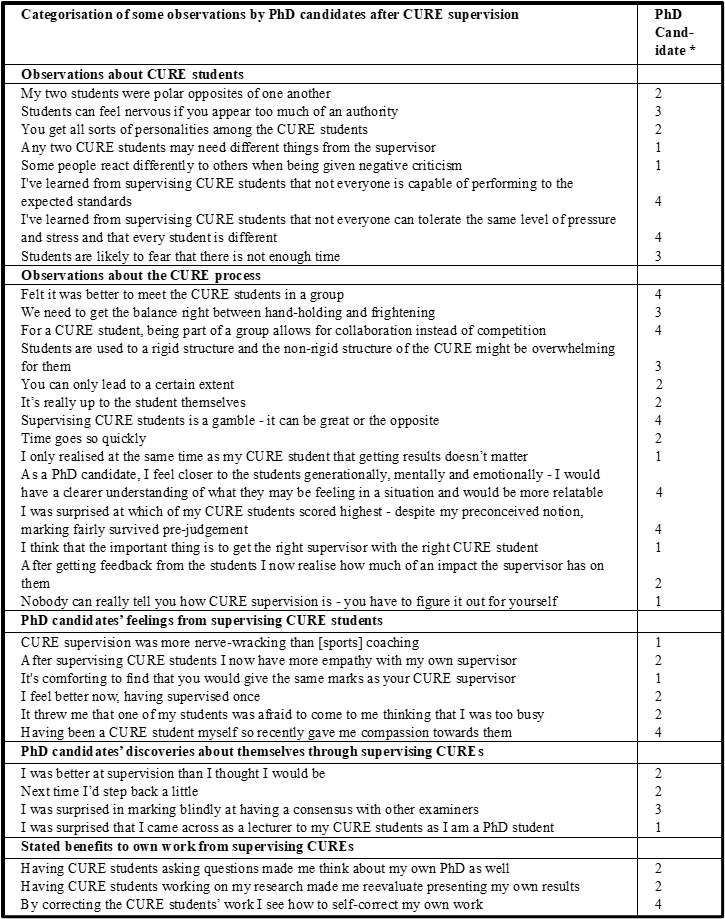
*PhD Candidate 1: Well supervised for CURE but poorly supervised previously over a period of years in sport and is now a sports coach themselves, in their spare time; PhD Candidate 2: Poorly supervised for CURE; PhD Candidate 3: Well supervised for CURE; PhD Candidate 4: Well supervised for CURE
4.Discussion
Supervision has been said to be comprised of intellectual, methodological and pastoral elements and the significance of each element will change over the course of the research project (Watts, 2010). In keeping with the stated experiences of Candidate 3 in the current study, it has previously been shown that lecturers have a valuable role in influencing the decision-making of potential doctoral students when their mentioning of this possibility for undergraduate students occurs at a personal level (Brailsford, 2010; Guerin et al, 2015). It was interesting in the current study, however, that Candidate 2, despite having had poor CURE supervision, still went on to undertake a PhD in the same department. Candidates 1 and 4 undertook a third-year undergraduate placement with research groups in other Universities, which caused them to want to undertake a PhD themselves, before their CURE took place. Table 1 shows what the PhD candidates learned about CURE supervision from doing it themselves and as Candidate 1 pointed out “nobody can really tell you how CURE supervision is – you need to figure it out for yourself”. It was interesting that Candidate 1 also felt that the CURE student should be matched to the supervisor, which would be a difficult-to-achieve task where there are large cohorts of CURE students to be assigned to supervisors. It should be mentioned that in the current study all CURE students conducted their projects in the broad area of human biology and that in the case of a very specific requirement for the student who wished to conduct their (feasible) research in a specialized area, there would be a need to select the supervisor, but this is not commonplace. In a paper by Armstrong et al. (2010), that examined the implications of cognitive style for the management of student‐supervisor relationships in the UK, the authors reported there not being any clear‐cut evidence to demonstrate the benefits of a ‘matching’ approach, and they advised that a focus on the interaction between student and supervisor, using qualitative methods, rather than on the individuals themselves, might be more beneficial. The inferred or expressed needs of each of the four PhD candidates when becoming
The PhD candidates, as CURE supervisors (from their reported experiences) included their needing support with their own feelings of insecurity while supervising, suggesting a need for unconditional support from their own supervisor.
Having a marking rubric in the department was likely to have played a role in standardizing the marking by the PhD candidates with the marks allocated by the supervisors for the same CURE projects and all four candidates expressed degrees of surprise at their giving similar marks to their supervisors (one quote appears in Table 1).
In the current study Candidate 2 reported that CURE supervision made them feel more than a student themselves at the time, also saying that they felt more like a member of staff in the department afterwards. It was also striking that through their received poor supervisory experience they stated that “After supervising CURE students I now felt empathy with my own supervisor”. Candidate 1 stated that they were surprised that they came across as a lecturer to their CURE students and they felt that nobody could have stopped them feeling pressure at the start of the supervision process, also noting that supervision is a very personal journey. Whether the PhD candidate as supervisor had a good or a bad experience when being supervised for their own CURE, they demonstrated that they incorporated their previous experience while acting as CURE supervisors themselves, and that they had identified aspects of supervision that were good or bad when they were on the receiving end of that supervision. Candidate 1, who reported having a positive CURE experience discussed having previously had a very poor, prolonged experience with a sports coach, which they contrasted with their positive CURE experience, saying from their sports experience “I don’t want to be that person for someone else”, also wondering “Whether I’d care as much if I hadn’t had such poor supervision myself”. and. Candidates 3 and 4, who reported being well supervised themselves, articulated much less fear about potential pitfalls when supervising others than Candidates 1 and 2.
In her paper entitled “Who is responsible?” Roland (EMBO reports, 2007) states that supervisors need to develop an appropriate range of teaching supervisory skills all while reflecting on their own practice and future needs. In the current case study, the experiences of the PhD candidates suggested learning about their own practice and skills development through mentoring others. It has been stated elsewhere that students who are mentored effectively outperform those who are not (Woolston, 2019). It was not possible to measure quantitatively the benefits to the PhD candidates of mentoring them to mentor undergraduate CUREs; however, in the current case study, the PhD candidates showed a recognition, of the benefits of supervising CUREs, including stimulation of self-reflection of their own research journey, of their perception of their own autonomy and experience, a better understanding of how to be self-critical of their own work, an understanding of how to supervise research and how to evaluate others’ projects when it came to marking theses, and a recognition of diversity of motivating factors between their CURE students. It has previously been shown that supervision positively affects PhD candidates’ autonomous motivation Chen et al, 2023; Devos et al, 2016). One paper from the UK (Tullet et al, 2024) where the authors established a mentoring programme for the PhD candidates in the University, reported that providing a “reflexivity in research” facilitator, was beneficial to the PhD candidates, given their propensity for anxiety, stress, feelings of isolation and having challenges in the student-supervisor relationship.
The benefits of mentored mentoring of the PhD candidates supervising the CURE students included that the PhD candidates felt supported in their novice experience of supervision and ultimately empowered. Furthermore, the ideal of excellent supervision in the department, it is hoped, was inculcated by providing backup and advice as requested. Candidate 1 wished to mimic the CURE supervision that they had received themselves and to supervise others well for their PhD supervisor’s sake. All four PhD candidates articulated that supervision was something that they ultimately needed to construct for themselves, however, three noting the differences between the pairs of CURE students whom they were supervising.
The benefits of the mentored mentoring of CURE students included the shared intentions of the PhD candidates and their own supervisors towards the undergraduate students and of a common focus outside of the usual PhD candidate-supervisor relationship. It was clear from the feedback of the PhD candidates after supervising that they felt empowered. The whole process required open communication and trust between themselves and their own supervisor.
In conclusion, the type of support that the PhD candidates needed for mentoring CURE students included being able to discuss the process with their supervisor while it was happening, having a marking rubric to help them to understand the standard required and being able to compare the marks they awarded independently with those of the supervisor. Some support was inherently provided by the CURE students themselves, in their recognition of the PhD candidate supervisor’s authority as their supervisor. This study has shown that there are aspects of supervision that are personal to every supervisor and that are only learnt through doing. The findings of this study are transferable to other disciplines than STEM. Limitations of the case study included having only four PhD candidates, not having structured measures of supervisory skill development and thereby the capacity to assess the impact, and getting the viewpoint of very motivated individuals, judging by their successful completion of their PhD.
References
Armstrong, S., Allinson, C. W., & Hayes, J. (1997). The Implications of Cognitive Style for the Management of Student‐Supervisor Relationships. Educational Psychology, 17(1–2), 209–217. https://doi-org.mtu.idm.oclc.org/10.1080/0144341970170116
Brailsford, I. (2010). Motives and aspirations for doctoral study: Career, personal, and inter-personal factors in the decision to embark on a History PhD. International Journal of Doctoral Studies, 5, 15–27. https://ijds.org/Volume5/IJDSv5p015-027Brailsford283.pdf
Braun, V., & Clarke, V. (2006). Using thematic analysis in psychology. Qualitative Research in Psychology, 3(2), 77–101. https://doi.org/10.1191/1478088706qp063oa
Chen, J., King, R. B., Li, Y., & Xu, W. (2023). The role of the research environment and motivation in PhD candidates’ well-being: a perspective from self-determination theory. Higher Education Research & Development, 43(4), 809–826. https://www.tandfonline.com/doi/abs/10.1080/07294360.2023.2269870
Crossley, R. M., & Maini, P. K. (2025). Ten simple rules for early-career researchers supervising short-term student projects. PLoS Comput Biol. 18;21(11):e1013690. doi: 10.1371/journal.pcbi.1013690. PMID: 41252459; PMCID: PMC12626309. https://journals.plos.org/ploscompbiol/article?id=10.1371/journal.pcbi.1013690
Devos, C., Boudrenghien, G., Van der Linden, N., Frenay, M., Azzi, A., Galand, B., & Klein, O. (2016). Misfits between doctoral students and their supervisors: (how) are they regulated? International Journal of Doctoral Studies, 11, 467–486. https://ijds.org/Volume11/IJDSv11p467-486Devos2875.pdf
Grimwood, M., & Hetherington, R. (2021). A neglected area: supervision development opportunities for doctoral researchers involved in undergraduate and masters project mentoring. International Journal for Academic Development, 28(1), 74–86. https://doi.org/10.1080/1360144X.2021.1959336
Guerin, C., Jayatilaka, A., & Ranasinghe, D. (2015). Why start a higher degree by research? An exploratory factor analysis of motivations to undertake doctoral studies. Higher Education Research & Development, 34(1), 89–104. https://psycnet.apa.org/record/2015-07856-007
Lucey, B., O’Sullivan, S., Collins, L., & Ó Céilleachair, R. (2018). Staff mentoring in Higher Education: the case for a mentored mentoring continuum. All Ireland Journal of Higher Education. 10(3):36501-36516. https://ojs.aishe.org/index.php/aishe-j/article/view/365
Quick, C. M., & Cisneros, M. R. (2022). Vertically‐integrated course‐based undergraduate research experiences (CUREs) structure a biomedical research certificate program that promotes inclusivity. The FASEB Journal, 36(Suppl 1). https://doi.org/10.1096/fasebj.2022.36.S1.R6208
Roland, M-C. (2007). Who is responsible? Supervisors and institutions need to focus on training in the responsible conduct of research and change the culture in the laboratory. EMBO reports, 08;8:706=711. https://pmc.ncbi.nlm.nih.gov/articles/PMC1978077/
Shortlidge, E. E., & Eddy, S. L. (2018). The trade-off between graduate student research and teaching: A myth? PLoS ONE, 13(6), e0199576. https://doi-org.mtu.idm.oclc.org/10.1371/journal.pone.0199576
Tullet, J., Leigh, J., Coke, B., Fisher, D., Haszczyn, J., Houghton, S., Fish, J., Freeman, L., Garcia, I., Penman, S., & Hargreaves, E. (2024). Using reflective practice to support PhD students in the biosciences. eLife, 13, e92365. https://doi.org/10.7554/eLife.92365. https://doi.org/10.7554/eLife.92365
Watts, J.H. (2010). Team supervision of the doctorate: managing roles, relationships and contradictions. Teaching in higher education, 06/2010, 15 (3). https://www.tandfonline.com/doi/abs/10.1080/13562511003740908
Willis, L.B.; Schall, K.C.; & Piazza, L. (2018). A Survey of Communication Sciences and Disorders Undergraduate Students' Research Experience and Interest in A Master's Thesis and PhD Degree. Perspectives of the ASHA special interest groups, 3(10). 11-26. https://pubs.asha.org/doi/10.1044/persp3.SIG10.11
Woolston, C. (2019). A message for mentors from dissatisfied graduate students. Nature, 575(7783), 551–552. https://doi.org/10.1038/d41586-019-03535-y