A Competency-Based Learning Framework for Interdisciplinary Medical Additive Manufacturing: Democratizing Surgical Planning Education Through Open-Source Workflows
A Competency-Based Learning Framework for Interdisciplinary Medical Additive Manufacturing
A Competency-Based Learning Framework for Interdisciplinary Medical Additive Manufacturing: Democratizing Surgical Planning Education Through Open-Source Workflows
Sreeja
Gadhiraju1
 ,
Hannes Panzer2
,
Peter Mayr2
,
Harald Schmid3
1TUM.Additive, Technical University of Munich, Germany, 2 Chair of Materials Engineering of Additive Manufacturing, Technical University of Munich, Germany, 3 Gramm GmbH, Germany.
How to cite: Gadhiraju, S.; Panzer, H.; Mayr, P.; Schmid, H.(2026). A Competency-Based Learning Framework for Interdisciplinary Medical Additive Manufacturing: Democratizing Surgical Planning Education Through Open-Source Workflows. In: 12th International Conference on Higher Education Advances (HEAd’26). Valencia, 15-18 June 2026. https://doi.org/10.4995/HEAd26.2026.21748
Abstract
Medical additive manufacturing (AM) education faces significant accessibility barriers due to reliance on expensive proprietary software, limiting opportunities for institutions with constrained resources. This paper proposes a competency-based learning framework for teaching patient-specific surgical planning using exclusively open-source tools. Drawing from constructivist learning theory, a four-stage competency pathway is defined: (1) Medical Imaging Literacy, (2) Anatomic Modeling, (3) Surgical Planning and Design, and (4) Digital Fabrication. To illustrate the technical feasibility of the framework, a complete mandibular reconstruction workflow was implemented using open-source software. The results demonstrate that an end-to-end open-source pathway can produce geometrically accurate models and functionally suitable prototypes for surgical planning contexts. The framework offers a scalable and accessible model for interdisciplinary education by reducing financial barriers while maintaining alignment with industry-relevant workflows. While the present study focuses on technical validation, future work will involve empirical evaluation of learning outcomes and competency acquisition in educational settings.
Keywords: Competency-based education; open educational resources; interdisciplinary learning; biomedical engineering education; 3D printing.
1. Introduction
Additive manufacturing (AM) enables patient-specific production of medical devices and implants, allowing unprecedented customization to individual anatomical and functional needs. The integration of AM into clinical practice represents a paradigm shift in personalized medicine (Gibson et al., 2015), particularly in maxillofacial reconstruction, where patient-specific implants significantly improve surgical outcomes (Ventola, 2014; Abraham, 2014). However, the educational infrastructure for training healthcare professionals and engineers in medical AM remains fragmented and financially prohibitive. Current pedagogical approaches predominantly rely on proprietary software ecosystems requiring institutional licenses costing more than €15,000 annually (Materialise, n.d.), making it difficult for smaller universities and institutions in developing economies to offer comprehensive training in this critical domain.
This financial barrier creates an equity gap in biomedical engineering and dental education. While industry-standard tools such as Materialise Mimic and 3D Systems provide robust solutions, their cost structures prevent widespread curricular integration, limiting hands-on learning experiences to well-funded research clusters. Consequently, graduates enter the healthcare workforce lacking practical skills in digital surgical planning, design, and fabrication skills, despite increasing clinical demand for such competencies (Abraham, 2014; Powcharoen et al., 2019).
Competency-based education (CBE) offers a pedagogical framework well-suited to technical skill acquisition, emphasizing measurable outcomes and mastery over seat-time (McClelland, 1973; Gervais, 2016). However, existing CBE frameworks for medical AM remain underdeveloped, particularly those leveraging open-source alternatives that could democratize access (UNESCO, 2019; Atenstaedt, 2017). While technical literature extensively documents AM applications in maxillofacial surgery (Tsai & Wu, 2014; Powcharoen et al., 2019), pedagogical research examining how these complex, interdisciplinary skills should be structured, sequenced, and assessed remains scarce.
This paper addresses this gap by proposing a four-stage competency framework utilizing exclusively open-source software (InVesalius, Blender, and PrusaSlicer) (Bidgood et al., 1997; InVesalius, 3.x.; Blender Foundation, 2.90.; Prusa Research, n.d.). The research question guiding this work is: How can a competency-based framework utilizing open-source software effectively structure learning outcomes for interdisciplinary medical AM education? To address this question, a scaffolded learning pathway that progresses from medical image interpretation to physical prototype fabrication, validated through a proof-of-concept implementation involving mandibular reconstruction (Tsai & Wu, 2014; Powcharoen et al., 2019), was developed.
2. Theoretical Framework
2.1 Competency-Based Education in Technical Domains
CBE centers on the mastery of specific, measurable skills rather than time-based progression (McClelland, 1973). In engineering education, CBE aligns with constructivist principles, in which learners build capabilities through sequential, authentic tasks of increasing complexity (Gervais, 2016). A backward design approach is adopted for the proposed framework, identifying terminal competencies (designing patient-specific surgical implants) and scaffolding prerequisite skills through staged learning modules. This aligns with McClelland's (1973) foundational CBE principles and recent applications in biomedical engineering contexts, where competency mapping ensures graduates meet industry readiness standards.
2.2 Interdisciplinary Learning and the "T-Shaped" Professional
Medical AM inherently requires interdisciplinary knowledge translation between clinical medicine (anatomy, surgical constraints, biocompatibility) and engineering (computer-aided-design (CAD) modeling, manufacturing processes, material science). This intersection necessitates what Guest (1991) termed T-shaped professionals, individuals with deep disciplinary expertise coupled with cross-domain communication capabilities.
Effective interdisciplinary education requires intentional curriculum design that creates mutual learning contexts where neither discipline is subordinate (Klein, 2005). In medical AM, this means engineering students must understand clinical requirements (e.g., sterilization constraints, anatomical variation), while medical students engage with design limitations (e.g., overhang angles in printing, material shrinkage). The proposed framework structures these intersections, using the technical workflow as a boundary object to facilitate knowledge exchange between domains (Klein, 2005).
2.3 Open Educational Resources and Democratization
The open-source philosophy aligns with the United Nations Educational, Scientific, and Cultural Organization's Open Educational Resources recommendations, which advocate teaching materials free of cost barriers (UNESCO, 2019). In technical education, open-source software offers unique pedagogical advantages beyond cost savings: transparency of algorithms, community-driven documentation, and the ability for students to install software on personal devices, enabling anytime-anywhere learning impossible with network-licensed proprietary tools (Wiley & Hilton, 2018). However, OSS in medical education requires careful validation to ensure clinical viability (Atenstaedt, 2017), a central tenet of the framework presented here.
3. A Four-Stage Competency Framework
The proposed framework structures medical AM education into four sequential competency stages, each with defined learning outcomes, open-source tools, and assessment metrics (Table 1). The progression follows the authentic workflow of digital surgical planning, from raw medical data to physical prototype.
3.1 Stage 1: Medical Imaging Literacy
The foundation of patient-specific design lies in the interpretation of medical imaging data. Learners must understand the Digital Imaging and Communications in Medicine (DICOM) standards and computed tomography (CT) data structures. This stage develops competency in threshold-based segmentation, differentiating bones from surrounding tissue based on Hounsfield units (HU) using InVesalius. The segmented anatomy is subsequently exported as a surface mesh file (STL), transforming voxel-based imaging data into a manipulable three-dimensional model (InVesalius, 3.x.).
3.2 Stage 2: Anatomic Modeling
Raw segmented meshes require extensive editing to become manufacturable models (Blender Foundation, n.d.). In this stage, geometric reasoning is developed through mesh decimation, Boolean operations for the subtraction of existing design files, and mirroring techniques for the reconstruction of missing anatomy, utilizing symmetrical contralateral structures as templates (Tsai & Wu, 2014). Blender, traditionally an animation tool, provides mesh editing capabilities that transfer directly to CAD skills valued in industry, while its Python scripting interface offers pathways for automation education.
3.3 Stage 3: Surgical Planning and Design
The critical intersection of clinical and engineering knowledge occurs here. Learners must translate surgical requirements into geometric constraints: designing implants with adequate wall thickness for mechanical stability, creating screw holes matching surgical fixation plates, and ensuring guides fit uniquely to patient anatomy (Abraham, 2014; Powcharoen et al., 2019). This stage requires understanding design for manufacturing principles specific to AM, including minimum feature sizes and support structure accessibility.
3.4 Stage 4: Part Fabrication
The final stage bridges digital design and physical production. Learners select appropriate AM technologies based on application requirements, stereolithography (SLA) for high-detail anatomical models versus fused deposition modeling (FDM) for durable surgical guides. Competency includes orientation optimization to minimize support scarring, parameter configuration (layer height, exposure times), and post-processing protocols (Ultra Violet (UV) curing, support removal). This stage emphasizes quality control by verifying dimensions against digital models.
Table 1: Competency-Based Learning Framework for Medical Additive Manufacturing
Stage |
Competency Domain |
Learning Outcomes |
Open-Source Tool |
Assessment Criteria |
1 |
Medical Imaging Literacy |
Segment DICOM datasets; identify landmarks; generate 3D surface models. |
InVesalius |
Successful STL generation; accurate tissue isolation. |
2 |
Anatomic Modeling |
Edit high poly meshes, perform Boolean operations, and ensure mesh integrity. |
Blender |
Geometric accuracy; surface continuity; watertight manifold. |
3 |
Surgical Planning |
Design patient-specific implants/guides; clinical-to-engineering translation. |
Blender |
Dimensional accuracy/anatomical fit. |
4 |
Part Fabrication |
Configure AM parameters, select technology (SLA/FDM), and post-processing. |
PrusaSlicer |
Print success; surface finish; dimensional stability post-curing. |
4. Proof of Concept: Framework Implementation
To validate the educational viability of this framework, the complete four-stage workflow was implemented for a mandibular reconstruction case involving a patient with oral cavity cancer requiring a segmental mandibulectomy. This implementation served as a Proof of concept, testing whether the open-source pathway could achieve clinical-grade precision without proprietary software (Atenstaedt, 2017).
4.1 Case Context
The patient was presented with Stage III oral cavity cancer necessitating resection of the left mandible (lower jaw), with reconstruction requiring a patient-specific reconstruction plate. The educational objective was to produce: (1) a physical model of the reconstructed mandible for surgical planning, (2) a custom titanium implant design, and (3) a surgical guide for osteotomy alignment (Tsai & Wu, 2014; Powcharoen et al., 2019).
4.2 Competency Progression
Stage 1: DICOM data from CT imaging (467 slices) were imported into InVesalius. Segmentation using thresholding (662-1988 HU) successfully isolated compact bone (Bidgood et al., 1997), generating an initial STL mesh of 2.7 million triangles.
Stage 2: In Blender, the raw skull mesh was separated to isolate the mandible. The remaining healthy right mandible was mirrored across the sagittal plane to reconstruct the defective left side. Boolean operations joined the mirrored geometry with the original, creating a continuous, anatomically accurate reconstruction. Mesh repair tools ensured manifold integrity necessary for printing.
Stage 3: The implant was designed to follow the mandibular curvature, with a uniform 3 mm wall thickness to ensure mechanical stability under masticatory loads (Abraham, 2014). Screw holes (1.15 mm radius) were positioned according to standard surgical fixation patterns. Dimensional verification confirmed wall thickness uniformity and hole diameter precision within 0.05 mm of specifications through direct measurement tools in Blender (Blender Foundation, n.d.) and physical calibration of the digital model.
Stage 4: The mandible was fabricated via SLA (Prusa SL1, 0.05 mm layers) using tough resin, requiring support structures on overhanging surfaces. Post-processing included IPA washing and 15-minute UV curing. The surgical guide was produced via FDM (Prusa i3 MK3S) in PLA for cost efficiency. Figure 1 demonstrates the alignment accuracy between the printed mandible and surgical guide, indicating successful translation from digital design to physical reality.
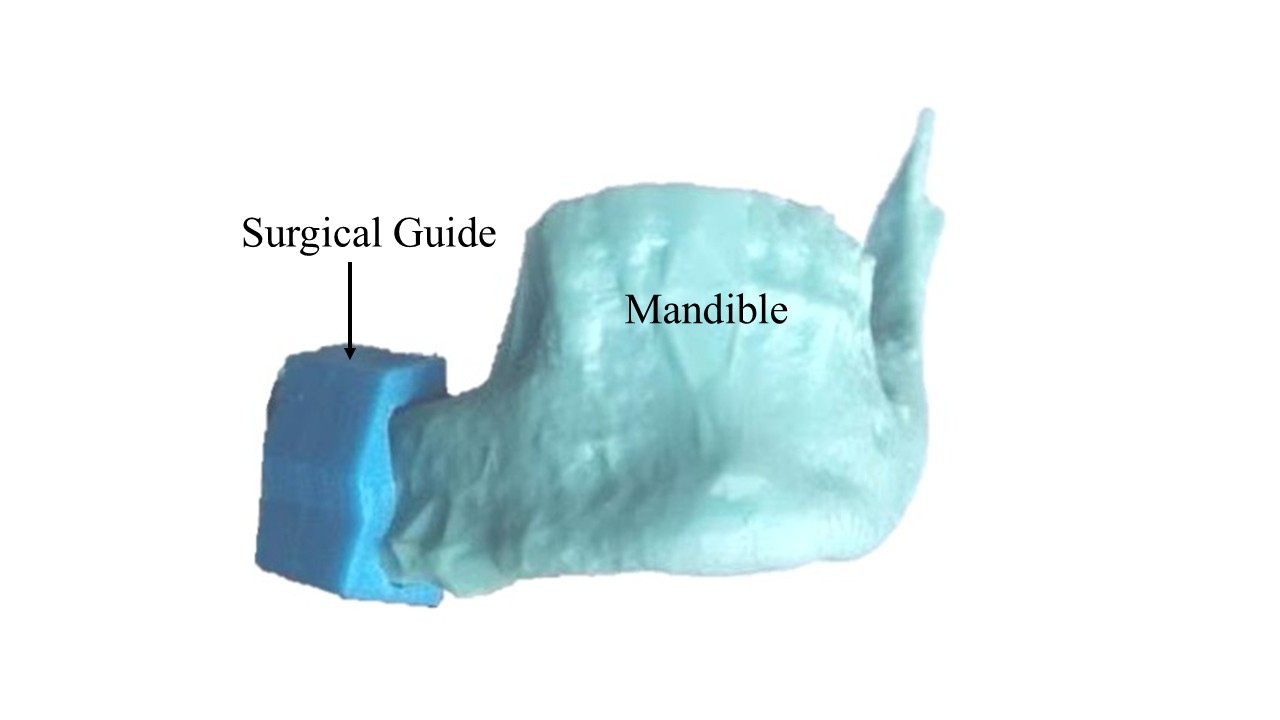
Figure 1. 3D printed mandible with surgical guide demonstrating alignment accuracy
4.3 Technical validation
The completed prototypes demonstrated satisfactory geometric alignment and functional suitability within the context of surgical planning workflows. The surgical guide seated on the mandible model without observable misalignment or instability during placement, indicating adequate geometric fidelity for educational and prototyping purposes.
The implant design met predefined geometric constraints, including uniform wall thickness and precise positioning of fixation points. These results indicate that the proposed framework enables the successful execution of an end-to-end digital workflow using open-source tools.
It is important to note that this validation reflects technical feasibility of the workflow rather than clinical validation or educational effectiveness. The results demonstrate that the framework can serve as a robust foundation for competency-oriented learning, which will require further empirical evaluation in learner-centered environments.
5. Discussion
5.1 Implications for Curriculum Design
In this framework, immediate practical applications for higher education institutions are offered. Biomedical engineering programs can integrate the four-stage model into capstone courses without incurring budgetary costs for site licenses. Dental schools can implement abbreviated versions focused on Stages 1 (imaging) and 3 (guide design) for implantology training. The modular structure allows flexible implementation: individual stages can function as standalone workshops or combined into courses during the semester (Gervais, 2016; Wiggins & McTighe, 2005).
The framework particularly supports interdisciplinary education (Klein, 2005) by proposing the workflow understanding required for surgical margins (clinical knowledge) and mesh Boolean operations (engineering skills). Institutions could deploy this as a joint course between engineering and medical faculties, with students from both disciplines collaborating on cases, mirroring real-world healthcare teams (Klein, 2005). The open-source nature enables students to continue learning beyond classroom constraints, installing software on personal devices for iterative practice (UNESCO, 2019; Wiley & Hilton, 2018).
5.2 Accessibility and Scalability
Eliminating software costs removes a significant barrier to entry. A complete workstation for this curriculum requires only standard computing hardware (no graphic workstations necessary) and consumer-grade 3D printers (under €500). This democratization enables institutions globally to provide technical training equivalent to that of elite research centers while maintaining efficiency. By providing open-source alternatives to commercial software, these platforms enable customization and extension of tools, a capability vital to research-driven education (Wiley & Hilton, 2018).
Furthermore, the framework supports continuous professional development for practicing clinicians (McClelland, 1973). Surgeons seeking to understand AM capabilities can self-pace through the modules without institutional procurement delays, fostering lifelong learning in digital healthcare technologies.
6. Conclusions and Outlook
The replicable, competency-based framework presented in this paper demonstrates that a medical additive manufacturing curriculum can be feasibly implemented using exclusively open-source tools (Atenstaedt, 2017; Bidgood et al., 1997; InVesalius, 3.x.; Blender Foundation, 2.90.; Prusa Research, n.d.). Through the structured progression from Medical Imaging Literacy to Digital Fabrication, the reliance on proprietary software is critically challenged (Materialise, n.d.; UNESCO, 2019). The proof-of-concept implementation indicates that open-source workflows can achieve a level of geometric accuracy and functional suitability appropriate for educational and prototyping purposes, while offering advantages in transparency and adaptability (Wiley & Hilton, 2018; Atenstaedt, 2017).
The implications of this approach extend toward improved accessibility in medical AM education. By reducing financial barriers, the framework provides institutions, particularly those with constrained resources, with a pathway to engage in interdisciplinary training without dependence on proprietary ecosystems (UNESCO, 2019; Wiley & Hilton, 2018). Furthermore, the open-source nature of these platforms enables modification of software architectures and the integration of novel functionalities, supporting research-led teaching and student-driven innovation (Klein, 2005; Wiley & Hilton, 2018).
Future developments of this framework are anticipated to focus on two primary areas: regulatory integration and workflow automation (Ventola, 2014). As clinical implementation is contingent upon adherence to regulatory standards such as CE marking and FDA clearance, the inclusion of an additional stage dedicated to Regulatory and Quality Management represents a logical extension (Gibson et al., 2015). Additionally, reducing cognitive load through Python-based automation within modeling environments presents a promising direction. By streamlining manual processes, learner focus may be redirected toward higher-order design and decision-making, aligning with competency-based education principles in complex technical domains (McClelland, 1973; Gervais, 2016).
References
Abraham, C. M. (2014). A brief historical perspective on dental implants, their surface coatings and treatments. The Open Dentistry Journal, 8, 50–55. https://www.ncbi.nlm.nih.gov/pmc/articles/PMC4040928/
Atenstaedt, R. (2017). Open-source software in medical education: A systematic review. Journal of Visual Communication in Medicine, 40(3), 108–115. https://doi.org/10.1080/17453054.2017.1314036
Bidgood, D., Horii, S. C., Prior, F. W., & Van Syckle, D. E. (1997). Understanding and using DICOM, the data interchange standard for biomedical imaging. Journal of the American Medical Informatics Association, 4(3), 199–212. https://doi.org/10.1136/jamia.1997.0040192
Blender Foundation. (2.92.). Blender. https://www.blender.org/
Gadhiraju, S., Harald Schmid, & Deggendorf Institute of Technology. (2021). Additively Manufactured Solutions for Maxillofacial Surgeries. Zenodo. https://doi.org/10.5281/zenodo.18229856
Gervais, J. (2016). The operational definition of competency-based education. The Journal of Competency-Based Education, 1(2), 119–133. https://doi.org/10.1002/cbe2.1011
Gibson, I., Rosen, D., & Stucker, B. (2015). Additive manufacturing technologies: 3D printing, rapid prototyping, and direct digital manufacturing (2nd ed., pp. 1–498). Springer.
Guest, D. (1991, September 17). The hunt is on for the Renaissance Man of computing. The Independent, 12.
InVesalius. (3.x.). About InVesalius. https://invesalius.github.io/about.html
Klein, J. T. (2005). Interdisciplinary education: The case for integration. Liberal Education, 91(2), 16–23.
Materialise. (n.d.). Personalized solutions for cranio-maxillofacial surgeons. https://www.materialise.com/en/medical/solutions-for-cranio-maxillofacial-surgeons/personalized-solutions
McClelland, D. C. (1973). Testing for competence rather than for "intelligence." American Psychologist, 28(1), 1–14. https://doi.org/10.1037/h0034092
Powcharoen, W., Yang, W. F., Li, K. Y., Su, Y. X., & Zhu, W. (2019). Computer-assisted versus conventional freehand mandibular reconstruction with fibula free flap: A systematic review and meta-analysis. Plastic and Reconstructive Surgery, 145(1), 25e–36e. https://doi.org/10.1097/PRS.0000000000005513
Prusa Research. (n.d.). PrusaSlicer. https://www.prusa3d.com/prusaslicer/
Tsai, M. J., & Wu, C. T. (2014). Study of mandible reconstruction using a fibula flap with application of additive manufacturing technology. BioMed Research International, 2014, Article 519574, 1–8. https://doi.org/10.1155/2014/519574
UNESCO. (2019). Recommendation on open educational resources (pp. 1–8). UNESCO General Conference, 40th Session. https://unesdoc.unesco.org/ark:/48223/pf0000373434
Ventola, C. L. (2014). Medical applications for 3D printing: Current and projected uses. P & T: A Peer-Reviewed Journal for Formulary Management, 39(10), 704–711. https://www.ncbi.nlm.nih.gov/pmc/articles/PMC4189697/
Wiggins, G. P., & McTighe, J. (2005). Understanding by design (2nd ed., pp. 1–370). Association for Supervision and Curriculum Development.
Wiley, D., & Hilton, J. (2018). Defining OER-enabled pedagogy. International Review of Research in Open and Distributed Learning, 19(4). https://doi.org/10.19173/irrodl.v19i4.3607