EscapeLab: reinventing the electronics laboratory in Higher Education through b-learning and gamification
EscapeLab: reinventing the electronics laboratory through b-learning and gamification
EscapeLab: reinventing the electronics laboratory in Higher Education through b-learning and gamification
Raúl Aparicio-Téllez, Gabriel López-Pinar, Uxua Esteban-Eraso, Miguel Garcia-Bosque, Carlos Sanchez-Azqueta, Santiago Celma, Concepción Aldea
Group of Didactics of Electronics with ICT Resources (DIELTIC), University of Zaragoza, Spain
How to cite: Aparicio-Téllez, R.; López-Pinar, G.; Esteban-Eraso, U.; Garcia-Bosque, M.; Sanchez-Azqueta, C.; Celma, S.; Aldea, C. (2026). EscapeLab: reinventing the electronics laboratory in Higher Education through b-learning and gamification. In: 12th International Conference on Higher Education Advances (HEAd’26). Valencia, 15-18 June 2026. https://doi.org/10.4995/HEAd26.2026.21759
Abstract
This work presents EscapeLab, a proposal for redesigning the electronics laboratory in Higher Education through the integration of blended learning (b-learning) and gamification. The main objective is to strengthen the connection between theory and practice while fostering active and meaningful learning. The methodology used places students in the role of electronics designers and structures the experience into the phases of: design, simulation, implementation, and experimental verification, organized according to a hall escape dynamic. This way, throughout these phases, conceptual, procedural, and epistemic knowledge are progressively integrated. The proposal is applied to the study of digital and analog oscillators in an advanced electronics course. Pilot results show improved preparation before laboratory sessions, increased motivation, enhanced understanding and critical analysis. EscapeLab emerges as an effective strategy for promoting competency-based learning in electronics laboratories.
Keywords: b-learning; electronics laboratory; gamification; Higher Education; motivation.
1. Introduction
In Higher Education, students often 1face significant learning difficulties in physics and engineering, largely because instruction tends to emphasize theoretical understanding of concepts, laws, and principles rather than promoting the construction of physical models that enable students to generate and validate knowledge through inquiry and experimentation (Pfundt and Duit, 2009; Ceberio et al., 2014).
Numerous authors currently argue that instruction through modeling is essential in science education for fostering the construction of robust mental models in students (Oliva et al., 2015; Prins et al., 2009). It is therefore evident that model-based instruction should represent a key learning objective, alongside the acquisition of disciplinary content inherent to the learning process itself. Moreover, it should be embraced as both a teaching and learning approach, since modeling entails the development of most scientific skills, including problem formulation, hypothesis generation, information seeking, the development of new explanations, and the interpretation of phenomena (Barsalou et al., 1999; Nersessian, 2002). Despite the advantages that modeling appears to offer for the construction of students’ mental models, its implementation remains uncommon in the university context (Cascarosa et. al 2020). Almudí et al. (2016) argue that structuring activities and guiding students through research processes is essential for the development of their own knowledge models. Approaching the teaching of science and engineering in this manner fosters meaningful learning, as it establishes a progressive and organized process that deepens students’ understanding of abstract concepts and ensures that knowledge is integrated in a coherent and robust way.
One of the areas most strongly emphasized in the curricula of scientific and technological disciplines is the development of competencies related to experimentation and laboratory work. Accordingly, from the early stages of their studies, students engage in practical sessions in which they are required to apply the theoretical knowledge acquired in different courses to real-world situations. In addition to degree-specific competencies—such as the operation of specialized instrumentation, the use of component datasheets, and familiarity with applicable safety procedures—students also develop transversal skills, including teamwork, the preparation of technical reports, and, to some extent, goal- and deadline-oriented work, given that laboratory sessions are conducted within limited time frames.
With the aim of enhancing student mental models within the field of electronics, two classroom interventions are proposed and evaluated through a pilot implementation, each one combining two active learning methodologies: b-learning and gamification. To this purpose, a series of activities are designed, each of which corresponds to a specific type of knowledge generated.
2. Theoretical framework
Specifically, in the field of electronics, the focus of this research, students often perceive aspects such as circuit theory as abstract concepts disconnected from practical applications (Yadav et al., 2011). This disconnect is frequently evident in traditional electronics laboratory sessions, where experiments are performed mechanically, and students rarely critically assess whether the results are physically coherent or align with theoretical expectations. Consequently, student motivation and engagement are negatively affected, significantly diminishing the educational impact of laboratory work on their academic development.
Learning electronics in Higher Education faces significant challenges due to the abstraction of concepts and the disconnection between theory and practice. In this context, active and contextualized methodologies have emerged as effective strategies for enhancing both student understanding and motivation. Active learning engages students in constructing knowledge through activities that require analysis, reflection, and the application of concepts in real or simulated scenarios. In the electronics laboratory, this approach entails designing activities that integrate the three types of content:
Conceptual content: applying fundamental theories and principles of electronics to understand how the systems function.
Procedural content: developing practical skills, such as correctly connecting circuits, measuring voltages and currents, and performing experimental procedures rigorously and systematically.
Epistemic content: interpreting results, questioning their consistency with theoretical expectations, constructing their own understanding, formulating hypotheses, and validating their knowledge through critical reflection on experiments.
This approach prevents the mechanical execution of experiments, strengthens conceptual understanding, and develops critical thinking and problem-solving skills, all essential competencies in the training of electronics engineers and scientists. In this study, these three types of content are integrated into a single learning situation through the methodologies of blended learning (b-learning) and gamification. On the one hand, b-learning integrates face-to-face instruction with digital resources and independent online activities (Holland, 2016; Shinghal et al., 2020). This approach allows students to work flexibly; review theoretical materials at their own pace, and reinforce concepts. In particular, in electronics laboratories, b-learning enables the complementing of hands-on practices with circuit simulators, self-assessment quizzes, and activities that strengthen the connection between theory and practical application.
On the other hand, gamification is based on applying game elements in educational contexts to increase motivation, participation, and engagement (Lu et al., 2021; Ghoulam and Bouikhalene, 2024). Particularly, in electronics education, students must face progressive challenges, solve problems in teams, and receive immediate feedback, creating a more dynamic and stimulating learning experience. This active methodology promotes collaboration and creativity and helps students internalize complex concepts.
As a result, the combination of b-learning and gamification provides a solid educational framework that enhances meaningful learning. Digital platforms allow for gamifying both theoretical and practical content, while face-to-face activities focus on experimentation and critical discussion of results in a more engaging environment. This strengthens the connection between theory and practice while also developing transversal skills such as teamwork, critical thinking, and complex problem solving.
3. Methodology
3.1. Context and participants
This intervention is designed for students enrolled in a fourth-year electronics course within a Physics degree program. At this stage, students demonstrate a solid background in the mathematical methods most commonly applied in electronics, together with relevant laboratory experience. This preparation fosters a high level of learner autonomy and enhances student success in activities requiring reduced levels of direct instructor supervision, thereby enabling broader adoption of active learning methodologies.
3.2. Learning process
T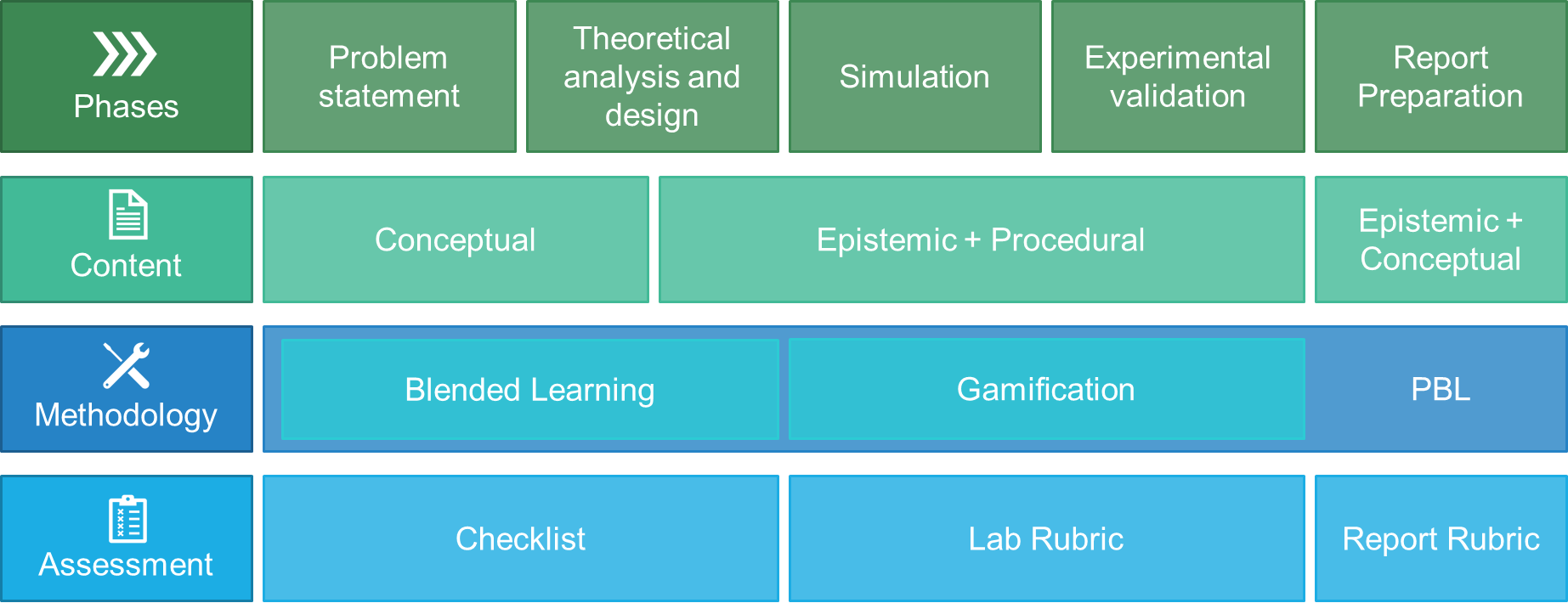
he
laboratory experience is structured around several activities, in
which the different types of knowledge (conceptual, procedural, and
epistemic) are progressively integrated (Figure 1). Each activity
uses mainly two active methodologies: b-learning, to guide students
through the initial stages of objectives definition and theoretical
circuit design and simulation; and gamification, in the circuit
implementation and experimental verification phases. This approach
ensures that students experience the complete cycle of an electronics
designer.
Figure 1. Phases, type of content, methodology used and assessment.
An initial meeting is held to establish the project objectives. Then, the theoretical analysis and simulation phases are carried out outside the classroom in heterogeneous groups to promote teamwork, diversity of perspectives, as well as to foster cooperative learning. This learning phase provides a foundation for students to evaluate whether the results obtained during the laboratory session align with the expected theoretical outcomes. Finally, the experimental verification phases of the circuit take place in the laboratory through a gamified experience.
Specifically, this work draws inspiration from the hall escape concept, but its primary focus is on gamifying the laboratory experience. Students work collaboratively to overcome progressively complex challenges, receive immediate feedback, and earn rewards that allow them to advance to subsequent stages. Each task is designed as a meaningful game element, integrating theoretical knowledge and practical skills, which enhances engagement, motivation, and active participation. The activities incorporate elements of narrative and storytelling, giving students a clear sense of purpose and progression. Additionally, the staged challenges allow students to experience a sense of achievement and mastery as they unlock each phase, culminating in the acquisition of a final secret code, which serves as both a tangible reward and a confirmation of successful completion of the laboratory experience. All this knowledge is integrated under the Project-Based Learning (PBL) methodology.
3.3. Classroom interventions
Following this learning process, two classroom interventions (CI) have been proposed:
Digital Domain. Students are asked to implement a rectangular signal generator as a project requested by an electronic instrumentation company, which requires this signal to synchronize a data acquisition module in a new device. They are provided with operational amplifiers, resistors, capacitors, a power supply, and an oscilloscope.
Analog Domain. Students must implement a Wien bridge analog oscillator as part of a collaborative project with an international research laboratory, which requires a stable sinusoidal signal to test and calibrate vibration sensors in an experimental system located abroad. They are also provided with the same laboratory resources.
4. Implementation and assessment
4.1. Implementation
Classroom interventions have been carried out with a pilot group of 20 students. Students are organized into heterogeneous groups of 2-3 members. A duration of ten hours is planned for each of the two classroom interventions. The temporal sequencing of the activities is structured as follows: one in-class hour devoted to defining objectives; three hours of out-of-class work focused on theoretical analysis and simulation; four in-person laboratory hours dedicated to the experimental component; and two hours allocated to the preparation of the report.
Both interventions have been already conducted as a pilot experience, which allowed the identification of strengths and areas for improvement before its full implementation. During this initial trial, it was observed that the b-learning methodology is particularly effective as it combines in-person guidance with autonomous work. This approach enabled students to arrive at the laboratory better prepared, gain a deeper understanding of the objectives of each challenge, and anticipate expected results, thereby enhancing both the efficiency and quality of experimental execution.
4.1.1. Classroom intervention 1: Digital Domain
Following the hall escape dynamic, the main challenge is broken into connected sub-challenges, where each stage unlocks clues or crucial information needed to advance to the next level. For example, one intermediate challenge requires discovering the expression for the oscillation frequency during the theoretical design phase; this expression acts as a puzzle that provides a hint for the simulation phase. Some of these “key items” are entered into a tracking form, allowing both the players (students) and the instructor to monitor the progress of the students in real time and identify obstacles before they become blockers (Figure 2). The final “key” of the session corresponds to a critical parameter of the circuit, which must be experimentally verified in the laboratory to complete the task. As shown in Table 1, each specific activity generates a particular type of content: from the initial phase, in which the objectives are defined and the theoretical analysis and design are carried out, aiming to foster the development of conceptual knowledge; through the simulation and experimental validation phase, where epistemic and procedural knowledge are developed; to the report-writing phase, which focuses on epistemic and conceptual knowledge.
This approach transforms learning into an interactive, narrative-driven experience, seamlessly integrating theory, simulation, and practice while encouraging strategic collaboration, problem-solving, and evidence-based decision-making.
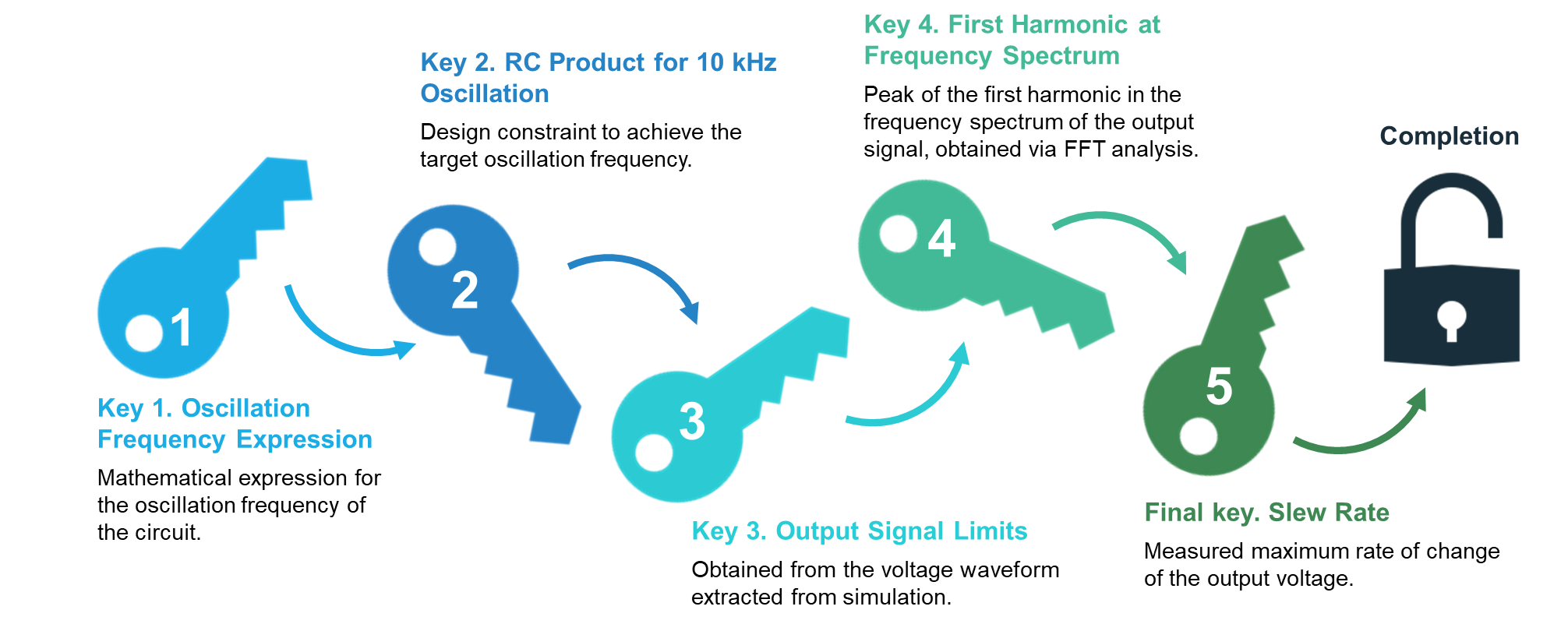
Figure 2. Example of keys and clues for level progression.
Table 1. Main activities, methodologies and type of content.
Activity |
Methodology |
Content |
A1. Collaborative virtual quiz for frequency derivation |
B-learning |
Conceptual |
A2. Checklist-based guided design on circuit components |
||
A3. Virtual laboratory for output signal analysis |
Espitemic + procedural |
|
A4. Collaborative guided inquiry on FFT signal analysis |
Gamification |
|
A5. Collaborative guided inquiry on the op-amp specitifcations |
||
A6. On-site quiz on slew rate calculation and interpretation |
4.1.2. Classroom intervention 2: Analog Domain
The second classroom intervention follows a similar pattern. An initial challenge requires determining the oscillation conditions of the circuit, which then connects to a puzzle providing critical information for the simulation. Intermediate challenges include entering the expression for an oscillation frequency into an online platform, with each solved clue unlocking the next stage. The final key is obtained by measuring the Total Harmonic Distortion (THD) of the implemented circuit. Once this key is acquired, the session is completed.
4.2. Assessment
Student assessment is conducted at multiple stages of the activity to provide continuous feedback and ensure comprehensive evaluation. During the initial b-learning phases, a checklist is used to evaluate their understanding of the objectives and the accuracy of their design proposals. In the implementation and experimental verification phases, a laboratory rubric is applied to assess procedural skills and correct execution of experiments. Finally, the submission of a scientific report is evaluated using a rubric, which focuses on the organization of content, justification of design decisions, critical analysis of results, and the effective communication of findings (Table 2). The preparation of the report requires students to structure and justify each decision made during the process, ensuring that the evaluation reflects both mastery of the content and the ability to apply knowledge in a practical context. This multi-stage assessment approach allows instructors to measure conceptual, procedural, and epistemic learning outcomes while promoting reflection, scientific rigor, and the development of practical and communication skills.
Table 2. Evaluation items.
A.Scientific exaplanation of the phenomena |
A1. Scientific knowledge of the problem. |
A2. Model generation and implications for society. |
|
A3. Predictions, hypotheses and relationships. |
|
B. Design and evaluation of the experiment |
B1. Objectives and methodology. |
B2. Experimental work. |
|
C. Data analysiss and communication |
C1. Data representation. |
C2. Data validity. |
5. Conclusions
EscapeLab shows that the combination of b-learning and gamification is an effective strategy for transforming the traditional electronics laboratory into an active and meaningful learning environment. The adoption of roles drawn from a professional context and the structuring of the activity into design, simulation, implementation, and experimental verification phases foster greater student engagement, promoting reflection, informed decision-making, and moving beyond the mechanical execution of guided laboratory practices.
Likewise, the integration of the hall escape dynamic facilitates a coherent connection between theory, simulation, and experimentation, encouraging collaborative work and critical analysis of results. The use of the b-learning approach improves preparation of the students prior to laboratory sessions and optimizes face-to-face time. Furthermore, EscapeLab proves to be a replicable and adaptable proposal for other laboratory contexts in physics and engineering, with clear potential for the development of experimental and professional competencies in higher education.
References
Almudí, J.M., Zuza, K. and Guisasola, J. (2016). Aprendizaje de la teoría de inducción electromagnética en cursos universitarios de física general. Una enseñanza por resolución guiada de problemas. Enseñanza de las Ciencias 34.2: 7-24. doi: 10.5565/rev/ensciencias.1612.
Barsalou, L. W. y col. (1999) Perceptual symbol systems. Behavioral and brain sciences 22, 577-660.
Ceberio, M., Almudí, J.M. and Zubimendi, J.L. (2014). Análisis de los argumentos elaborados por estudiantes de cursos introductorios de Física universitaria ante situaciones problemáticas. Enseñanza de las Ciencias, 32.3, 71-88.
Cascarosa, E., Sánchez-Azqueta, C., Gimeno, C. y Aldea, C. (2020) Model-based teaching of physics in higher education: a review of educational strategies and cognitive improvements. Journal of Applied Research in Higher Education 13, 33-47.
Ghoulam, K., and Bouikhalene, B. (2024). Evaluating the impact of gamification on cognitive skills development in higher education: A case study electronics and sensors learners. Journal of Information Technology Education: Research, 4(2), 13.
Holland, P. M. (2016). Developing a blended learning approach for the effective teaching of electronic circuit analysis. International Conference on Systems, Signals and Image Processing (IWSSIP), pp. 1-4, doi: 10.1109/IWSSIP.2016.7502742.
Lu, Y., Mao, X., Zhou, M., Zhang, Y., Li, Z., Wang, T., Yin G., and Wang, H. (2021). Motivation under gamification: An empirical study of developers’ motivations and contributions in stack overflow. IEEE transactions on software engineering, 48(12), 4947-4963. doi: 10.1109/TSE.2021.3130088
Nersessian, N. J. (2002) Maxwell and the method of physical analogy: Model-based reasoning, generic abstraction, and conceptual change. Essays in the History and Philosophy of Science and Mathematics, 129-166.
Oliva, J. M., Aragón, M. y Cuesta, J. (2015) The competence of modelling in learning chemical change: a study with secondary school students. International Journal of Science and Mathematics Education 13, 751-791
Pfundt, H. and Duit, R. (2009). Bibliography. Students´ and teachers´ conceptions and science education. Kiel, Germany: Institute for Science Education at the University of Kiel. http://archiv.ipn.uni-kiel.de/stcse/.
Prins, G. T., Bulte, A. M., Van Driel, J. H. y Pilot, A. (2009) Student involvement in authentic modelling practices as contexts in chemistry education. Research in Science Education 39, 681-700.
Shinghal, K., Saxena, A., Saxena, N., & Misra, R. (2020). IOT based modified hybrid blended learning model for education. International Conference on Advances in Computing, Communication & Materials (ICACCM), pp. 229-232. doi: 10.1109/ICACCM50413.2020.9213049
Yadav, A., Subedi, D., Lundeberg, M.A. and Bunting, C.F. (2011). Problem-based Learning: Influence on Students' Learning in an Electrical Engineering Course. Journal of Engineering Education, 100: 253-280, doi: 10.1002/j.2168-9830.2011.tb00013.x.