Creative Approaches to Translation for Language Learning in the Age of AI
Creative Approaches to Translation for Language Learning in the Age of AI
Creative Approaches to Translation for Language Learning in the Age of AI
Jennifer Irene Wood

Modern Languages Department, Prifysgol Aberystwyth University, Cymru, UK.
How to cite: Wood, J. I. (2026). Creative Approaches to Translation for Language Learning in the Age of AI. In: 12th International Conference on Higher Education Advances (HEAd’26). Valencia, 15-18 June 2026. https://doi.org/10.4995/HEAd26.2026.21761
Abstract
This paper showcases translation teaching and assessment approaches developed within the Modern Languages Department of Prifysgol Aberystwyth University (PAU) to promote communicative competence, critical and creative thinking and AI literacy for employability future-proofing. Alongside an exploration of both staff and student perspectives on the impact of AI, this paper offers concrete examples of classroom practice designed to address challenges raised by AI, focused on the need to mitigate concerns around AI dependence and to foster cognitive resilience in the student body, while supporting the development of professional skills. It also discusses the current language-teaching landscape, in which educators increasingly must defend the value of language-learning and plurilingualism in an era marked by freely accessible machine translation and proliferating AI use. The activities discussed were designed by Alex Mangold (German), Roberta Sartoni (Italian) and Jennifer Wood (Spanish).
Keywords: AI; translation; employability; creativity; critical thinking; cognitive resilience.
1. Introduction
A spate of recent articles in the English-speaking press have focused on the idea that learning another language is pointless in the age of AI, often countered by reports of the social, health and cognitive benefits and employability advantages of language learning and plurilingualism (Guest, 2024; Ramirez, 2024; Sparks, 2025). Concomitantly, the role of translation in language teaching has come under increasing scrutiny given the challenges raised by AI, freely available online machine translation (MT) tools and the advent of neural machine translation (NMT), driven by perceptions of their widespread and ‘inappropriate’ usage by students.
Previous discussion regarding the use of translation as a language-teaching tool has been on the need to focus on translation as a communicative and task-based activity (see Fraser, 1996; Hurtado Albir, 1999; González Davies, 2004; Balboni, 2017). That is, process- rather than product-oriented, so learners learn by doing and in so doing solve communicative problems, apply critical thinking and problem-solving strategies, while becoming aware of (inter)cultural context alongside lexical, grammatical and syntactical forms and functions. This focus on developing communicative competence (linguistic, extra-linguistic and contextual) chimes with the reported benefits of learning a language and the continuing need for the human translator, who can navigate cultural nuances, complex contexts, polysemy, idioms and other textual intricacies, areas where MT / AI can fall short, generating misinterpretations and inaccuracies.
2. Attitudes Towards AI
According to a range of recent surveys, faculty attitudes towards AI in education are rather mixed. While the Digital Education Council: Global AI Faculty Survey 2025 observes that 57% of faculty surveyed have positive feelings towards AI in education, many faculty members express concerns regarding students' AI literacy and potential over-reliance on AI: 83% are concerned about students' ability to critically evaluate AI output, and 82% worry that students may become too reliant on AI, findings echoed in other reports (see DfE, 2024; Attewell, 2025a; Carnegie Learning, 2025; GMB Union, 2025). On the whole, educators’ confidence in AI is uneven, frequently discussed in terms of wariness and scepticism, while ethical worries are increasing, in conjunction with widespread concerns around data protection, student over-reliance on AI tools, bias, academic quality and integrity (Attewell, 2025a; DfE, 2024).
Student attitudes around AI usage echo those of faculty, with particular concerns raised around misinformation, skills loss, academic integrity and the impact of AI on future employment opportunities (Attewell, 2025b). Students fear that increasing reliance on AI: “could lead to a homogenisation of thought, reducing individuality and a loss of creativity” (Attewell, 2025b); could inhibit the development of critical thinking; and negatively impact their interpersonal and communication skills, the latter being of especial significance in relation to language learning and translation. Such concerns also match those revealed in a study by Gerlich (2025, p.20) where interviews with study participants around their AI usage highlighted “three dominant themes: [concerns around] AI dependence, [impacts on] cognitive engagement, and ethical concerns.”
3. Edtech and GenAI
The usage of AI for language learning has developed from edtech, aka ‘programmed learning’ or ‘machine learning’. In the 1950s, the Harvard psychologist B. F. Skinner designed the teaching machine, which used behaviourist principles, such as operant conditioning and reinforcement, to automate learning through small, sequential steps with immediate corrective feedback. Accordingly, this would allow students to individualise their learning and work at their own pace, while educators would be freed from performing repetitive tasks to focus on other pedagogical areas, thus making teaching and learning more efficient: A familiar claim in relation to AI, not just to edtech and digital technologies, but one for which growing evidence suggests the opposite; that edtech tends to increase teachers’ workloads, while diminishing their professional autonomy and undermining their expertise (Facer & Selwyn, 2021). Skinner’s invention is seen as laying the groundwork for AI’s ‘reinforcement learning’ algorithms, and for adaptive learning models and platforms that tailor content based on user performance (e.g. Duolingo). However, in such programmed learning, there is little space for reflection, for the social construction of knowledge or for the development of intercultural understanding.
3.1. Same promises, new risks?
GenAI promises to automate routine and complex tasks, freeing up cognitive resources for higher-order thinking. It also promises to enhance learning outcomes by automatising and personalising learning, providing immediate feedback, supporting skill acquisition and knowledge retention, thereby increasing productivity. However, as with previous edtech promises, convenience comes at a cost. AI tools may offer quick solutions and ready-made information, but AI-usage discourages users from engaging in the deep cognitive involvement essential for memory retention, critical thinking and independent problem-solving, leading to a decline in cognitive flexibility and creativity, or cognitive resilience.1 The appeal of individualised learning may also fit with the trend for ‘self-directed’ and ‘self-regulated’ learning, but these ‘siloed’ modes of engagement have been shown to impair social knowledge-building, including interpersonal and communication skills, impacts well-documented as a result of the pandemic (Facer & Selwyn, 2021). Similarly, tools like Grammarly may help students improve their writing by offering instant feedback on grammar, style and coherence, refining their technical skills, but they don’t help foster the deep analytical thinking required for developing arguments and critical evaluation. Such tools also encourage formulaic writing over creative and critical thought. The ability to engage in deep, reflective thinking is essential for effective problem-solving while algorithmic bias can hinder critical evaluation by encouraging confirmation bias and by reducing critical scrutiny of information.
4. Language Teaching and Learning in the Age of AI
In the current AI-saturated climate, language teaching and learning is coming under increasing scrutiny, not just in regard to how we assess students’ linguistic competency but also in how we address their employability concerns, given the refrain that “technology can do it for you” (Ramirez, 2024). As with many disciplines, previous assessment practices are often no longer fit for purpose, but for language teaching and learning this is perhaps more pressing because AI is built on large language models (LLMs), which work by anticipating language patterns; effectively what we try to teach students – to recognise, replicate, manipulate and (re)produce language patterns. However, meaningful language learning goes beyond this anticipation and reproduction of language patterns, it also involves (inter)cultural and contextual understanding, as well as recognition of the ‘human’ element in language, as Guest (2024) notes: “Language is not just a set of rules and vocabulary; it is a living, breathing form of expression that conveys emotions, tone and the unique style of the speaker or writer”: An impact of AI-generated text already recognized by students, demonstrating an awareness “that if they passively accept AI suggestions without reviewing and engaging with how the words, phrasing and tone can influence meaning, they risk being unable to engage in social and professional interactions” (Attewell, 2025b).
The need for a human dimension, for pedagogical judgement, and for the fostering of creativity and criticality when interacting with and incorporating AI tools into educational spaces is a key theme in recent language pedagogy discussions (see Editorial Difusión, 2025: Carnegie Learning, 2025), particularly significant when considering the role of translation. Student employability concerns should also be acknowledged, given that anyone who wishes to work in the translation industry will be using technological supports, including MT, and post-editing AI-generated texts. As educators, our role is to provide students with the knowledge and tools to help them navigate this new employability landscape.
4.1. Machine-Translation: Shortcomings and the Human Dimension
Although MT technologies have made significant leaps forward, they still struggle to capture certain aspects of the source language (SL) and accurately convey them in the target language (TL), such as idioms, metaphors and wordplay, often providing a literal translation that lacks context. A lack of contextual knowledge or knowledge of cultural norms can also lead to misinterpretations, distorting the source text (ST) message. As Bowker (2023, p.46) remarks: “computers cannot think and are not capable of understanding language or culture.”
To illustrate the shortcomings of MT for students, it is possible to choose texts with which MT struggles, such as those that include colloquial language and swearwords; that include speech; that are highly specialised or that are stylistically innovative, but these then are often only accessible to higher levels (ECFR B2-C2) or don’t provide the necessary practice in a variety of text-types and registers. Teaching effective translation strategies can help address these challenges, while emphasizing the importance of that human dimension and the deeper cultural knowledge that learning a language entails (see Guest 2024; Ramirez, 2024).
5. Pedagogical Strategies: Concrete Examples
To optimise translation in language-teaching practice, an effective approach is to focus on communicative and task-based activities, process-rather than product-oriented. Such methods also address areas highlighted as significant when considering the integration of AI-tools into general educational practices and the mitigation of the long-term consequences of AI-usage on such areas as critical thinking. As Gerlich (2025, p.23) observes: “Educational interventions should … integrate critical thinking exercises and foster environments where students are encouraged to engage deeply with content rather than passively relying on AI tools … [including helping] users critically evaluate AI-generated content.” The focus should be on active learning strategies that involve students in the learning process, fostering cognitive resilience, flexibility and creativity by promoting deep thinking, analytical reasoning, problem-solving and reflective practices; that is, more active and engaged cognitive processes.
The following are examples of some task-based translation activities developed by colleagues in the PAU Modern Languages Department, starting with those that are more process-oriented. These tasks are adaptable across languages and target proficiency levels (TPL).
5.1. Stepped Unseen Translation Task
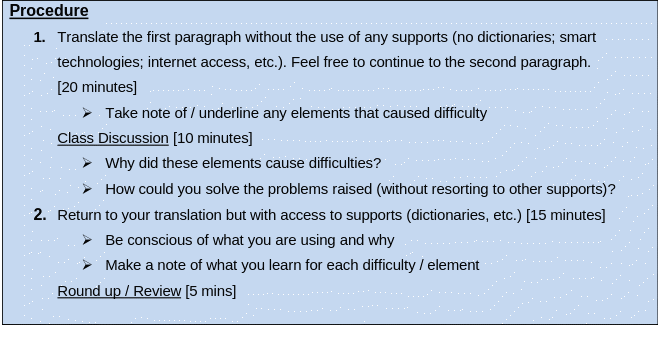
Figure 1. Extract from student instructions for Stepped Unseen Translation Task.
Developed by Sartoni, R. and Wood, J.
This scaffolding task (see fig.1) is designed to provide students (TPL A2-C1) with practical strategies for tackling an unseen translation under exam conditions, where students typically have no access to supports. The task’s purpose is to guide students towards techniques for tackling textual difficulties by encouraging them to critically evaluate the text and its (cultural) context, actively solving challenges without immediately resorting to the dictionary, MT tools or AI supports, building cognitive resilience and confidence in their own analytical skills and linguistic knowledge. This activity can also tie into a related task – textual analysis or textual commentary.
5.2. Textual commentary
The development of a textual commentary as a translation accompaniment (oral discussion or written), focuses students on textual aspects which might influence their translation choices, engaging them with (cultural) context, genre, register, style, tone and emotion, all part of the ST message and areas which MT manages less well. If students use AI tools, or MT, they can also be asked to discuss any problems and shortcomings encountered as well as instances where such tools were helpful. Oral commentaries can act as a first step towards higher-level written engagement which would typically include translation theory and deeper textual analysis. The demand that students analyse and reflect more consciously on ST qualities and their translation choices, requires them to engage more deeply and more critically with both the ST and TT.
5.3. Identifying transpositions
A further associated task is the identification of transpositions, cultural and / or grammatical; a fundamental translation technique which relies on good grammatical and cultural knowledge in both the SL and the TL. A way of introducing students to basic translation techniques and translation theory and to get them to analyse morphological and syntactical patterns, particularly when moving from one language to another. Students are expected to identify not just the change made but also to explain why they made that change. Related tasks would be to identify linguistic challenges or a difficult sentence and explain why it posed a challenge.
5.4. Working with MT / AI Tools
The following are a selection of more product-oriented scaffolded tasks, designed to develop AI literacy and employability-related post-editing skills.
5.4.1. Identifying errors in machine-translated texts
For this task, students (TPL B1-C1) are given the ST and a machine-translated version. They are asked to find a set number of errors in the TT and explain why each is incorrect. A sample rubric: ‘Find 20 mistakes in the Google Translate version of the text and for each one, explain why it is a mistake. Each mistake and explanation listed carries a mark of 5%. To be awarded the full 5%, the element highlighted must a) be a mistake and b) have an accurate and coherent explanation for why it is a mistake. Partial marks will be awarded.’ Surprisingly popular with students, this task requires a good ST understanding while fostering an understanding of the shortcomings of MT / GenAI. It also helps students to identify where post-edits will be needed so that they can then (re)apply this knowledge in the future.
5.4.2. Post-editing machine-translated texts
Students (TPL B1-C1) are given the ST and a machine-translated version. Rather than just identifying and explaining errors, they are asked to improve, or post-edit the TT, tackling not just errors but awkward or stilted expressions, misinterpretations, contextual inaccuracies, etc.
5.4.3 Scaffolded MT / AI Usage: From Prompt to Image
Students (TPL B1-C2) are instructed to use an AI tool to translate a short section of a longer text, such as a newspaper headline. They are then asked to use an AI image generator to illustrate the translated headline and to consider the AI tool’s understanding of what it is doing via the resultant image. Finally, they must rephrase the prompt to get a more accurate result. Beyond linguistic, contextual and (inter)cultural competencies, this activity fosters technical AI literacy – the skill of prompt crafting, alongside an understanding of how AI responses are generated – and critical literacy, by developing the skills to analyse, evaluate and question GenAI results. The activity may also raise discussions related to AI ethical literacy – the moral, social, EDI and humanist dimensions of AI use.
5.5. Comparing Translations
Students (TPL B1-C2) are given a ST and two different TTs – machine-translations, AI-generated, official published translations or a combination. They must evaluate the TTs, noting differences and / or considering which is the most successful TT and why. An additional step is to introduce translator commentaries into the discussion, to see if this changes students’ initial appraisal. This task works well as an oral discussion exercise but can also form a higher-level (TPL B2-C2) written submission.
6. Conclusion
These task-based translation activities foster creativity and critical thinking, that is “the ability to analyse, evaluate and synthesise information to make reasoned decisions” deemed “a fundamental cognitive skill essential for academic success, professional competence, and informed citizenship” (Gerlich, 2025, p.1). They also require students to actively engage with content, developing intercultural knowledge and communicative competence, while raising awareness of contextual, lexical, morphological and syntactical forms and functions. Such activities also promote numerous cognitive processes, including problem-solving, decision-making and reflective-thinking while highlighting the importance of and continuing need for the human translator. Furthermore, these approaches help to develop important AI literacy and employability skills – a vital consideration for 67% of students (Freeman, 2025) –, preparing them for future workplace challenges and for navigating complex, fluid and dynamic professional environments.
References
Attewell, S. (2025a), Staff perceptions of AI 2025. https://nationalcentreforai.jiscinvolve.org/wp/2025/09/02/staff-perceptions-of-ai-2025/
Attewell, S. (2025b). Student perceptions of AI 2025. https://www.jisc.ac.uk/reports/student-perceptions-of-ai-2025
Balboni, P. E. (2017). Translation in Language Learning: A ‘What For’ Approach. EntreLínguas, Araraquara, 3(2), 276-299. DOI: 10.29051/rel.v3.n2.2017.9546
Bowker, L. (2023). De-mystifying Translation. Introducing Translation to Non-translators. London: Routledge.
Carnegie Learning. (2025). The State of AI in Education 2025: Key Findings from a National Survey. https://discover.carnegielearning.com/hubfs/PDFs/Whitepaper%20and%20Guide%20PDFs/2025-AI-in-Ed-Report.pdf?hsLang=en
Department for Education [DfE]. (2024). Generative AI in education. Educator and expert views. https://assets.publishing.service.gov.uk/media/65b8cd41b5cb6e000d8bb74e/DfE_GenAI_in_education_-_Educator_and_expert_views_report.pdf
Digital Education Council. (2025). Global AI Faculty Survey. https://cdn.prod.website-files.com/65f1d299b87bcc50550a6398/678a9e0aa38a44fdac1d53a8_Digital%20Education%20Council%20Global%20AI%20Faculty%20Survey%202025-1.pdf
Editorial Difusión. (2025). Humanizando la enseñanza de lenguas en tiempos de algoritmos. [Video]. YouTube. https://www.youtube.com/watch?v=k3Q8aTWtmwU
Facer, K & Selwyn, N. (2021). Digital technology and the futures of education – towards ‘non-stupid’ optimism. https://unesdoc.unesco.org/ark:/48223/pf0000377071
Fraser, J. (1996). Mapping the Process of Translation. Meta, XLI (1), 84-96. https://doi.org/10.7202/002772ar
Freeman, J. (2025). Student Generative AI Survey 2025. https://www.hepi.ac.uk/wp-content/uploads/2025/02/HEPI-Kortext-Student-Generative-AI-Survey-2025.pdf
Gerlich, M. (2025). AI Tools in Society: Impacts on Cognitive Offloading and the Future of Critical Thinking. Societies, 15(6). 1-28. https://doi.org/10.3390/soc15010006
GMB Union. (April 2025). Digital and Technology Standards and Artificial Intelligence in Education Survey. Summary Report. https://www.gmb.org.uk/assets/media/documents/digital-and-technology-standards-and-ai-in-education-survey-summary-report.pdf
González Davies, M. (2004). Multiple Voices in the Translation Classroom. Activities, tasks and projects. Amsterdam, John Benjamins Publishing Company.
Guest, C. (2024). Why learning a language is better than using machine translation. https://www.pearson.com/languages/community/blogs/why-learning-a-language-is-better-than-machine-translation-2-24.html
Hurtado Albir, A. (1999). La competencia traductora y su adquisición. un modelo holístico y dinámico. Perspectives, 7(2), 177–188. https://doi.org/10.1080/0907676X.1999.9961356
Mahardhika Artawijaya, L. & Supratiwi, M. (2024). Cognitive Flexibility and Resilience in Adolescents: Exploring Gender Differences and Cultural Implications. Nusantara Journal of Behavioral and Social Science. 3(4), 151-160. https://doi.org/10.47679/njbss.202462
Ramirez, E. (2024). With AI translation tools so powerful, what is the point of learning a language? The Conversation. https://theconversation.com/with-ai-translation-tools-so-powerful-what-is-the-point-of-learning-a-language-238068
Sparkes, Matthew. (2025). Should you still learn a second language if AI can translate for you? NewScientist. https://www.newscientist.com/article/2482190-should-you-still-learn-a-second-language-if-ai-can-translate-for-you/
1 In an educational context, cognitive resilience refers to the ability to adapt to challenges, reflect on and recover from setbacks, process relevant information, make rapid and flexible decisions, use problem-solving skills, apply critical thinking and sustain mental adaptability in unpredictable contexts. See Mahardhika Artawijaya & Supratiwi (2024) for discussion.