Next-Generation Professional Development: A Case Study of Inclusive Pedagogy as the Design Framework for Faculty Learning Communities
Next Generation Professional Development
Next-Generation Professional Development: A Case Study of Inclusive Pedagogy as the Design Framework for Faculty Learning Communities
Sonia
Chaidez1
 ,
Paige Sturley2
1Center for Teaching and Learning, Whittier College, United States of America, 2Quantitative Success Center, Whittier College, United States of America.
How to cite: Chaidez, S.; Sturley, P. (2026). Next-Generation Professional Development: A Case Study of Inclusive Pedagogy as the Design Framework for Faculty Learning Communities. In: 12th International Conference on Higher Education Advances (HEAd’26). Valencia, 15-18 June 2026. https://doi.org/10.4995/HEAd26.2026.21779
Abstract
This case study examines how inclusive teaching pedagogy can function not only as the content of professional development, but also as the guiding framework for sustaining faculty learning communities (FLCs). Conducted at Whittier College, a small liberal arts school and Hispanic Serving Institution (HSI) in Southern California, the study traces three years of inclusive-teaching initiatives implemented through facilitated, cross-disciplinary learning communities. Evidence from program surveys, reflections, and documented instructional changes suggest that the FLCs build community among participants, sustain participation across semesters, and support classroom-level pedagogical change. The model remained viable after an abrupt loss of grant funding, indicating that community-based professional learning can support sustainability under resource constraints. The paper offers a transferable framework for institutions seeking to embed inclusive pedagogy into professional development structures and argues that inclusive-principled FLCs can operate as a mechanism for pedagogical change.
Keywords: Inclusive teaching; faculty learning communities, professional development; instructional change
1. Introduction
Whittier College is a small liberal arts college and Hispanic Serving Institution located in Southern California, serving a diverse student population. Like many institutions, Whittier has faced post-pandemic challenges in enrollment and retention while responding to growing student diversity and uneven academic preparedness (Adkins, 2022). During the period of this case, our institution faced declining enrollment alongside a consistently high proportion of first-generation students (Figure 1). These conditions underscore the need for iterative instructional approaches that meet students where they are and are grounded in inclusivity and equity. Research indicates that inclusive teaching practices are associated with improved engagement, learning, and persistence (Addy et al., 2021; O’Keeffe, 2013). Yet faculty professional development frequently relies on stand-alone workshops that introduce strategies without supporting sustained change.
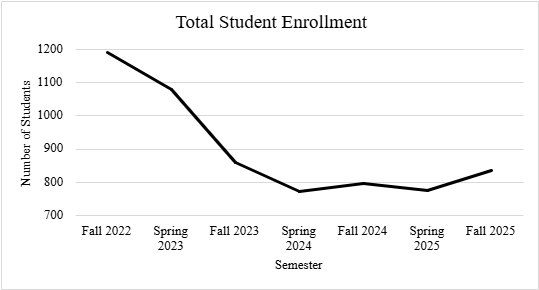
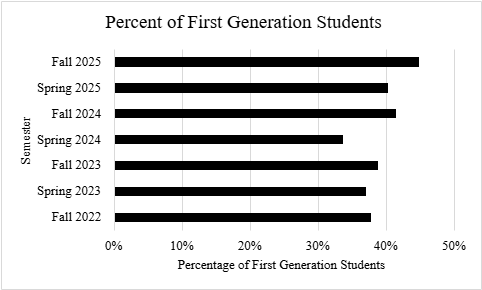
Figure 2. Percent First Generation Students Population
This paper presents a three-year institutional case study in which inclusive teaching pedagogy served not only as the focus of professional development but also as the design framework for facilitating and iterating FLCs. The case asks: How can inclusive pedagogy guide the design and facilitation of FLCs? What outcomes do participants report? And what features sustain participation under resource constraints?
2. Context and Evidence Base
2.1. Institutional Setting and Programs
The Center for Teaching and Learning (CTL) serves as a hub for professional development and pedagogical innovation at Whittier College, supporting faculty and staff in strengthening teaching and learning in service of student success. In January 2023, the Quantitative Success Center (QSC) was established through a three-year grant with the goal of improving passing rates in quantitative-based courses. The QSC partnered closely with the CTL to design and implement professional development programming focused on inclusive teaching.
The initiative began with a focus on STEM education supported by grant-funded seed resources. The institution adopted the Inclusive STEM Teaching Project (ISTP), a National Science Foundation-funded program grounded in evidence-based inclusive pedagogy (Coddington et al., 2024), as the shared learning curriculum. Over time, professional development expanded beyond STEM and came to include an applied pathway through program-specific learning groups. These included the Whittier Inclusive and Supportive Educators (WISE) Scholars and two discussion-based communities known as Book Club and Non-Book Club.
2.2. Data Sources and Analytic Approach
Inclusive teaching in higher education refers to practices designed to provide equitable opportunities for all students to learn while recognizing diverse identities, backgrounds, and abilities (Addy et al., 2021). Adding inclusive teaching pedagogies to faculty development programming creates an intentional approach to meet the instructional needs of all students (Bifulco and Drue, 2023). As part of our inclusive teaching initiatives, we implemented principles that include shared voice, transparency, belonging, and recognizing barriers to learning as facilitation norms and program features in FLCs.
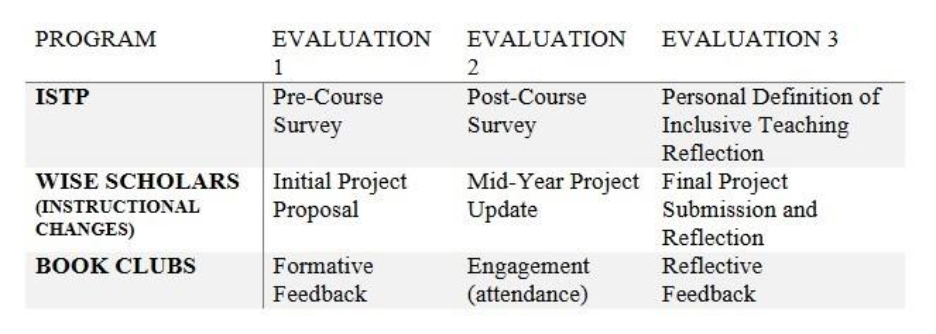
Evidence was gathered across initiatives from (a) program surveys, (b) participant reflections (including end-of-program self-written definitions of inclusive teaching), and (c) documented instructional changes reported by participants (e.g., course design or assessment shifts). We conducted a small-scale thematic analysis of open-ended survey responses and reflections. Data collection varied by program; Table 1 summarizes the evaluation of artifacts used across ISTP, WISE, and Book Club.
Table 1. Summary of Survey and Reflections by Program
2.3. Limitations
Key limitations include self-selection into programs, primarily self-reported evidence, a single-institution context, and limited linkage to student outcome measures. The case does not claim causal effects on student learning or retention; rather, it identifies participant-reported outcomes and design features that plausibly support sustained faculty learning and implementation.
3. Program Design and Three-Year Iteration
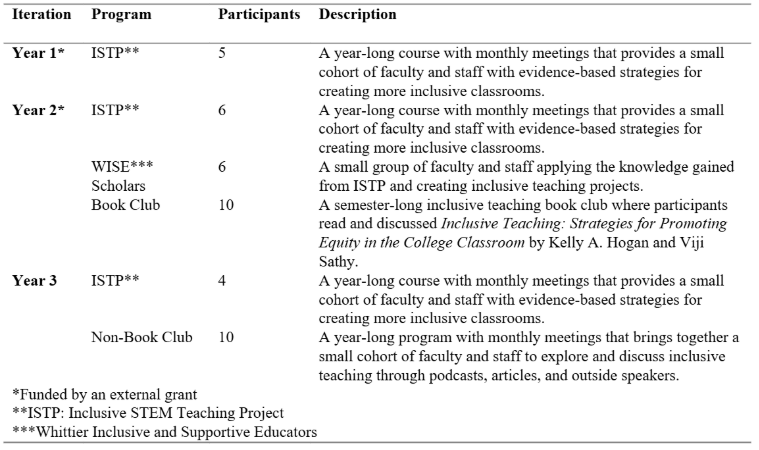
The initiative unfolded as a sequence of related professional development offerings over three years. Table 2 summarizes the initiatives, participation, and brief descriptions across the three-year implementation.
Table 2. Three-Year Iterative Professional Development Programming
3.1. Year 1: ISTP Cohort and Facilitation Design (Fall 2023-Spring 2024)
Members of the CTL and QSC completed ISTP facilitator training that entailed graded online modules and extensive written reflections prior to launching the first year-long local cohort in Fall 2023. The cohort, composed primarily of STEM faculty, used a flipped classroom design: participants completed ISTP modules independently and then met monthly in person for facilitated discussion and application. A central outcome was the development of a personal, actionable definition of inclusive teaching. This definition functioned as an instructional “north star” intended to sustain inclusive teaching practice beyond the program.
The flipped-course design mirrored inclusive instructional strategies by using synchronous time for reflection, sense-making, and local application rather than content delivery.
3.2. Year 2: Expansion and Application (Fall 2024-Spring 2025)
In the second year, the model expanded in two ways. First, ISTP participation broadened from primarily STEM faculty to a more multidisciplinary cohort that included additional faculty and staff. Second, an applied pathway was added through the Whittier Inclusive and Supportive Educators (WISE) program, which supported participants in translating learning into classroom-based inclusive teaching projects. WISE incorporated choice and flexibility in project focus and format, emphasizing relevance and transferability across disciplinary contexts.
Additionally, a semester-long inclusive teaching book club launched in Spring 2025 using Hogan and Sathy’s Inclusive Teaching: Strategies for Promoting Equity in the College Classroom as a shared text, structured as an additional FLC with facilitated chapter-based discussions. Together, ISTP, WISE, and the Book Club functioned as a scaffolded approach that moved participants from awareness and reflection toward implementation.
3.3. Year 3: Sustainability After Funding Loss (Fall 2025-Spring 2026)
In February 2025, grant funding was abruptly cut, eliminating stipends that had supported early participation and reduced program resources. Despite this constraint, core FLCs continued. ISTP persisted with reduced financial support, and the Book Club evolved into a year-long FLC called “Non-Book Club” maintaining monthly meetings while expanding content sources to articles, podcasts, and guest speakers. This created flexibility for emerging topics while preserving the community structure and facilitation norms that participants identified as central to learning.
4. Findings
Four themes emerged across surveys, reflections, and reported instructional changes.
4.1. Community as the Foundation for Learning
Participants consistently emphasized the value of sustained, small-group engagement in fostering trust, vulnerability, and meaningful dialogue. Meeting regularly with the same cohort created a space for open sharing and deeper learning across disciplinary boundaries:
“[ISTP] created a community. As a new faculty, seeing the same few people over and over again helped me to create new relationships with my new colleagues. Everyone’s willingness to be vulnerable and step in/step back as we had discussions was essential to supporting my learning.”
“I have done many inclusive teaching online courses, and having the experience of a small, in-person community was really helpful.”
4.2. Inclusivity as Purpose and Method
Rather than treating inclusivity solely as content, we embedded inclusive principles into the learning community through norms supporting equitable voice, structures that encouraged honest inquiry, and iterative feedback loops that informed program redesign.
4.3. Sustained Participation
Unlike one-time events, the model generated repeat participation across initiatives and semesters, with participants moving from one FLC into additional offerings (e.g., subsequent cohorts, applied projects, discussion-based communities). Faculty also reported continued engagement outside formal sessions through informal peer networks to share teaching ideas and troubleshoot implementation. Participation persisted even after stipends ended, suggesting that the social and intellectual value of the community supported continued engagement under constraint.
4.4. Translating Theory into Practice
Faculty reported implementing concrete instructional changes, particularly through applied opportunities such as WISE that encouraged experimentation and reflection (e.g., assessment redesign, project-based implementation, alternative grading). Examples included adopting alternative assessment methods in upper-division courses and shifting toward alternative grading in entry-level courses. End-of-program reflections suggested conceptual shifts in how faculty understood teaching, emphasizing safe spaces for vulnerable topics, belonging, and student empowerment:
“Inclusive teaching is more than teaching content… it includes establishing a safe classroom community where every student feels valued.”
“When students feel safe and included, they feel a sense of belonging not just in the classroom but within my field of science as well.”
“This course was essential at this stage of my teaching career… I am now more confident including DEI-related topics and approaches in my teaching and advising.”
5. Discussion
This case suggests that inclusive teaching pedagogy can function as a framework for professional development infrastructure. When inclusive principles shaped facilitation norms and program structures, participants reported stronger engagement and a greater willingness to ask vulnerable questions, seek feedback, and iterate on practice.
A second implication is institutional: inclusive-principled FLCs can normalize inclusive teaching work as collective and developmental rather than optional or individualized. Cross-disciplinary participation supported a shared language and a durable community of practice, positioning inclusive teaching as a campus-wide responsibility.
Finally, the persistence of participation after the loss of funding for stipends in February 2025 provides evidence of sustainability under constraint. Rather than collapsing, the FLC model adapted (e.g., Book Club to Non-Book Club) while preserving core mechanisms: community continuity, facilitation aligned with inclusive principles, and practical relevance to classroom practice. While the study cannot claim causal student-outcome effects, it identifies faculty learning structures as a plausible institutional lever that warrants stronger measurement in future work.
6. Transferable Model and Recommendations
Institutions seeking sustainable professional development for inclusive teaching may benefit from adopting an inclusive pedagogy-aligned FLC model defined by two commitments: (1) inclusive pedagogy as the content of professional development, and (2) inclusive pedagogy as the method by which professional learning is facilitated.
Recommendations for implementation include:
Use inclusive pedagogy to guide facilitation, not just content. Establish shared norms and discussion structures that support equitable voice and space for vulnerable conversations (e.g., structured participation, small-group dialogue, reflective prompts, attention to power dynamics).
Design professional development as iterative and multi-semester. Prioritize semester or year-long FLCs that allow time for trust-building, experimentation, and revision, and use participant feedback to refine program design across cohorts.
Begin with small, committed cohorts and scale intentionally. Start small to establish norms and test facilitation strategies; expand across disciplines and roles after early refinement.
Support application through project-based opportunities. Create pathways (e.g., WISE) for participants to translate learning into classroom practice through course redesign, assessment shifts, or sustainable resource development.
Plan for sustainability under constraint. Diversify formats (curriculum cohort, applied cohort, discussion-based community) and build relational infrastructure that can persist even when funding or stipends end.
7. Conclusion
This three-year case study demonstrates that inclusive teaching pedagogy can guide not only what faculty learn in professional development, but how professional development is designed, facilitated, and sustained through faculty learning communities. An inclusive-principled FLC model supported participant-reported engagement, strengthened community and belonging, and enabled reported instructional change across disciplines. Importantly, the model remained viable after an abrupt loss of grant funding and stipends, suggesting that community-based professional learning can sustain momentum when participants experience the work as meaningful, supportive, and institutionally relevant. Inclusive pedagogy-aligned FLCs offer a scalable approach for institutions seeking next-generation professional development that advances equity and inclusion.
References
Addy, T. M., Dube, D., Mitchell, K. A., & SoRelle, M. (2021). What inclusive instructors do: Principles and practices for excellence in college teaching. Stylus Publishing.
Adkins, S. M. (2022). The Z factor: Generation Z and the perspectives of recruitment professionals on sustaining small private liberal arts institutions during a decade of expected decline in higher education enrollment (Order No. 29168329)
Bifulco, C. & Drue, C., (2023) “A collaborative model for faculty development: Helping faculty develop inclusive teaching practices”, To Improve the Academy: A Journal of Educational Development 42(2): 5. doi: https://doi.org/10.3998/tia.3168
Coddington, D., Yen, A. H., Lewis, H., Johnson-Ojeda, V., Frey, R. F., Hokanson, S. C., & Goldberg, B. B. (2024). Nationwide inclusive facilitator training: Mindsets, practices, and growth. To Improve the Academy: A Journal of Educational Development, 43(2).
Hogan, K. A., & Sathy, V. (2022). Inclusive Teaching: Strategies for Promoting Equity in the College Classroom.
O’Keeffe, P. (2013). A sense of belonging: Improving student retention. College Student Journal, 47(4), 605–613.