Bridging the Gap: The STEAM Junior Academy as a Catalyst for Higher Education in Inland Portugal
STEAM Junior Academy in Inland Portugal
Bridging the Gap: The STEAM Junior Academy as a Catalyst for Higher Education in Inland Portugal
Ana Isabel
Rodrigues Gouveia1,2,3 ,
Mafalda Fonseca4
,
Raquel Abrantes Moreira5
,
Beatrice Santos5,
Vanessa Brito5,
Abílio Silva6
,
José Aleixo7
,
Bruno Silva8
,
Helena Alves3,9
1Faculdade de Ciências da Saúde, Universidade da Beira Interior, Portugal, 2Instituto de Biofísica e Engenharia Biomédica, Faculdade de Ciências, Universidade de Lisboa, Portugal, 3NECE - Research Center for Business Sciences, Faculdade de Ciências Sociais e Humanas, Universidade da Beira Interior, Portugal, 4RISE-Health, Departamento de Ciências Médicas, Faculdade de Ciências da Saúde, Universidade da Beira Interior, Portugal. 5Universidade da Beira Interior, Portugal, 6C-MAST, Centre for Mechanical and Aerospace Science and Technologies, Universidade da Beira Interior, Portugal, 7Centre of Mathematics and Applications (CMA), University of Beira Interior, Portugal, 8Instituto de Telecomunicações, Departamento de Informática, Universidade da Beira Interior, Portugal, 9Departamento de Gestão e Economia, Universidade da Beira Interior, Portugal.
How to cite: Gouveia, A. I. R.; Fonseca, M.; Moreira, R. A.; Santos, B.; Brito, V.; Silva, A.; Aleixo, J.; Silva, B.; Alves, H. (2026). Bridging the Gap: The STEAM Junior Academy as a Catalyst for Higher Education in Inland Portugal. In: 12th International Conference on Higher Education Advances (HEAd’26). Valencia, 15-18 June 2026. https://doi.org/10.4995/HEAd26.2026.21791
The STEAM Junior Academy is an educational initiative developed at the University of Beira Interior (Covilhã, Portugal) to support the transition of upper secondary school students to higher education in Science, Technology, Engineering, Arts, and Mathematics (STEAM), with a particular focus on inland Portugal. Targeting students in the final year(s) of secondary education, the programme combines project-based laboratory work, interactive talks, and campus exploration activities, promoting experiential, interdisciplinary, and collaborative learning. Participant feedback collected across three editions reveals high levels of satisfaction, especially regarding hands-on experimentation, active involvement, topic relevance, and interaction with academic staff and peers. Although the present analysis is descriptive, the consistency of positive responses suggests that STEAM Junior Academy contributes to student motivation and helps strengthen links between secondary and higher education. Longitudinal studies are recommended to assess the long-term educational impact of the initiative.
Keywords: STEAM education; secondary–higher education transition; student motivation; active learning methodologies; educational outreach.
1. Introduction
The development of human capital in Science, Technology, Engineering, Arts and Mathematics (STEAM) is widely recognised as essential for innovation, economic competitiveness and sustainable development. Despite this strategic relevance, higher education institutions continue to face significant challenges in attracting young people to STEAM-related degree programmes. International evidence shows that students’ interest in science and mathematics often declines during secondary education, particularly as they approach the final years when academic choices become more consequential (Sadler et al., 2012; OECD, 2019). This decline is linked not only to perceptions of difficulty but also to a lack of meaningful experiences that connect school science with real-world applications and authentic scientific practices.
Research contextualising students’ educational trajectories highlights that early and sustained engagement with practices such as inquiry-based learning, project-based work and collaborative investigation promotes deeper interest in STEAM fields (Maltese & Tai, 2011; Pinar et al., 2025). Such experiences enhance scientific creativity and foster higher-order cognitive skills, making students more likely to consider science-related careers. Moreover, interventions that encourage students to generate and test hypotheses, design investigations, and reflect on evidence contribute to deeper conceptual understanding across disciplines (Pinar et al., 2025).
Despite increased research on effective teaching and learning strategies, a persistent gap between secondary and higher education remains. University science programmes typically expect students to engage in autonomous inquiry and collaborative problem solving, competencies that are not always cultivated in traditional secondary school. This misalignment can undermine students’ academic performance and sense of belonging in higher education environments, contributing to attrition during the first university years (Tinto, 2017). Evidence supports the integration of active learning approaches, such as collaborative projects and inquiry-based tasks, to better prepare students for the demands of higher-level scientific study (Freeman et al., 2014).
To address these challenges, educational interventions that bring secondary students into contact with university environments have gained attention. European models such as STEM@school demonstrate that structured collaboration between schools and universities can enhance scientific literacy, motivation and readiness for higher education (De Meester et al., 2020). Additionally, systematic reviews indicate that pedagogical approaches emphasising inquiry, project-based learning and real-world problem solving positively influence students’ choices in science and technology fields (Pinar et al., 2025).
However, despite this growing body of evidence, there remains a scarcity of initiatives specifically designed for inland and peripheral regions, where geographical distance and limited institutional interaction continue to hinder students’ engagement with higher education. It is within this context that the STEAM Junior Academy in University of Beira Interior (UBI) is situated. Targeting students in the final year(s) of secondary education, the Academy brings young people into the university to develop interdisciplinary projects and participate in hands-on scientific activities. By providing early immersion in academic culture and scientific practice, the initiative seeks to bridge the gap between secondary and higher education, while acting as a catalyst for increased participation in STEAM pathways in inland Portugal.
2. Framework and Implementation of the AJSTEAM Junior Academy
The STEAM Junior Academy (AJSTEAM in Portuguese) is grounded in an educational framework specifically designed to support the transition of upper secondary school students into higher education within STEAM fields (Science, Technology, Engineering, Arts, and Mathematics). The Academy seeks to respond simultaneously to two major challenges identified in the literature: the limited exposure of secondary school students to authentic scientific environments and the misalignment between secondary education and the expectations of higher education. AJSTEAM is conceived as a space for work, discussion, reflection and experimentation, promoting observation, questioning and active learning around STEAM disciplines. More than a short-term outreach initiative, the Academy offers students a collective and immersive experience of university life, enabling them to better understand academic practices, institutional culture and potential future pathways in higher education.
The programme targets students in the final year(s) of secondary education from schools located within a 100 km radius of the UBI. Participants are selected by their schools, based on criteria defined locally and on the number of available places established by UBI, ensuring balanced representation across participating institutions. Given UBI’s location in a rural, mountainous and cross-border region, the implementation of AJSTEAM relies on a strong network of institutional partnerships. Local Municipal Councils play a key role in providing logistical support, particularly transportation, while school coordinators—typically one or two teachers per school—act as the main interface between students and the University throughout the programme.
The pedagogical and organisational design of AJSTEAM is structured around three complementary pillars, which together foster engagement, exploration and informed decision-making regarding STEAM studies. These are organised monthly, as shown in Figure 1 and explained in the following sections.
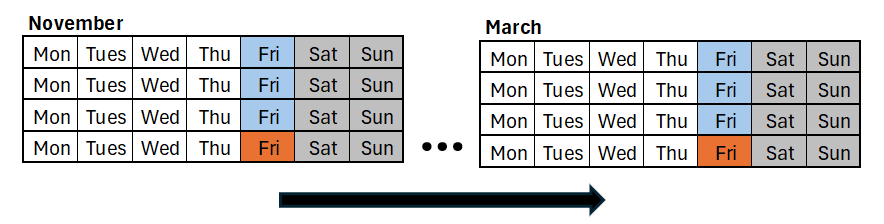
Figure 1. Schematic representation of the project timeline. The first three Fridays (in blue) are for project-based activities and the last one (in orange) is for talks and campus exploration activities.
Together, these components create a coherent framework that combines academic engagement, social interaction and institutional familiarisation. By offering students early, meaningful and structured contact with higher education, the AJSTEAM aims to reduce the gap between secondary education and university, while fostering informed and motivated choices towards STEAM pathways.
2.1. Projects
The core component of AJSTEAM consists of project-based activities carried out in university laboratories. Each project runs for one session per week in Fridays afternoons (for 4 hours) over a three-week period. From a diverse portfolio of projects offered monthly by different STEAM faculties, students select the topic that best aligns with their interests. These activities enable direct contact with researchers, laboratories and scientific methodologies, encouraging inquiry, collaboration and hands-on monthly (Fig.1) experimentation. The number of students on each project (from 5 to 25) varies depending on its nature and the laboratory resources available.
2.2. Talks / Lectures
Talks are organised for all participants simultaneously and take place on the last Friday afternoon of each month (Fig.1). These sessions feature invited professionals, researchers and UBI alumni from diverse STEAM fields. Designed to be informal and interactive, the talks aim to promote dialogue, share career trajectories and demystify academic and professional paths within STEAM.
2.3. Campus Exploration Activities (Peddy Papers and Study Visits)
To complement academic activities, AJSTEAM includes gamified and exploratory experiences such as Peddy Papers and study visits. After the talks, the students were engaged in the peddy papers that also stood out, adding a more playful and interactive component to the lecture days, enriching participants’ experience and fostering greater interaction among students from different schools. Through multidisciplinary challenges carried out in mixed teams from different schools (8–10 students per team), participants explore the university campus, learn about UBI’s history and services, and reinforce secondary school knowledge in a social and collaborative setting. These activities are supported by doctoral students and student associations, reflecting a whole-academy approach and strengthening students’ sense of belonging to the university environment.
3. Activities of the STEAM Junior Academy: some examples
The AJSTEAM adopts an experiential and interdisciplinary approach, integrating activities that connect scientific concepts with real-world contexts. The following examples (Fig. 2) illustrate the diversity and pedagogical intent of the programme.
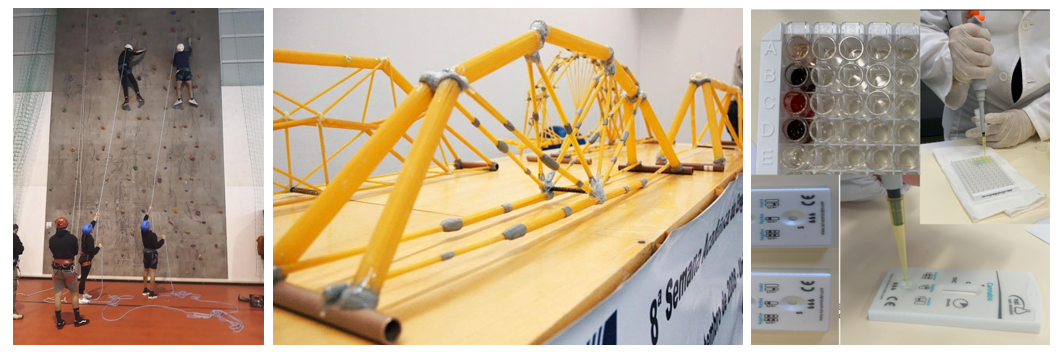
Figure 2. Left - climbing wall (Project “Climbing a Mountain? … Only Science Can Help”); Middle - example of a spaghetti bridge (project “Spaghetti Bridges”); Right - laboratory activity (project “Medical Cannabis vs. Recreational Cannabis”).
3.1. Project “Climbing a Mountain? … Only Science Can Help”
This project uses mountaineering and rappelling as a multidisciplinary learning context. Students begin with indoor experimentation on safety systems, knots and anchorage configurations. Theoretical foundations are then explored, including human physiology at altitude, Newton’s Second Law, impulse and momentum variation, friction, tension and force decomposition, as well as geological aspects related to rock types. The project culminates in an outdoor activity in Serra da Estrela, where students apply scientific principles to real climbing and rappelling scenarios, reinforcing the link between theory, safety and environmental context.
3.2. Project “Spaghetti Bridges”
Focusing on structural engineering, this project introduces concepts such as equilibrium of forces and moments, internal forces in truss structures and strength of materials. Students subsequently design and build truss bridges using spaghetti as the construction material. The activity promotes creativity, collaboration and problem-solving, highlighting the relationship between theoretical modelling and practical design constraints.
3.3. Project “Medical Cannabis vs. Recreational Cannabis”
This interdisciplinary project addresses biomedical, chemical and societal dimensions of cannabis use. Students engage in guided discussions and lectures with researchers and experts on medical and recreational cannabis. Small-scale laboratory activities allow participants to identify cannabinoids in plant extracts, medicinal preparations and, where applicable, biological samples, introducing perspectives from toxicology and forensic science.3.4 Lecture “Scientific Illustration”
3.4. Lecture “Scientific Illustration”
In addition to project-based work, AJSTEAM includes monthly talks aimed at broadening students’ awareness of STEAM careers. An illustrative example is the lecture “Scientific Illustration: Creating Images to Communicate Scientific Facts and Concepts” by Pedro Salgado (BSc in Biology; MSc in Scientific Illustration, Internationally awarded and a member of several organizations connected to scientific illustration), which emphasised the role of visual communication in disseminating scientific knowledge and highlighted the integration of art and science within STEAM.
4. Participant Satisfaction and Program Impact: A Multi-Year Analysis
The AJSTEAM has been implemented annually since 2022/2023, with stable participation across editions. In 2022/2023, the programme involved 82 students from 13 schools, followed by 93 students from 10 schools in 2023/2024 and 89 students from 8 schools in 2024/2025.
Participant satisfaction has been assessed after each edition through anonymous online surveys administered to students, school coordinators, activity facilitators and teachers, using the Google Forms platform. Data collection has been conducted consistently since the first edition.
In 2022/2023, 58 of the 82 enrolled students completed the questionnaire (71% response rate). Among respondents, 91% reported that they would recommend the AJSTEAM to their peers, and 85% indicated that the programme met their expectations. All 14 school coordinators involved in this edition also reported that they would recommend the initiative to other schools and that it met their expectations.
In the 2023/2024 and 2024/2025 editions, student response rates were lower, ranging between 31% and 50%. Nevertheless, satisfaction indicators remained consistently positive across cohorts, as summarised in Table 1.
Table 1. Satisfaction indicators for 2023/2024 and 2024/2025 editions.
|
2023/24 |
2024/25 |
The project is suited to my level of knowledge |
90% |
70% |
The project met my expectations |
71% |
51% |
The project is important for my academic training |
57% |
49% |
The project contributes to my enjoyment/interest in the field |
70% |
52% |
The project was well run and organised, allowing for a good understanding of all activities |
92% |
75% |
4. Discussion
Preparing students for future challenges requires access to high-quality STEM education that demonstrates its relevance to societal issues while fostering subject knowledge, cross-disciplinary thinking, critical reasoning, curiosity, and creativity (Boon Ng 2019). Based on participants’ feedback, AJSTEAM successfully met these goals. Students consistently valued the practical and dynamic nature of the projects, particularly laboratory work, hands-on experimentation, and active participation, as well as the support of supervising faculty. Group work, topic relevance, and peer interaction were also highlighted. However, some areas have fewer projects (e.g., Arts) or projects that are less appealing to students (e.g., Physics).
Across its three editions, AJSTEAM involved more than 80 weekly participants, over 50 faculty members and researchers, and a wide range of contributors, including school coordinators, student associations, doctoral students, and technical staff.
Although this analysis is primarily descriptive, the consistent positive feedback suggests that AJSTEAM enhances student engagement and strengthens links between secondary and higher education in inland Portugal. Regarding the evaluation of activities, in future we could introduce a questionnaire using a Likert scale to allow for greater differentiation. A longitudinal evaluation would be needed to assess long-term impact, though subjective evidence indicates that some participants later applied to STEAM degrees at the UBI.
5. Conclusion
The STEAM Junior Academy highlights the importance of experiential and collaborative learning approaches in supporting students’ transition from secondary to higher education, particularly in inland regions. By engaging students in hands-on, interdisciplinary activities within a university setting, AJSTEAM fosters motivation, curiosity, and a clearer understanding of academic pathways in STEAM. The consistently positive feedback across editions suggests that such initiatives can play a meaningful role in strengthening educational continuity and promoting informed student choices. Future longitudinal research will be important to better understand the programme’s long-term educational impact.
References
Boon Ng, S. (2019). Exploring STEM competences for the 21st century (In-Progress Reflection No. 30 On Current and Critical Issues in Curriculum, Learning and Assessment). UNESCO International Bureau of Education. https://unesdoc.unesco.org/ark:/48223/pf0000368485
De Meester, J., Boeve-de Pauw, J., Buyse, M.-P., Ceuppens, S., De Cock, M., De Loof, H., Goovaerts, L., Hellinckx, L., Knipprath, H., Struyf, A., Van de Velde, D., Van Dooren, W., Van Petegem, P., & Deprez, W. (2020). Bridging the gap between secondary and higher STEM education – the case of STEM@school. European Review, 28(S1), S135–S157. doi:10.1017/S1062798720000964
Freeman, S., Eddy, S. L., McDonough, M., Smith, M. K., Okoroafor, N., Jordt, H., & Wenderoth, M. P. (2014). Active learning increases student performance in science, engineering, and mathematics. Proceedings of the National Academy of Sciences, 111(23), 8410–8415. https://doi.org/10.1073/pnas.1319030111
Maltese, A. V., & Tai, R. H. (2011). Pipeline persistence: Examining the association of educational experiences with earned degrees in STEM among U.S. students. Science Education, 95(5), 877–907. https://doi.org/10.1002/sce.20441
OECD. (2019). Education at a Glance 2019: OECD Indicators. OECD Publishing. https://doi.org/10.1787/f8d7880d-en
Pinar, P. F., Sagcal, R. R., & Prudente, M. S. (2025). Fostering scientific creativity in science education through scientific problem-solving approaches: A meta-analysis. Disciplinary and Interdisciplinary Science Education Research, 7, 18. https://doi.org/10.1186/s43031-025-00137-9
Sadler, P. M., Sonnert, G., Hazari, Z., & Tai, R. H. (2012). Stability and volatility of STEM career interest in high school: A gender study. Science Education, 96(3), 411–427. https://doi.org/10.1002/sce.21007
Tinto, V. (2017). Through the eyes of students. Journal of College Student Retention: Research, Theory & Practice, 19(3), 254–269. https://doi.org/10.1177/1521025115621917