Teaching sustainability in universities: What works? A systematic review of waste reduction strategies in higher education institutions
Teaching sustainability in HEIs: What works? A systematic review of waste reduction strategies in HEIs
Teaching sustainability in universities: What works? A systematic review of waste reduction strategies in higher education institutions
María-José
Pinillos
 ,
Adriana Rivera-Heredia
,
María-Concepción Rodríguez-Benavides
Department of Business Economics, Rey Juan Carlos University, Spain.
How to cite: Pinillos, M.-J.; Rivera-Heredia, A.; Rodríguez-Benavides, M.-C. (2026). Teaching sustainability in universities: What works? A systematic review of waste reduction strategies in higher education institutions. In: 12th International Conference on Higher Education Advances (HEAd’26). Valencia, 15-18 June 2026. https://doi.org/10.4995/HEAd26.2026.21793
Abstract
Higher education institutions (HEIs) play a key role in advancing sustainability, both as educational environments and as organisations with significant environmental impacts. Waste reduction has become a central concern in university sustainability agendas; however, evidence on the effectiveness of different strategies remains fragmented. This study presents a PRISMA-based systematic review of 25 studies published between 1999 and 2025, aimed at identifying what works in waste reduction initiatives within higher education. The findings indicate that isolated technical or behavioural interventions tend to produce limited and short-term effects. In contrast, integrated approaches that combine experiential learning, institutional governance, behavioural strategies and enabling technologies show stronger and more sustained outcomes. While experiential learning enhances sustainability competencies, its environmental impact depends on institutional embedding. Overall, the results highlight the importance of conceptualising the campus as a learning ecosystem where educational and operational dimensions are aligned, offering practical insights for the design of effective waste reduction strategies in HEIs.
Keywords: sustainability; higher education; waste reduction; experiential learning; systematic review.
1. Introduction
Higher education institutions (HEIs) play a key role in advancing sustainability due to their dual function as educational spaces and organisations with substantial environmental impacts. University campuses, often described as “small cities”, generate significant amounts of waste, making them strategic contexts for implementing sustainability initiatives.
In the face of growing environmental challenges, HEIs are increasingly expected not only to reduce their own environmental footprints but also to educate future professionals capable of promoting sustainable practices. Waste reduction therefore represents both an institutional responsibility and an educational opportunity, closely linked to circular economy principles, responsible consumption and Sustainable Development Goal 12.
Although many universities have implemented waste management initiatives—such as recycling, food waste prevention, zero-waste and smart campus strategies—evidence of their effectiveness, particularly when integrated into teaching and learning processes, remains fragmented. Previous studies suggest that technical solutions alone are insufficient, highlighting the importance of governance structures, pedagogical approaches and community engagement in achieving sustained behavioural change.
Against this background, this study examines which strategies implemented in higher education contexts effectively promote waste reduction, environmental awareness and behavioural change. Using a PRISMA-based systematic review of 25 studies, the paper identifies effective practices and proposes a transferable framework for integrating waste reduction into sustainability education and institutional practice in HEIs.
2. Theoretical background
Universities function as microcosms of society in which future decision-makers are educated, making them key contexts for promoting environmental responsibility. Integrating sustainability into university curricula enhances student awareness, which is critical for effective waste segregation and reduction initiatives (Yang et al., 2021).
Student engagement has been identified as a central factor in waste reduction efforts. Practical education supported by adequate infrastructure can significantly influence behaviour. For example, the provision of recycling bins and educational resources has been shown to substantially reduce student waste generation (Pike et al., 2003).
Early research on waste management in higher education institutions (HEIs) focused on waste characterisation and quantification to improve management systems. While these approaches provided essential baseline data, they offered limited insight into the social, educational and organisational drivers of waste generation.
Subsequent studies demonstrated the limitations of purely technical solutions, highlighting the importance of educational, organisational and behavioural interventions.
More recent research conceptualises campuses as socio-technical systems in which governance, infrastructure and daily practices interact. Integrated initiatives such as Green Campus, Zero Waste and smart campus approaches reflect this shift, combining education, infrastructure and monitoring, while digital technologies such as IoT systems offer new opportunities for data-driven waste management, contingent on pedagogical integration.
Overall, the literature reflects a shift from fragmented interventions towards more integrated approaches, while highlighting persistent gaps in comparative evidence and long-term evaluation.
3. Methodology
This study was conducted as a systematic literature review following the PRISMA 2020 guidelines and the PRISMA-S recommendations for transparent and reproducible search strategies.
3.1. Search strategy and data sources
The bibliographic search was conducted in Web of Science Core Collection, Scopus and Dimensions.
Web of Science provides high selectivity and historical depth, enabling the tracing of the evolution of campus policies and sustainability practices. Scopus expands coverage in engineering, environmental sciences and social sciences, including conference proceedings relevant to innovations in waste management. Dimensions increases search exhaustiveness and allows triangulation with funded research outputs, which is particularly relevant in an interdisciplinary field such as university waste management. This combination mitigates known disciplinary and language coverage biases and enhances search sensitivity.
Additionally, Consensus was used as a complementary tool to identify potentially relevant studies that might not appear in the initial searches due to differences in database coverage.
3.2. Selection process
The time frame covered publications from 1999 to 2025. Figure 1 presents the PRISMA flow diagram. A total of 25 studies met all criteria and were included in the review.
3.3. Data analysis
The included studies were mapped using a comparative matrix capturing strategy type, waste stream, level of educational integration, type of evidence reported and outcomes evaluated. To characterise the level of evidence, Smart Citations were employed using Scite, allowing the identification of the citation context of the reviewed documents and the degree of subsequent support or discussion received by their main propositions. The studies were classified according to the proportion of supporting, mentioning and contrasting citations, providing an indication of how their contributions have been received and discussed in the subsequent literature.
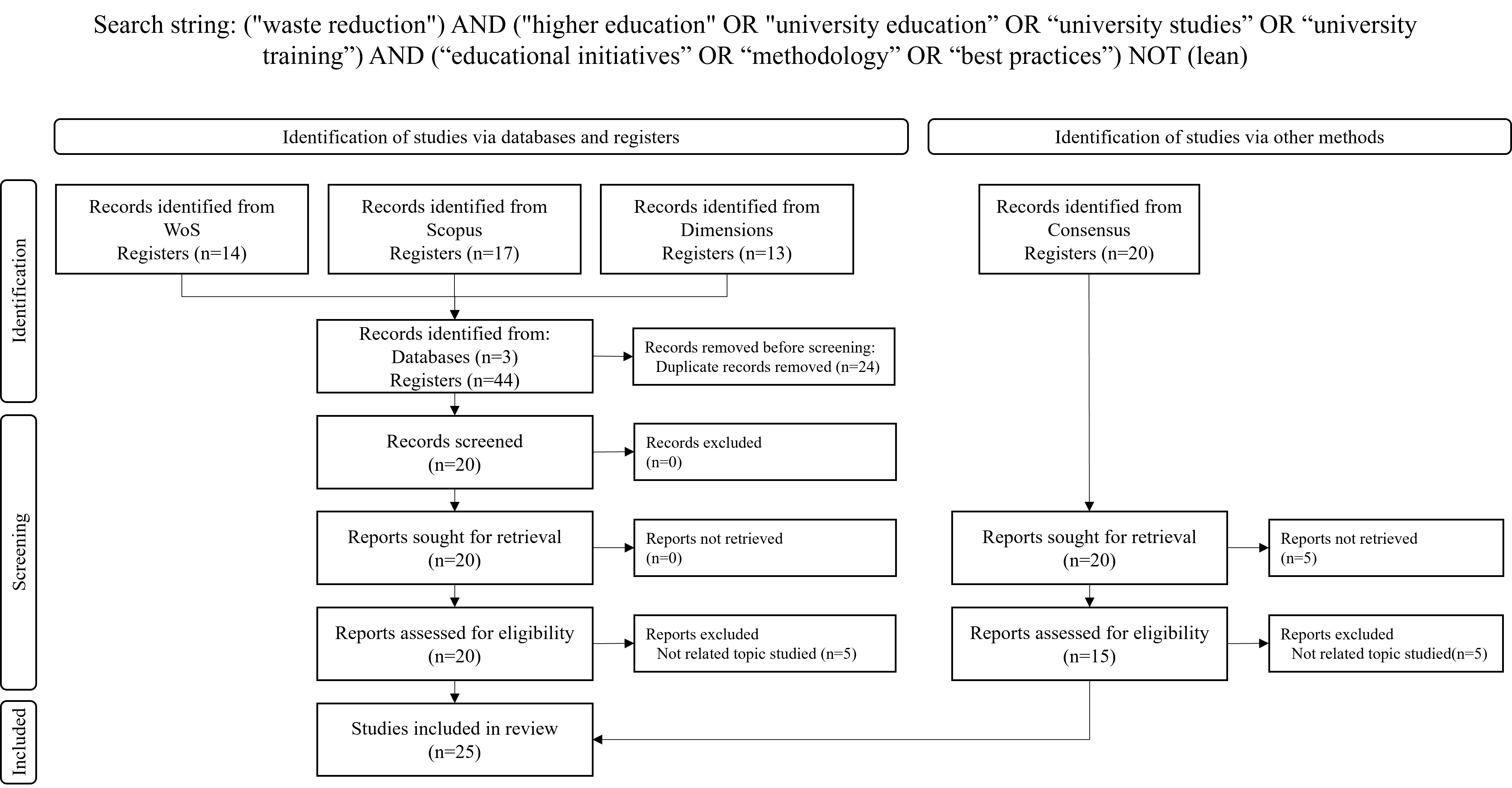
Figure 1. PRISMA 2020 flow diagram of the systematic review. Source: Author’s own elaboration.
4. Results
4.1. Temporal and geographical patterns
The literature shows a marked increase in publications after 2017, reflecting growing attention to sustainability in HEIs studies adopt case-study or cross-sectional designs, with limited longitudinal evaluation.
The analysis reveals a strong geographical concentration of research in Europe, Southeast Asia and North America. Sustainability emerges as the main focus of research, followed by food waste, waste management, recycling and the circular economy (Dalla Gasperina et al., 2022). Accordingly, studies mainly focus on visible and quantifiable waste streams within the university context, such as organic waste, paper and cardboard, and single‑use plastics (Jaipakdee et al., 2025).
4.2. Classification of intervention strategies
The comparative analysis identified four dominant categories of strategies: (1) Experiential learning approaches, integrating waste reduction into curricula and campus-based projects. (2) Integrated institutional programmes, combining governance, infrastructure, education and monitoring. (3) Behaviour-oriented interventions, including communication campaigns and nudging strategies. (4) Technological solutions with educational framing, such as smart monitoring and refill systems. Experiential learning strategies (1), particularly common in engineering and design programmes, integrate waste reduction into curricula and campus‑based projects, fostering sustainability competencies and student engagement (Salinas‑Navarro et al., 2024). Institutional programmes (2), such as Green Campus or Zero Waste, combine infrastructure, policies and educational actions, showing significant impacts when supported by strong organisational commitment (Ares‑Pernas et al., 2020; Jaipakdee et al., 2025). Behaviour‑oriented interventions (3), based on communication campaigns, feedback, incentives and nudging strategies, promote more sustainable practices, especially when combined with structural changes in services such as university catering (Cole & Fieselman, 2013; Tangwanichagapong et al., 2017). Finally, technological solutions with an educational framing (4), such as smart refill stations or digital monitoring systems, contribute to waste reduction—particularly single‑use plastics—when embedded in broader pedagogical strategies (Curralo et al., 2022; Dalla Gasperina et al., 2022).
A simple count of the reviewed literature, as summarised in Table 1, shows a clear dominance of institutional programmes, whereas experiential learning and technologically mediated educational solutions are comparatively scarce.
4.3. Evidence patterns
Across the four categories of intervention strategies, the reviewed studies display differentiated patterns in terms of reported impact and supporting evidence. Integrated institutional programmes show the strongest and most sustained environmental impact, particularly when supported by leadership and governance. Experiential learning approaches demonstrate high educational effectiveness but limited standalone environmental impact unless connected to institutional initiatives. Behaviour-oriented interventions are effective in the short to medium term, while technological solutions contribute to specific waste streams when embedded in broader strategies.
Table 1 also reports the level of evidence associated with each study, based on the analysis of citation context using Smart Citations. Higher levels of evidence are predominantly observed in institutional programmes and some behaviour‑oriented interventions, which tend to rely on direct measurement, longitudinal designs or repeated empirical validation. By contrast, experiential learning approaches and educationally framed technologies more frequently exhibit medium or emerging levels of evidence, reflecting their focus on educational outcomes, limited implementation scales or relatively recent adoption within higher education contexts.
5. Discussion
The findings of this review reinforce existing evidence that effective waste reduction in higher education institutions (HEIs) requires systemic approaches that integrate educational, organisational, behavioural and technological dimensions, rather than isolated interventions. This aligns with previous studies highlighting the limitations of purely technical or individualised strategies in campus sustainability programmes (Tangwanichagapong et al., 2017; Ares‑Pernas et al., 2020).
Table 1: Studies included on waste reduction. Source: Author’s own elaboration
Reference |
DOI |
Dominant strategy |
Type of waste |
Level of evidence |
Evidence provided |
Main dimension evaluated |
Agarwal (2023)* |
10.1016/j.heliyon.2023.e13909 |
4. Educationally framed technologies |
Waste (environmental) |
Medium |
Institutional survey |
Best practices |
Aleixo et al. (2018)* |
10.1108/IJSHE-02-2017-0016 |
2. Institutional programmes |
Waste (environmental) |
Medium-high |
Institutional survey |
Level of integration |
Aleixo et al. (2021)* |
10.1016/j.jclepro.2021.129429 |
2. Institutional programmes |
Campus waste |
Medium-high |
Comparative analysis |
Institutional priorities |
Ares-Pernas et al. (2020) |
10.1108/IJSHE-02-2020-0056 |
2. Institutional programmes |
Campus waste |
Medium-high |
Program indicators |
Governance and culture |
Baba-Nalikant et al. (2023)* |
10.3390/recycling8010021 |
2. Institutional programmes |
Solid waste |
Low |
Conceptual framework |
Behavior (pre) |
Banerjee et al. (2025)* |
10.52783/jier.v5i1.2350 |
2. Institutional programmes |
E-waste |
Low–medium |
Conceptual framework |
Competencies |
Budihardjo et al. (2021)* |
10.3390/su13126562 |
2. Institutional programmes |
Solid waste |
High |
Multivariate statistics |
Explanatory factors |
Chan et al. (2022)* |
10.3390/su16166866 |
2. Institutional programmes |
Plastics |
High |
System data |
Elimination of use + curriculum design |
Cole & Fieselman (2013) |
10.1108/14676371311312888 |
3. Behaviour-oriented interventions |
Paper/recycling |
High |
Direct measurement |
Behavior (pre/post) |
Curralo et al. (2022) |
10.3390/su14105922 |
4. Educationally framed technologies |
Plastics |
Medium |
System data |
Substitution of use |
Dalla Gasperina et al. (2022) |
10.1108/IJSHE-12-2020-0480 |
4. Educationally framed technologies |
Waste (general) |
Medium |
Institutional framework |
Contribution to SDGs |
Dyrbye-Wright et al. (2025)* |
10.20900/jsr20250034 |
2. Institutional programmes |
Food waste |
High |
Quantitative synthesis |
Measured reduction |
Gallardo et al. (2016)* |
10.1016/j.wasman.2016.04.013 |
2. Institutional programmes |
Campus waste |
High |
Quantitative audit |
Generation and composition |
Jaipakdee et al. (2025) |
10.1016/j.grets.2025.100252 |
2. Institutional programmes |
Solid waste |
High |
Direct measurement |
Composition + engagement |
Kaur et al. (2025)* |
10.3390/su17083644 |
2. Institutional programmes |
Campus waste |
Low–medium |
Analytical framework |
Governance and performance |
Khalili et al. (2015)* |
10.1016/j.jclepro.2014.01.099 |
2. Institutional programmes |
Waste/resources |
Medium |
Educational assessment |
Curriculum design |
Kumarasinghe et al. (2023)* |
10.28945/5160 |
4. Educationally framed technologies |
E-waste |
Low–medium |
Survey |
Consumption intention |
Leal Filho et al. (2021)* |
10.1080/13504509.2020.1865474 |
2. Institutional programmes |
Food waste |
Medium |
Review + cases |
Practices and barriers |
Manfredi et al. (2021) |
10.3390/su13158378 |
2. Institutional programmes |
Design/waste |
Medium |
Formative assessment |
Competencies and responsibility |
Phillips et al. (1999)* |
10.1016/S0921-3449(99)00016-6 |
2. Institutional programmes |
Solid waste |
Medium |
Pilot programs |
Reduction of generation |
Phrophayak et al. (2024)* |
10.3390/su16083346 |
2. Institutional programmes |
Campus waste |
Medium-high |
Longitudinal analysis |
Continuous improvement |
Rodríguez-Guerreiro et al. (2024)* |
10.3390/environments11120293 |
2. Institutional programmes |
Campus waste |
High |
Systematic review |
Best practices |
Salinas-Navarro et al. (2024) |
10.3390/su162310789 |
1. Experiential learning |
Circularity |
Medium |
Educational assessment |
Learning outcomes |
Tangwanichagapong et al. (2017) |
10.1108/IJSHE-10-2015-0175 |
3. Behaviour-oriented interventions |
Campus waste |
Medium |
Operational indicators |
Reduction + participation |
Tripathi, et al. (2024)* |
10.1007/978-981-97-0823-9_8 |
3. Behaviour-oriented interventions |
Solid waste |
Medium |
Institutional framework |
Generation reduction |
Note: Some studies combine more than one strategy; the classification corresponds to the dominant strategy.
*Studies marked with an asterisk are not included in the reference list due to space constraints; their DOIs are provided in the table to ensure traceability.
Interpreting the campus as a learning ecosystem helps explain why experiential learning approaches, despite their strong educational outcomes, tend to generate limited environmental impacts when implemented in isolation. As shown in prior research, the translation of learning outcomes into sustained behavioural and environmental change depends on institutional embedding, governance structures and alignment with operational practices (Manfredi et al., 2021; Salinas‑Navarro et al., 2024).
The comparative evidence also supports the view that institutional leadership and governance play a critical enabling role in sustainability initiatives, influencing both the scale and durability of outcomes (Ares‑Pernas et al., 2020; Jaipakdee et al., 2025). Similarly, behavioural interventions appear more effective when combined with supportive infrastructure and organisational culture, confirming earlier findings from community‑based social marketing and campus studies (Cole & Fieselman, 2013; Tangwanichagapong et al., 2017).
Overall, this review contributes to the literature by moving beyond fragmented accounts of individual initiatives and by synthesising how different intervention strategies interact. Figure 2 presents an analytical framework derived from the comparative evidence of the reviewed studies, illustrating the relationships between experiential learning, institutional governance, behavioural strategies and enabling technologies. The results underscore that durable waste reduction in HEIs is less dependent on specific tools or technologies than on the strategic alignment of learning processes, institutional governance and organisational practices within coherent campus‑wide frameworks (Dalla Gasperina et al., 2022).
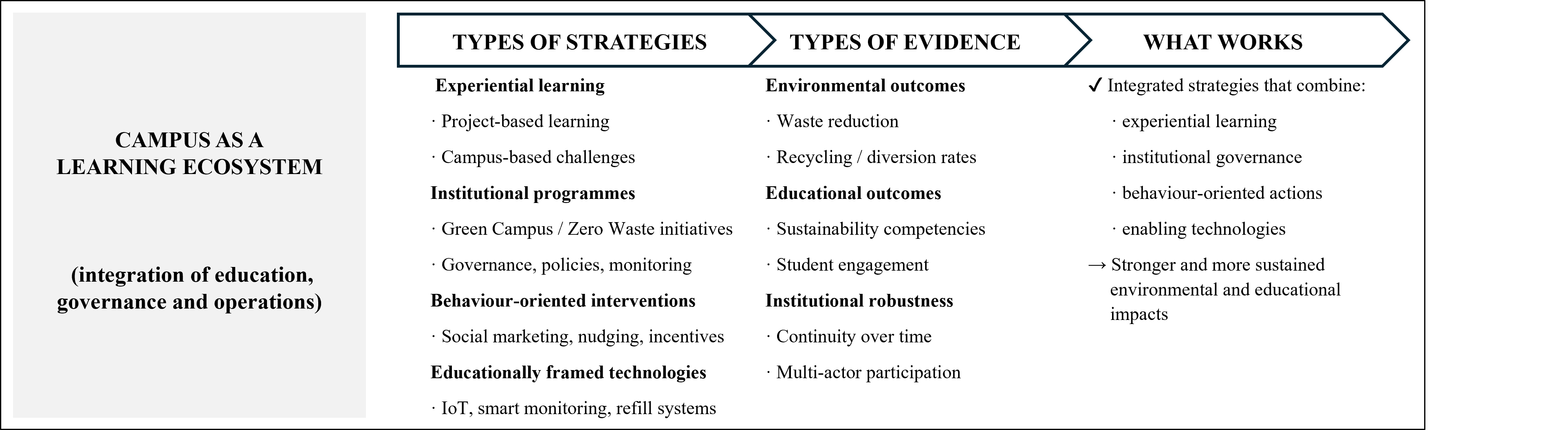 Figure
2. Analytical framework synthesising the results of the systematic
review. Source: Author’s own elaboration.
6. Conclusions and future research
This systematic review demonstrates that what works in teaching sustainability through waste reduction in HEIs is the alignment of experiential learning, institutional commitment, behavioural strategies and enabling technologies within coherent campus-wide frameworks.
The study contributes a structured evidence base to a fragmented field and proposes an analytical framework transferable across institutions. Future research should prioritise longitudinal designs, standardised indicators and deeper analysis of links between educational outcomes and sustained environmental performance.
References
Ares-Pernas, A., Coronado Carvajal, C., Gomis Rodríguez, A., Fernández Ibáñez, M. I., Díaz Casás, V., Zaragoza Fernández, M. S., Bouza Fernández, M. S., Santos Pita, M. del P., García Allut, A. D., Comesaña Pérez, M. P., Caínzos López, M. J., Feal Cabezón, B., & Torres Miño, A. (2020). Towards a sustainable campus: Working together to achieve the green campus flag on the UDC peripheral campus of Ferrol. International Journal of Sustainability in Higher Education, 21(7), 1367–1390. https://doi.org/10.1108/IJSHE-02-2020-0056
Cole, E. J., & Fieselman, L. (2013). A community-based social marketing campaign at Pacific University Oregon: Recycling, paper reduction, and environmentally preferable purchasing. International Journal of Sustainability in Higher Education, 14(2), 176–195. https://doi.org/10.1108/14676371311312888
Curralo, A. F., Lopes, S. I., Mendes, J., & Curado, A. (2022). Joining sustainable design and Internet of Things technologies on campus: The IPVC Smartbottle practical case. Sustainability, 14(10), 5922. https://doi.org/10.3390/su14105922
Dalla Gasperina, L., Mazutti, J., Brandli, L. L., & Rabello, R. dos S. (2022). Smart practices in HEIs and the contribution to the SDGs: Implementation in Brazilian university. International Journal of Sustainability in Higher Education, 23(2), 356–378. https://doi.org/10.1108/IJSHE-12-2020-0480
Jaipakdee, P., Vibhatabandhu, P., Vitayavarawat, P., & Supakata, N. (2025). Waste composition and engagement in management initiatives: A study at Chulalongkorn University across academic periods. Green Energy and Technology Studies, 100252. https://doi.org/10.1016/j.grets.2025.100252
Manfredi, L. R., Stokoe, M., Kelly, R., & Lee, S. (2021). Teaching sustainable responsibility through informal undergraduate design education. Sustainability, 13(15), 8378. https://doi.org/10.3390/su13158378
Pike, L., Shannon, T., Lawrimore, K., McGee, A., Taylor, M., & Lamoreaux, G. (2003). Science education and sustainability initiatives. International Journal of Sustainability in Higher Education, 4(3), 218-229. https://doi.org/10.1108/14676370310485410
Salinas-Navarro, D. E., Palma-Mendoza, J. A., & Vilalta-Perdomo, E. (2024). Integrating circular supply chains into experiential learning: Enhancing learning experiences in higher education. Sustainability, 16(23), 10789. https://doi.org/10.3390/su162310789
Tangwanichagapong, S., Nitivattananon, V., Mohanty, B., & Visvanathan, C. (2017). Greening of a campus through waste management initiatives: Experience from a higher education institution in Thailand. International Journal of Sustainability in Higher Education, 18(2), 203–217. https://doi.org/10.1108/IJSHE-10-2015-0175
Yang, X., Chen, X., Xiao, X., Xi, H., & Shi-wei, L. (2021). College Students’ Willingness to Separate Municipal Waste and Its Influencing Factors: A Case Study in Chongqing, China. Sustainability, 13(22), 12914. https://doi.org/10.3390/su132212914