Learning by Entrepreneuring: An Experiential Teaching Approach to Opportunity Identification and Communication Skills in Higher Education
Learning by Entrepreneuring
Learning by Entrepreneuring: An Experiential Teaching Approach to Opportunity Identification and Communication Skills in Higher Education
María-José Pinillos1
 ,
Javier Roldán2
1Department of Business Economics, Rey Juan Carlos University, Spain 2Department of Business Economics, Rey Juan Carlos University, Spain
How to cite: Pinillos, M.-J.; Roldán, J. (2026). Learning by Entrepreneuring: An Experiential Teaching Approach to Opportunity Identification and Communication Skills in Higher Education, In: 12th International Conference on Higher Education Advances (HEAd’26). Valencia, 15-18 June 2026. https://doi.org/10.4995/HEAd26.2026.21799
Abstract
Entrepreneurship is increasingly recognised as a relevant professional pathway for university graduates, which calls for experiential pedagogical approaches aimed at developing entrepreneurial competencies. This paper presents a practice-based learning activity implemented in a compulsory fourth-year undergraduate course (Iniciativas Empresariales, 6 ECTS) in the Degree in Labour Relations and Human Resources at Universidad Rey Juan Carlos (Spain). The activity was designed to foster two transversal competencies: opportunity identification and persuasive communication of business ideas. It consisted of a two-phase process involving the analysis of a real business opportunity and the delivery of a one-minute elevator pitch to a simulated investor audience. Data collected through students’ self-assessment questionnaires show high levels of perceived improvement, particularly in opportunity identification, along with positive gains in communication skills. The findings highlight the pedagogical value of experiential learning and its potential for replication across higher education settings.
Keywords: Entrepreneurship education; experiential learning; opportunity identification; communication skills; higher education.
1. Introduction
Recent international evidence highlights a growing interest among university students in entrepreneurial careers. The latest Global University Entrepreneurial Spirit Students’ Survey (GUESSS Report; Sieger et al., 2024), based on more than 226,000 students across 57 countries, shows that 15.7% intend to start a business immediately after graduation, while 30% expect to do so within five years. This trend reinforces entrepreneurship as a viable and increasingly relevant career path.
This is particularly relevant given the economic role of micro, small, and medium-sized enterprises (MSMEs), which account for approximately 95% of firms worldwide and generate around 60% of private-sector employment (Ayyagari et al., 2007), playing a key role in job creation and economic activity. In developing economies, their importance is even more pronounced, often functioning as a primary mechanism for self-employment despite their structural vulnerability (Endris & Kassegn, 2022).
However, research consistently shows that many students do not feel adequately prepared to start their own businesses (Xanthopoulou & Sahinidis, 2024). This gap between entrepreneurial intention and perceived preparedness highlights the need for pedagogical approaches that strengthen entrepreneurial competence and self-efficacy in higher education.
Within this context, opportunity identification emerges as a fundamental dimension of entrepreneurial competence. The entrepreneurial process begins with recognising and interpreting favourable conditions for value creation (Shane & Venkataraman, 2000). In addition, entrepreneurial education has been shown to influence attitudes, perceived behavioural control, and self-efficacy, thereby increasing the likelihood of entrepreneurial action (Fayolle & Gailly, 2015).
Based on these premises, this study presents a structured experiential learning activity aimed at developing two key transversal competencies: opportunity identification and persuasive communication. These competencies are essential in real entrepreneurial contexts, where recognising value creation opportunities and communicating them effectively to stakeholders are critical for success.
In line with practice-based approaches to entrepreneurship education, the study focuses on the design, implementation, and reflective evaluation of a learning experience grounded in action. Rather than assessing causal effects, it aims to illustrate how experiential learning can support the development of entrepreneurial competencies in higher education contexts.
The following sections describe the instructional design of the activity, present students’ perceived learning outcomes, and discuss the pedagogical implications of the experience.
2. Materials and Methods
2.1. Context and activity design
The activity was structured into two complementary phases.
Phase I: Opportunity search and analysis
In the first phase, each student was required to identify a business opportunity based on up-to-date information obtained from the press, the Internet, or other relevant sources. Based on this information, students prepared a short written document following a structured template that included: a description of the business idea, a justification of the identified opportunity, the type of innovation according to Schumpeter’s classification (e.g., new product, new market, new channel, etc.), and bibliographic references formatted in accordance with APA guidelines (7th edition).
Phase II: Oral defence (Elevator Pitch)
In the second phase, students assumed the role of entrepreneurs and presented their proposals to the class through a one-minute elevator pitch. Each student was required to defend the viability of the opportunity identified in Phase I and persuade an audience acting as fictitious potential investors. To reinforce the simulation, each student was assigned a fictitious amount of funding, which they had to allocate among the three proposals they considered most viable and attractive, excluding their own, while justifying their decision.
The learning activity was implemented over three consecutive academic years in a compulsory fourth-year undergraduate course (Iniciativas Empresariales, 6 ECTS) in the Degree in Labour Relations and Human Resources at Universidad Rey Juan Carlos (Spain), with 44 students enrolled in the analysed cohort.
2.2. Assessment and grading criteria
A distinctive feature of the activity was the integration of a competitive, relative grading mechanism based on the simulated investment outcomes obtained during the elevator pitch phase.
Part of the final grade was linked to the total amount of investment attracted by each proposal. Grades were assigned based on quartile positions. Proposals in the top quartile of total investment received the maximum score (10/10), those in the second quartile received 9 points, those in the third quartile received 8 points, and the remaining proposals received 7 points.
This grading approach was explicitly communicated to students in advance. Its aim was to reproduce competitive dynamics similar to those faced by entrepreneurs in real funding contexts, where outcomes depend not only on intrinsic quality but also on relative positioning. As students were not accustomed to this type of assessment, the system introduced an additional element of realism and strategic decision-making into the learning experience.
2.3. Teaching methodology
The activity combined active learning methodologies, such as role play and simulation, with authentic assessment. This approach enabled the integration of cognitive competencies related to information analysis and opportunity identification, as well as transversal competencies associated with oral communication, autonomy, and decision-making in contexts of uncertainty.
2.4. Data analysis
A qualitative content analysis was conducted on students’ open-ended self-assessment responses collected at the end of the course. A keyword-based coding strategy was applied to identify references to two target competencies: opportunity identification and communication skills.
The analysis aimed to support an interpretative synthesis of students’ perceived development of these competencies based on their written reflections.
3. Results
Overall, the activity received a high level of acceptance, with students highlighting its practical orientation, active format, and close connection to realistic entrepreneurial contexts.
3.1. Quantitative self-assessment results
At the end of the course, students completed a self-assessment questionnaire evaluating their perceived development of selected competencies using a five-point Likert scale (1 = no improvement; 5 = very high improvement). The results indicate consistently positive perceptions of learning across the evaluated dimensions.
Regarding opportunity identification, approximately 93% of respondents reported substantial or very substantial improvement (levels 4 or 5). This competency obtained one of the highest mean scores among all evaluated dimensions, reflecting students’ perception that the activity strengthened their ability to recognise and analyse viable business opportunities.
In relation to communication skills, around 78% of students reported substantial or very substantial improvement. Although the perceived improvement in this competency was slightly lower than that reported for opportunity identification, the results nonetheless suggest that the elevator pitch and oral defence component contributed positively to students’ self-assessed communication skills.
3.2. Qualitative analysis of open-ended responses
In addition to the Likert-scale items, the questionnaire included an open-ended question inviting students to reflect on what they had learned through the activity compared to the beginning of the course. These responses were analysed using a simple inductive content analysis aimed at identifying recurring themes linked to the target competencies.
A considerable proportion of students explicitly referred to improvements in opportunity identification, emphasising aspects such as recognising unmet needs, assessing feasibility, and analysing market and competitive conditions. Fewer, although still notable, references were made to communication skills, particularly in relation to the oral defence of ideas and the adaptation of messages to a specific audience.
More broadly, students’ reflections frequently highlighted the experiential nature of the activity as a key facilitator of learning. The opportunity to work with realistic information, assume entrepreneurial roles, and engage in simulated investor decision-making was perceived as enhancing understanding of the entrepreneurial process and fostering active engagement with course content.
Figure 1 presents an integrated, interpretative synthesis of students’ perceived development of opportunity identification and communication skills. This representation does not reflect measured gains, but rather a synthesis of students’ reflective feedback. It illustrates a higher perceived level of development in opportunity identification compared to communication skills, consistent with both the quantitative results and the emphasis placed on opportunity analysis in the design of the activity.
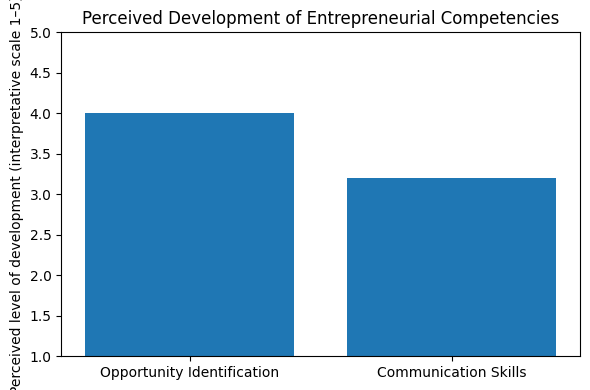
Figure 1. Perceived development of entrepreneurial competencies derived from qualitative analysis of students’ self-assessment responses. Values represent an interpretative synthesis of perceived competency development on a five-point scale (1 = very low, 5 = very high).
4. Discussion
As outlined in the Introduction, this study aims to describe and reflect on a practice-based learning experience designed to foster opportunity identification and persuasive communication. Accordingly, the findings should be interpreted as reflective evidence of students’ perceived learning rather than as objective measures of competency acquisition.
The results show that opportunity identification was the competency with the highest perceived level of development. This is consistent with the instructional design, where opportunity search and analysis constituted the core of the activity. By engaging with real-world information, justifying business opportunities, and assessing their viability, students developed skills directly aligned with this competency.
Communication skills were also positively evaluated, although to a lesser degree. This pattern reflects the role of communication within the activity, primarily as a means of articulating and defending ideas rather than as a standalone objective.
The use of a quartile-based relative grading system linked to simulated investment outcomes further enhanced the authenticity of the experience. By introducing competitive dynamics similar to real funding contexts, the evaluation design created a controlled level of uncertainty and strategic pressure, fostering higher levels of engagement and persuasive effort.
These findings support prior critiques of traditional lecture-based approaches in entrepreneurship education (Carland & Carland, 2010) and align with the view of entrepreneurship as a method grounded in action (Neck et al., 2015). In this sense, the activity enabled students to develop key entrepreneurial competencies through practice, integrating action and reflection in a way that facilitated meaningful engagement with entrepreneurial thinking. This reinforces the value of aligning instructional design with targeted competencies in experiential entrepreneurship education.
5. Conclusions
This study demonstrates how a simple and replicable experiential learning design can foster key entrepreneurial competencies within a compulsory undergraduate course. By combining opportunity analysis with a simulated investor pitch, the activity places students in an authentic entrepreneurial context that promotes active engagement, reflection, and decision-making under conditions of uncertainty.
Rather than seeking to demonstrate effects on entrepreneurial outcomes or psychological constructs, the contribution of this study lies in its pedagogical insights. The findings support the view that entrepreneurship education benefits from approaches that prioritise action, practice, and student responsibility for learning (Carland & Carland, 2010; Neck et al., 2015).
From a practical perspective, the methodological simplicity of the activity enhances its adaptability across disciplines and institutional contexts. As it does not require external partners or specialised infrastructure, it is particularly suitable for programmes where entrepreneurship is taught as a transversal competence.
Future research could extend this work by exploring complementary assessment strategies, longitudinal designs, or applications in different educational settings. However, such efforts should remain sensitive to the practice-based nature of entrepreneurship education, where the value of learning experiences is not always fully captured through traditional evaluation methods.
In line with the initial objectives, this study does not aim to demonstrate entrepreneurial effects, but rather to illustrate how learning by entrepreneuring, understood as engaging students in structured entrepreneurial action, provides a meaningful and pedagogically robust approach to entrepreneurship education in higher education.
References
Ayyagari, M., Beck, T., & Demirgüç‑Kunt, A. (2007). Small and medium enterprises across the globe. Small Business Economics, 29(4), 415–434. https://doi.org/10.1007/s11187-006-9002-5
Carland, J. C., & Carland, J. W. (2010). Entrepreneurship education: Building for the future. Journal of Business and Entrepreneurship, 22(2), 40–59.
Endris, E., & Kassegn, A. (2022). The role of micro, small and medium enterprises (MSMEs) to the sustainable development of sub-Saharan Africa and its challenges: a systematic review of evidence from Ethiopia. Journal of Innovation and Entrepreneurship, 11(1), 20. https://doi.org/10.1186/s13731-022-00221-8
Fayolle, A., & Gailly, B. (2015). The Impact of Entrepreneurship Education on Entrepreneurial Attitudes and Intention: Hysteresis and Persistence. Journal of Small Business Management, 53(1), 75-93. https://doi.org/10.1111/jsbm.12065
Neck, H. M., Greene, P. G., & Brush, C. G. (2015). Teaching entrepreneurship as a method that requires practice. In Teaching Entrepreneurship: A practice-Based Approach (pp. 1–22). Edward Elgar Publishing. https://doi.org/10.4337/9781782540564.00005
Sieger, P., et al. (2024). Global University Entrepreneurial Spirit Students' Survey (GUESSS) Report 2024. GUESSS Consortium. https://www.guesssurvey.org/report2024
Schumpeter, J. A. (1934). The Theory of Economic Development. Harvard University Press.
Shane, S., & Venkataraman, S. (2000). The Promise of Entrepreneurship as a Field of Research. Academy of Management Review, 25(1), 217–226. https://doi.org/10.5465/amr.2000.2791611
Xanthopoulou, P., & Sahinidis, A. (2024). Students’ entrepreneurial intention and its influencing factors: A systematic literature review. Administrative Sciences, 14(5), 98. https://doi.org/10.3390/admsci14050098