Teaching communication skills to school psychology students: An innovative teaching and learning experience
Teaching communication skills to school psychology students: An innovative experience
Teaching communication skills to school psychology students: An innovative teaching and learning experience
Marta
Minguela
 ,
Javier Onrubia
,
Ana Lou
,
Monica Guerrero
1Department of Cognition, Development and Educational Psychology, University of Barcelona, Spain
How to cite: Minguela, M., Onrubia, J., Lou, A., Guerrero, M. (2026). Teaching communication skills to school psychology students: An innovative teaching and learning experience. In: 12th International Conference on Higher Education Advances (HEAd’26). Valencia, 15-18 June 2026. https://doi.org/10.4995/HEAd26.2026.21802
Abstract
This paper presents an innovative teaching and learning experience designed for teaching communication skills for collaborative consultation to psychology students. It was implemented in an elective course on school psychology for two consecutive academic years, and included tasks of identification of discourse strategies, use of these strategies in role-playing and simulation activities, and reflection. Each course was conceived as an iteration of the innovation, so that the assessment of what was done in the first iteration was used as a basis to improve the innovation in the second iteration. Overall, students’ and teachers’ assessment of the experience is positive, highlighting the educational potential of the simulation activities and the subsequent reflection. The students' learning outcomes are also positive.
Keywords: School psychology training; communication skills; discourse strategies; school psychology; collaborative consultation
1. Introduction
This paper presents an experience of teaching innovation aimed at teaching communication skills for collaborative consultation to psychology students. This proposal has been implemented for two academic years (2023/2024 and 2024/2025) in an elective course in the bachelor’s degree in psychology at the University of Barcelona (UB). It is part of a teaching innovation project (2023PID-UB/029) recognized by the UB's Research, Innovation and Teaching and Learning Improvement Programme (RIMDA).
2. Theoretical framework
2.1. Collaborative consultation in school psychology
The intervention of school psychologists has traditionally focused on providing individual attention to students with developmental disorders or learning difficulties, using an essentially corrective approach (Mulser & Naser, 2020). From this traditional approach, the psychological processes of students and their possible disorders are evaluated, and individual intervention plans for the students are implemented. These plans are directly implemented by psychologists or, eventually, are prescribed in detail to teachers for them to implement. In this approach, the relationship between the psychologist and the teachers is clearly hierarchical; it is assumed that the psychologist is the professional who has the specialized knowledge about the student's difficulties and, therefore, who conducts, or prescribes, the intervention.
In recent years, an alternative ‘indirect approach’ to school psychologists' intervention has been gaining ground. This indirect approach focuses school psychologists' intervention on the systemic improvement of teaching practices for all students by supporting educational agents, particularly teachers. To this end, collaborative consultation between the psychologist/consultant and teachers/consultees ‒either individually or as a team‒ becomes a fundamental intervention strategy. This type of collaborative consultation aims to systematically support the improvement of teachers' practices. In this approach, the relationship between the psychologist and the teachers is understood as necessarily collaborative, as both psychologists and teachers are considered to have specific expertise which is relevant to improve teaching practices (Conoley et al., 2020). For this collaborative relationship to develop, a particular type of interaction and discourse between psychologists and teachers is required, one which is very different from that used in direct intervention (Soto et al., 2026).
2.2. Communication skills in collaborative consultation
In collaborative consultation, school psychologists do not prescribe teachers what to do but rather seek to support them in jointly reflecting on their practice, identifying areas for improvement, designing plans to implement these improvements, and evaluating them using relevant indicators. This support also aims to promote teachers’ autonomy and professional learning. All of this requires specific dialogic forms of interaction, which allow for productive collaboration between psychologists and teachers, and among teachers themselves.
To promote this type of interaction, school psychologists need to master a wide range of communication and conversational skills (Newman & Rosenfield, 2024). This includes skills aimed at assisting teachers in improving their teaching practices and analysing the pedagogical principles on which these practices are based —such as obtaining information from teachers, verifying that the psychologist understands the teachers’ contributions, providing complementary information and offering suggestions, as well as skills aimed at constructing and maintaining positive socio-emotional dynamics throughout the collaboration —such as creating mutual trust and promoting an egalitarian and inclusive conversation. Mastering these communication skills requires the deliberate and situated use of a wide range of discourse strategies. Some of these strategies are specifically addressed to support the discussion and conceptual understanding and improvement of teaching practices (i.e., questioning, revoicing, reconceptualizing, challenging teachers’ ideas…) while others are specifically addressed to support collaborative socio-emotional dynamics (i.e., understanding and normalizing feelings and emotions, valuing positively, attributing competence and responsibility, recognizing teachers’ concerns…) (Onrubia et al., 2024). Given their importance for the development of collaborative consultation, these communication skills and discourse strategies must be taught to future school psychologists.
2.3. Teaching communication skills to future school psychologists
Despite the need to master the kind of communication skills and discourse strategies mentioned above for school psychologists to successfully conduct collaborative consultation processes, teaching these skills and strategies is not common. Hence, there is a need to incorporate this teaching into their initial training (Newman, Gerrard, et al., 2022). Additionally, there is a dearth of research on the training of psychology students in these skills (Ljunggren et al., 2023).
At the same time, teaching these skills and strategies is not easy (Newman, Villarreal, et al., 2022). On the one hand, these skills and strategies are not to be used mechanically, but require intentional, deliberate, combined and reflective use. On the other hand, collaborative consultation processes can take place in very diverse situations and contexts, with diverse participants, at different educational levels and referring to different curricular contents. Thus, these skills and strategies must be taught in a situated and metacognitively informed manner.
3. Description of the innovation
3.1. Context of the innovation
This innovation experience was carried out in the course "School Psychology and Psychopedagogical Intervention" of the bachelor’s degree in psychology at the University of Barcelona (UB). It is an elective course (3 ECTS) that students can choose in their last year of the bachelor’s degree, and that takes place in two-hour weekly sessions over the course of one semester. Typically, when students access this course, they have previously taken a compulsory course on Educational Psychology, which provides them with some conceptual bases to understand the teaching-learning processes in different educational contexts, and another one on Psychological Intervention, which introduces them to the basic coordinates of psychoeducational intervention.
The course aims to provide some key ideas and proposals regarding psychoeducational intervention at school, in line with the theoretical framework described above (cf. 2.1.). In particular, the course offers conceptual elements and specific consultation strategies to support the improvement of educational institutions and teaching practices from the perspective of inclusive education.
3.2. Objectives, contents and methodological criteria of the innovation
The main aim of this experience was to improve students’ communication skills in professional situations. More specifically, the innovation aimed to help students: (a) learn about communication skills and discourse strategies considered to be relevant for their future professional practice; (b) identify specific discourse strategies and the purposes they serve in authentic communicative situations between psychologists and teachers; (c) use specific discourse strategies at the service of certain communicative purposes within the framework of collaborative consultation processes; (d) reflect on their own use of language in such processes.
In accordance with these objectives, the main learning contents of the proposal were: (i) the importance of the psychologists’ use of language in collaborative consultation; (ii) some communication skills and discourse strategies used by consultants in prototypical situations of collaborative consultation; and (iii) the necessarily strategic nature of the consultants’ use of discourse strategies.
Based on the considerations raised above on the teaching of communication skills and discourse strategies to future school psychologists (cf. 2.3.), the design of the activities that made up the innovation was based on two main methodological criteria: (a) to promote a situated (adapted to the situation, the context and moments of the consultation process), strategic, reflective use of communication skills and discourse strategies; and (b) teaching these skills and strategies in a metacognitively informed way, promoting a self-regulated use of them, through prior planning and subsequent reflection.
3.3. Implementation of the innovation and data collection
The innovation was carried out for two consecutive academic years (2023/2024 and 2024/2025) with all the students that participated in the elective course (i.e., 17 students in the first academic year, and 45 students in the second one). Each course was conceived as an iteration of the innovation, so that the assessment of the first iteration was used as a basis to improve the proposal in the second iteration.
At the end of each course, three types of instruments were used to assess the development and results of this innovation:
a students’ questionnaire, which combined close-ended and open-ended questions about their learning, the elements of the teaching innovation that helped them the most to learn, the improvements they would suggest, and their satisfaction
a teachers’ self-report, including a description of the development of the innovation in classroom, an assessment on the students’ engagement and participation in classroom, and the strengths and weaknesses of the innovation
the assessment and the feedback provided by the teachers on the activities throughout the course, as well as the students’ final grades
3.4. First iteration of the innovation: development and results
The first iteration of the innovation included the introduction of two sets of activities within the framework of the usual content and structure of the course.
The first of these two sets of activities was carried out in the first thematic block of the course, focused on the general basis for psychoeducational intervention at school from an indirect approach of intervention at the service of inclusive education. The aim of these activities was twofold: to highlight and raise awareness of the importance of the consultant's use of language, and to present some specific discourse strategies commonly used in typical collaborative consultation situations and the communicative purpose they can serve.
In detail, three activities were carried out:
identifying, in brief dialogues extracted from collaborative consultation situations, which discourse strategies, among those included in a list, the consultant is using
formulating, using the previous discourse strategies, and argue some psychologist’s short interventions (one or two turns in a conversation) in response to specific teacher requirements in the context of specific collaborative consultation situations
identifying, in a long dialogue between a teacher and a school psychologist, the discourse strategies that the psychologist uses, and the communicative purpose they serve in the context of the conversation and the situation
The dialogue excerpts used in these activities were based on transcripts of authentic consultation situations. The activities were carried out with the support of a set of specific materials which were revised on class, including a table with a selection of discourse strategies (some of them to support the discussion and conceptual understanding and improvement of teaching practices, and others to support the collaborative socio-emotional dynamics), possible specific uses of each and examples of their use. The students worked on these activities during a two-hour class.
The second set of activities was carried out in the last thematic block of the course, focused on psychoeducational intervention to promote inclusive teaching practices. These activities revolve around the planning and participation in a simulation activity in which the students, playing the role of school psychologists, held a meeting with the teacher/consultee who had raised a request for consultation. The aim of the meeting was deepening the initial information of the request and agreeing on possible lines of action to continue with the collaborative consultation process.
To do this, the students, organized in small groups (3-5 students), had to:
prepare the meeting with the teacher/consultee, planning its content, the interaction to be established and the discourse strategies to use considering the request, the situation, the aims of the meeting, and any difficulties that may arise during the conversation
participate in the simulation, playing the role of the psychologists
reflect on their use of language during the simulation activity
The duration of these activities was approximately six hours.
Overall, the students’ learning results were clearly satisfactory, both in terms of the average grades in the different activities (B grade) and the range of these grades (without F grades). The participants’ assessment was also clearly positive and reflected a high satisfaction with the innovation. In the close-ended questions of the questionnaire, the students especially highlighted the simulation as the element that helped them the most to learn. At the same time, in their answers to the open-ended questions in the questionnaire, the students argued that it should not be done at the end of the course, because they did not have enough time to comment and reflect on it afterwards. Thus, they highlighted the educational potential of the reflection on their own use of language in the simulation but asked for more time for reflecting and sharing their impressions in the classrooms to make it a more valuable resource for learning. The teacher agreed on the need to spend more time on the post-simulation reflection.
3.5. Second iteration of the innovation: development and results
Based on the students’ and the teacher comments on the first iteration of the innovation, some adjustments were incorporated in the second one. These adjustments consisted of the increase in role-playing and simulation activities, and the subsequent reflection on the performance of the students in these activities.
Therefore, the role-playing and simulation strategy was incorporated as the central axis of the innovation throughout the semester. Specifically, instead of conducting a single simulation at the end of the course, three role-playing and/or simulation activities were proposed throughout the semester: a brief initial role-playing used as an awareness-raising task on the importance of the psychologists’ communication skills to collaborate with teachers, and two simulation activities in which students played the role of the psychologists in different moments of a consultation process in a particular school.
Moreover, the students’ reflection on their own performance was incorporated as a tool for improving their use of discourse strategies, highlighting the importance of reflective practice as key for their future profession. To this end, a reflection activity was introduced after each role-playing/simulation activity, so that the reflection after each of the activities could be used as the basis to improve students’ performance in the next one.
About thirteen hours of the course were devoted to these activities.
Overall, and like in the first iteration of the innovation, both the students’ learning results (around A grade) and their assessment were clearly positive. Both the students and teachers highlighted the role-playing and simulation activities and the subsequent reflection as the main assets of the innovative experience to help students develop communication skills for their future profession. In line with this, Figure 1 shows the students’ assessment of the degree in which the resources and activities used during the innovation helped them learn communication skills in a Likert scale (from 1, ‘little’, to 4, ‘a lot’). According to the students’ responses shown in this figure, most of them considered the activities made as helpful for their learning (ratings 3 and 4), with few students considering the activities helped them only a little.
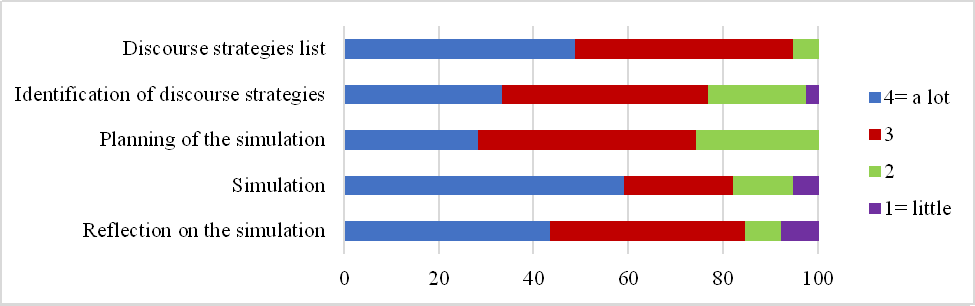
Figure 1. Percentage of students’ responses for each rating category to the question asking to what extent each of the activities had helped them to learn
In one of the students’ words: “what helped me most to learn was using the discourse strategies in an authentic context and becoming aware of how I communicate”.
4. Discussion and Conclusions
The innovation presented in this paper addresses a topic of special importance in the training of future school psychologists, at a time when the limitations of a direct approach to psychoeducational intervention, and the potentialities of an indirect intervention approach based on joint and collaborative work between psychologists and teachers, are being raised (Conoley et al., 2020). The assessment of the innovation by the participants, and its results in terms of learning, provide evidence that the proposal raised and developed in the two iterations described above can be a useful tool for the improvement of the quality of the training of future school psychologists. This evidence builds on, and complements, the findings of previous studies such as those by Ljunggren et al. (2023), Newman, Gerrard, et al. (2022) or Newman, Villarreal, et al. (2022).
In particular, the innovation presented in this paper suggests a number of implications and criteria for the training of (future) psychologists in the communication skills and discourse strategies which are necessary for carrying out school collaborative consultation processes. We would like to highlight three of these implications: (i) to emphasise, during the training, the flexible, deliberate and non-mechanical use of these skills and strategies; (ii) to practise, throughout the training and via simulated practice, the use of these skills and strategies in a variety of situations of collaborative consultation; and (iii) to allow time for reflection on one’s own use of these skills and strategies, and to promote this reflection as an important tool for professional improvement. Future teaching innovation and research processes will make it possible to confirm, refine and elaborate on these implications and suggestions.
References
Conoley, J., Powers, K., & Gutkin, T. (2020). How is school psychology doing: Why hasn't school psychology realized its promise? School Psychology, 35(6), 367–374. https://doi.org/10.1037/spq0000404
Ljunggren, I., Najström, M., Levitt, D. H., & Ramnerö, J. (2023). Dialogue as psychological method – a study of training interviewing and communication skills in psychology students. Nordic Psychology, 75(4), 386–396. https://doi.org/10.1080/19012276.2022.2112744
Mulser, R., & Naser, S. (2020). The roles and responsibilities of the school psychologist in promoting child rights. In B. Nastasi, S. Hart, & S. Naser (Eds.), International Handbook on Child Right and School Psychology (pp. 65–80). Springer.
Newman, D. S., Gerrard, M. K., Villarreal, J. N., & Kaiser, L. T. (2022). Deliberate Practice of Consultation Microskills: An Exploratory Study of Training. Training and Education in Professional Psychology, 16(3), 263–271. https://doi.org/10.1037/tep0000368
Newman, D. S., & Rosenfield, S. (2024). Building Competence in School Consultation: A Developmental Approach (2nd edition). Taylor & Francis.
Newman, D.S., Villarreal, J. N., Gerrard, M. K., McIntire, H., Barrett, C.A., & Kaiser, L. T. (2022). Deliberate practice of consultation communication skills: A randomized controlled trial. School Psychology, 37(3), 225–235. https://doi.org/10.1037/spq0000494
Onrubia, J., Minguela, M., & Roca, B. (2024). Facilitators’ specific discourse strategies to construct socio-emotional dynamics promoting collaboration and dialogue in teachers’ professional development. Teaching and Teacher Education, 144, Article 104581. https://doi.org/10.1016/j.tate.2024.104581
Soto, R., Minguela, M., & Onrubia, J. (2026). Modes of discourse and discourse strategies: Interaction between educational psychologists and teachers in consultation processes. Learning, Culture and Social Interaction, 58, Article 101004. https://doi.org/10.1016/j.lcsi.2026.101004