Behind Products That Promise Joy: Being, Knowing, and Doing in a Cross-Border COIL Experience on Responsible Consumption and Production.
Behind Products That Promise Joy
Behind Products That Promise Joy: Being, Knowing, and Doing in a Cross-Border COIL Experience on Responsible Consumption and Production
Adriana
Morales-Rodriguez1
 ,
Leonardo Simões Agapito2
,
Nelly Ramírez-Vásquez1
1Business School, Tecnologico de Monterrey, Mexico, 2Faculty of Human and Social Sciences, Universidade Estadual Paulista (UNESP), Brazil.
How to cite: Morales-Rodriguez, A.; Agapito, L.S.; Ramírez-Vásquez, N.; (2026). Behind Products That Promise Joy: Being, Knowing, and Doing in a Cross-Border COIL Experience on Responsible Consumption and Production. In: 12th International Conference on Higher Education Advances (HEAd’26). Valencia, 15-18 June 2026. https://doi.org/10.4995/HEAd26.2026.21803
Abstract
Collaborative Online International Learning (COIL) has emerged as a pedagogical tool aimed at fostering soft skills, meaningful learning, and intercultural awareness. Beyond developing professional skills (doing) and cognitive knowledge (knowing), COIL experiences may also influence students’ values and ethical orientations (being). This paper examines how a COIL experience focused on responsible consumption and production affected students’ consumption habits and perceptions. The activity was conducted between March and May 2025 with undergraduate students from a Business program at Tecnologico de Monterrey (Mexico) and a Law program at UNESP (Brazil). The analysis shows that students predominantly identified changes in personal perspectives and beliefs as the main outcomes of the experience, rather than the acquisition of information or the adoption of specific practices. At the same time, participants emphasized that more responsible consumption depends significantly on corporate commitments and structural changes within supply chains.
Keywords: Higher Education; Educational Innovation; COIL; Supply Chain; Sustainable Development Goals.
1. Introduction
Global consumption patterns increasingly reveal a paradox of contemporary markets: products commonly associated with happiness and celebration often conceal complex social and environmental harms within their supply chains. Chocolate and diamonds exemplify this contradiction. Although marketed as symbols of joy, love, and prosperity, both products are closely linked to environmental degradation, labor exploitation, social inequality, and weak regulatory enforcement. Addressing this tension requires not only sustainability knowledge but also critical ethical reflection on what it means to consume and produce responsibly.
Higher education plays a critical role in preparing future professionals to address these challenges. Contemporary pedagogical approaches in sustainability education and curriculum internationalization increasingly advocate for moving beyond exclusively cognitive models of learning toward holistic frameworks that integrate knowledge, values, and actions. One such framework conceptualizes learning as the integration of knowing, doing, and being—where knowing denotes cognitive understanding, doing refers to action-oriented competencies, and being encompasses ethical awareness, responsibility, and values. From this perspective, education for responsible consumption and production (aligned with Sustainable Development Goal 12) is not limited to acquiring information or adopting better practices, but also involves cultivating consciousness.
Collaborative Online International Learning (COIL) has emerged as a pedagogical model for fostering these integrated dimensions of learning. It was developed in the early 2000s, but its adoption has expanded significantly since the COVID-19 pandemic. COIL connects students and faculty from different countries through shared virtual coursework, enabling intercultural dialogue, collaborative problem-solving, and exposure to diverse perspectives on global challenges. Prior research indicates that COIL experiences can enhance intercultural competence (Hackett et al., 2023), engagement in learning activities (Quintana-Ordorika et al., 2023), confidence and soft skills (Priego-Quesada et al., 2024), and systems thinking through the contextualization of knowledge (Vázquez-Villegas et al., 2024). However, empirical evidence remains limited regarding how such experiences shape students’ reflections on responsible consumption and production through the integrated lenses of being, knowing, and doing.
This study addresses this gap by analyzing student reflections from a cross-border COIL experience in higher education and contributes to the literature on sustainability education, conscious business, and international collaborative learning. It provides empirical evidence of how COIL can support not only knowledge acquisition and skill development but also ethical awareness. In doing so, it highlights the pedagogical value of framing sustainability through products that represent happiness, while simultaneously revealing the hidden social and environmental costs embedded in global supply chains.
2. Methodology
This study examines an empirical COIL experience jointly developed by Tecnologico de Monterrey (Mexico) and Universidade Estadual Paulista (Brazil), implemented within the courses Introduction to Conscious Business and Environmental Law I from March to May 2025. The program involved 116 students from Mexico and 75 students from Brazil, for a total of 191 participants, of whom 136 completed the final reflection survey. Students represented 11 different home countries, creating a diverse and multicultural learning environment.
The learning experience explicitly addressed responsible consumption and production through the complementary lenses of conscious business and environmental regulation, encouraging students to critically examine the intersections among corporate practices, global supply chains, consumer choices, human well-being, and planetary limits. The Mexican course, Introduction to Conscious Business, is a foundational business course grounded in the Conscious Capitalism model and open to students from all disciplines. It was conducted synchronously online via Zoom. The Brazilian course, Environmental Law I, is a mandatory component of the Bachelor of Law program and introduces key concepts in environmental law, including international environmental law, the national conservation system, and the federal forestry code. It is offered in person to senior students.
2.1. The COIL experience
The COIL experience was structured around a case study of the Forever Chocolate Initiative developed by Barry Callebaut, a leading global chocolate and cocoa manufacturer. The initiative aims to make sustainable chocolate the norm through four strategic pillars: Prospering Farmers, Human Rights, Thriving Nature, and Sustainable Ingredients. Students examined the initiative in multidisciplinary and international teams, analyzing its industry relevance, impacts on producing communities, and limitations.
The five-week COIL experience combined three synchronous Zoom sessions with individual and collaborative asynchronous activities. The first session introduced the learning objectives and the Forever Chocolate case study. The second session featured two guest speakers—Prof. Afonso Mosquito Garrido and Dr. M’zée Fula Ngenge—who addressed sustainable development, supply chain traceability, and human rights issues related to diamond mining within the Lobito Corridor. The third session was dedicated to students’ final presentations.
Learning activities were designed to foster collaboration and critical reflection. In Week 1, students participated in an icebreaker activity using Padlet, sharing their hometowns and representative regional products and discussing perceptions of global supply chains. Teams also began their analysis of the Forever Chocolate initiative by responding to guiding questions on its goals, pillars, and alignment with the Sustainable Development Goals (SDGs). In Week 2, students examined responsible diamond supply chains and traceability as a comparative case to chocolate, reflecting on ethical and environmental challenges through individual Padlet posts following the guest speakers’ session.
In Weeks 3 and 4, student teams completed an in-depth analysis of the Forever Chocolate initiative and developed final presentations addressing its potential and limitations, with particular attention to sustainable development and the role of traceability in consumer awareness. In Week 5, participants completed an individual final reflection survey administered via Google Forms. The survey evaluated the impact of the COIL experience and explored students’ perceptions of responsible consumption, their purchasing decisions, and their ability to assess company-provided information related to sustainability and ethics.
2.2. Instrument of the Study
The final reflection survey consisted of single-choice, open-ended, and evaluative items (Table 1). Evaluative items measuring sustainability awareness, overall satisfaction, and intention to participate in future COIL initiatives used a five-point Likert scale. The evaluative items and the final two open-ended questions on learning application and opportunities for improvement were adapted from prior research on the Global Shared Learning Classroom (GSLC) COIL model (Vázquez-Villegas et al., 2024). Demographic data, including gender and home country, were also collected.
Table 1. Instrument of the study
Final Reflection Survey |
1. Considering the concept of "sustainable consumption," list three words that summarize what you learned from this COIL. |
2. Regarding the cocoa supply chain, list three words that represent the main challenges in the global market. |
3. Based on the concept of "responsible production," list three key commitments companies should adopt to promote well-being through their business model. |
4. After this COIL experience, have you changed how you select the products you purchase? (Yes, significantly/Yes, somewhat/No, but I’m more aware/No, my approach remains the same) |
5. After this COIL, how do you feel about the products you consume? (Indifferent/More uncertain about my daily choices/As uncertain as before/As conscious as before/More conscious about my daily choices) |
6. After this COIL, do you feel capable of using company-provided information to assess your purchases? *(e.g., fair business models, modern slavery-free products, Corporate Social Responsibility) (Yes, I can now apply this knowledge to understand what I consume/No, I don’t feel I learned how to assess products effectively/I learned about these concepts, but they seem unreliable/unapplicable/I already had knowledge before the COIL) |
7. What was the most valuable part of your COIL experience? (Learning about a new topic/Discovering new places and their practices/Collaborating with international peers/Engaging with new professors (including guest speakers)/Finding new academic references/Sharing common interests with students from different fields/Using a different learning platform-method/No valuable experience/Other) |
8. What was your biggest challenge during the COIL? (Language barriers/Group dynamics/Unclear instructions/Time constraints/The topic’s complexity/Other) |
9. COIL helped me develop my ability to raise awareness of global issues by focusing on Sustainable Development Goals. (1=Strongly disagree to 5=Strongly agree). |
10. How satisfied are you with your experience? (1=Very dissatisfied to 5=Very satisfied). |
11. Would you participate in another COIL in the future?(1=Strongly disagree to 5=Strongly agree). |
12. Reflecting on your COIL experience, what key lessons did you learn. Explain how this experience helps you apply your course knowledge. |
13.Reflecting on your COIL experience, how did the program meet (or differ from) your expectations? What can we do to improve this experience? |
2.3. Learning Objectives for the SDGs
This study is grounded in UNESCO’s Education for Sustainable Development Goals: Learning Objectives framework (UNESCO, 2017), which conceptualizes learning across three domains: cognitive, socio-emotional, and behavioral. The cognitive (knowing) domain comprises the knowledge and thinking skills necessary to understand the SDGs and the challenges associated with achieving them. The socio-emotional (being) domain includes social and interpersonal skills, as well as self-reflective capacities and values. The behavioral (doing) domain refers to action-oriented competencies. This study focuses specifically on the learning objectives associated with SDG 12: Responsible Consumption and Production.
2.4. Data Analysis
The dataset included responses from 136 students who completed the Final Reflection Survey. A qualitative content analysis was conducted using ATLAS.ti (version 25) to systematically examine students’ written reflections. The analysis followed an iterative coding process combining deductive and inductive strategies. An initial coding framework was guided by a conceptual model distinguishing three learning dimensions: Knowing, Being, and Doing.
To address conceptual ambiguity in isolated lexical responses, a coding protocol was established whereby terms were categorized according to their dominant semantic orientation. In relation to sustainable consumption, socio-emotional constructs (e.g., awareness, responsibility, ethical values) were coded as Being; cognitive constructs (e.g., understanding, impact, conceptual knowledge) as Knowing; and behavior-oriented constructs (e.g., efficiency, collaboration, innovation, sustainable practices) as Doing. In relation to responsible production, socio-emotional constructs (e.g., ethical values) were coded as Being; cognitive constructs (e.g., conceptual knowledge, supply chain) as Knowing; and behavior-oriented constructs (e.g., sustainable practices, fair labor practices, ethical sourcing, transparency) as Doing. Ethical sourcing, fair labor practices, and fair trade were classified as Doing constructs in alignment with the behavioral learning outcomes for SDG 12, which state that “the learner is able to promote sustainable production patterns” and “the learner is able to critically reflect on their role as an active stakeholder in the market.” (UNESCO, 2017). The Statistical Package for the Social Sciences (SPSS) software was used for quantitative data processing and statistical analysis.
3. Results
The participants in this study were undergraduate students, of whom 52% were male and 48% female. Of the total sample, 72% were enrolled at Tecnológico de Monterrey and 28% at Universidade Estadual Paulista. Regarding home country, 42% of participants were from Mexico, 28% from Brazil, 21% from France, and 9% from other countries. The results indicate that the COIL experience was well received, with a mean score of 4.07. Students reported that the experience helped them develop their ability to raise awareness of global issues by focusing on the SDGs, with a mean score of 4.29. Furthermore, students expressed their intention to participate in future COIL initiatives, with an average score of 3.99. As presented in Table 2, a correlation matrix was computed to examine the relationships among sustainability awareness, overall satisfaction with the learning experience, and intention to participate in future COIL initiatives. The results show that these three dimensions are positively and significantly correlated.
Table 2. Correlation matrix.
Variable |
COIL helped me develop my ability to raise awareness of global issues by focusing on SDGs |
How satisfied are you with your experience? |
Would you participate in another COIL in the future? |
COIL helped me develop my ability to raise awareness of global issues by focusing on SDGs |
1 |
.464** |
.280** |
How satisfied are you with your experience? |
.464**
|
1 |
537** |
Would you participate in another COIL in the future? |
280**
|
537**
|
1 |
Note: **sig< 0.01
3.1. Sustainable Consumption as an Ontological Shift.
As shown in Figure 1, analysis of responses to the question, “Considering the concept of sustainable consumption, list three words that summarize what you learned from this COIL,” revealed a dominant emphasis on socio-emotional learning outcomes. The findings suggest that, following the COIL experience, students primarily conceptualized sustainable consumption as an ontological shift toward being conscious consumers, rather than through concrete behaviors or cognitive mechanisms. Code–document analysis of this question together with the item “After this COIL experience, have you changed how you select the products you purchase?” revealed a predominance of Being-oriented codes (responsibility, awareness), followed by Doing (collaboration), with Knowing codes appearing less frequently. This pattern was most pronounced among students who reported changes in purchasing behavior. Among those who did not change behavior but reported increased awareness, responses similarly reflected primarily Being-oriented codes—especially awareness.
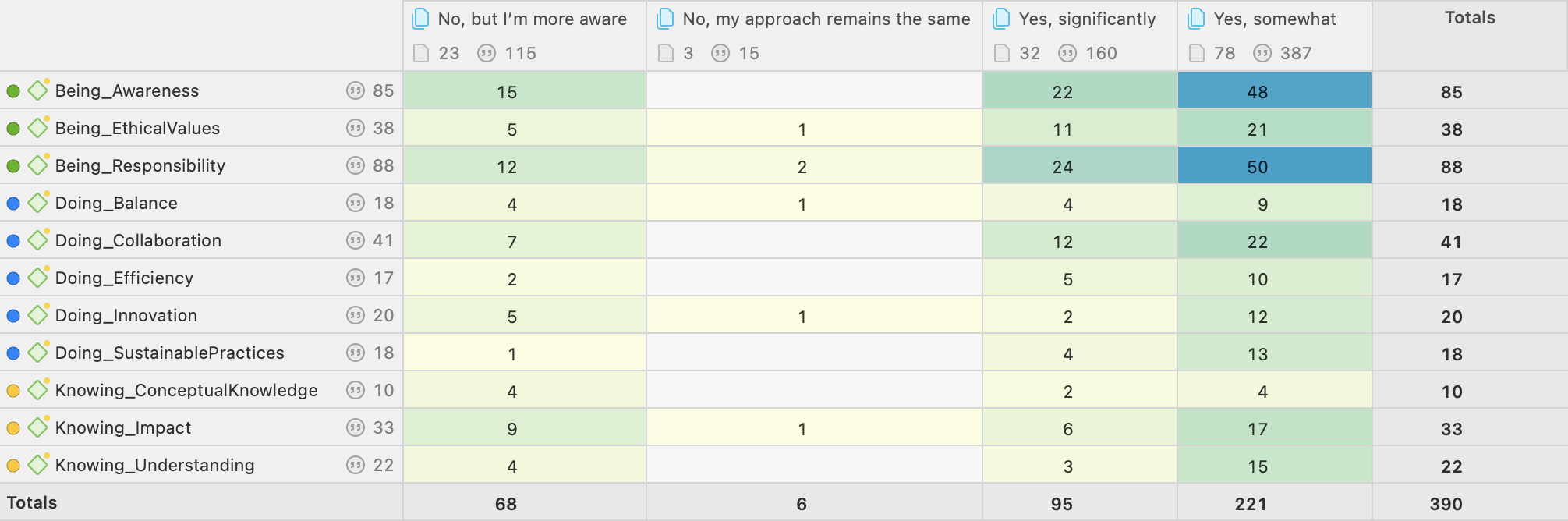
Figure 1. Code–document analysis of sustainable consumption learning outcomes and changes in purchasing behavior
3.2. Responsible Production as an Organizational Commitment
As shown in Figure 2, analysis of responses to the question, “Based on the concept of "responsible production," list three key commitments companies should adopt to promote well-being through their business model” reinforced a Doing-oriented framing, in which responsibility was conceptualized as deliberate corporate action embedded in business models and policies. Code–document analysis of this question alongside “After this COIL experience, do you feel capable of using company-provided information to assess your purchases?” indicated a predominance of Doing-oriented codes (e.g., sustainable practices, fair labor practices, ethical sourcing, transparency), followed by a Being-oriented code (ethical values), whereas Knowing-related codes appeared less frequently. This pattern was particularly evident among students who reported being able to apply this knowledge (87% of students).
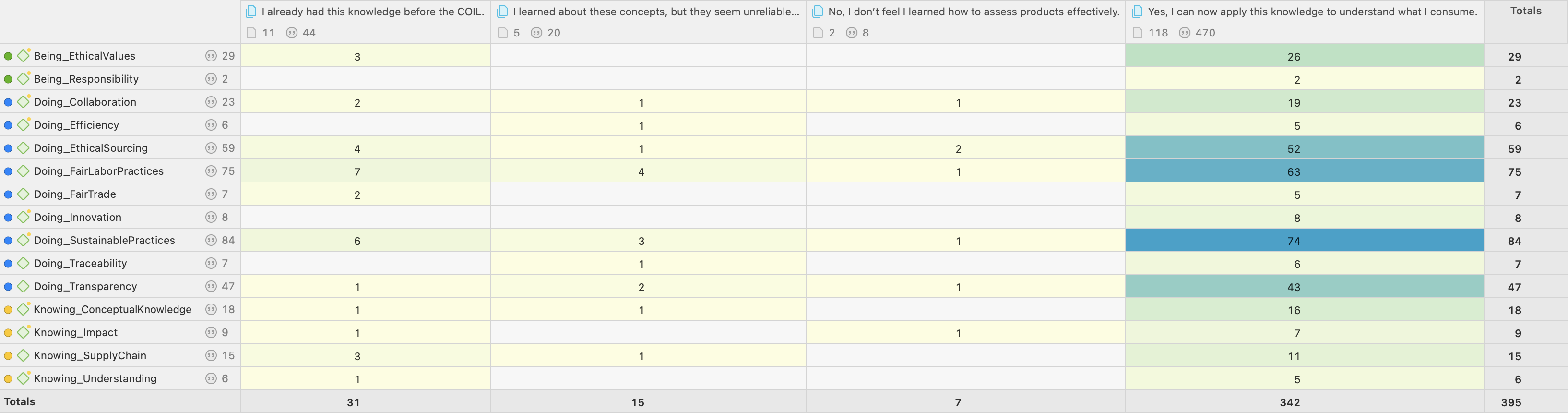 Figure 2. Code–document
analysis of responsible production learning outcomes and students’
capability to use company-provided information.
4. Conclusions
Students’ reflections revealed that the most significant outcome was an ontological shift toward greater awareness, ethical reflection, and responsibility in relation to consumption choices. While changes in concrete purchasing behavior were reported by some participants, the dominant effect was a transformation in how students perceive their role as consumers within global supply chains. At the same time, responsible production was largely framed as a corporate and organizational commitment, with students emphasizing transparency, ethical sourcing, and fair labor practices as central obligations of companies. This reinforces the idea that individual awareness alone is insufficient without corresponding structural and institutional change.
Further investigations should explore how students value the COIL experiences and how this same project could evolve over time if replicated by the same institutions with new groups of students. Future research should also explore more systematically which specific activities, pedagogical strategies, and moments of interaction have the deepest impact on students’ ethical reflection and sense of responsibility.
Acknowledgements
The authors would like to acknowledge the financial support of Writing Lab, Institute for the Future of Education, Tecnologico de Monterrey, Mexico, in the production of this work.
References
Hackett, S., Janssen, J., Beach, P., Perreault, M., Beelen, J., & van Tartwijk, J. (2023). The effectiveness of Collaborative Online International Learning (COIL) on intercultural competence development in higher education. International Journal of Educational Technology in Higher Education, 20(1), Article 41. https://doi.org/10.1186/s41239-022-00373-3
Priego-Quesada, J. I., Germano, A. M. C., Schmidt, D., Carpes, F. P., Encarnación-Martínez, A., & others. (2024). Collaborative online international learning in physiology: A case study. Advances in Physiology Education, 48(3), 513–517. https://doi.org/10.1152/advan.00034.2024
Quintana-Ordorika, A., Camino-Esturo, E., Portillo-Berasaluce, J., & Garay-Ruiz, U. (2023). Integrating COIL in teacher training: An estimation of learners’ motivational attitudes. Frontiers in Education, 8, 1141620. https://doi.org/10.3389/feduc.2023.1141620
UNESCO. (2017). Education for Sustainable Development Goals: Learning Objectives. UNESCO. https://www.unesco.org/en/articles/education-sustainable-development-goals-learning-objectives
Vázquez-Villegas, P., Gómez-Guerrero, D., Mejía-Manzano, L.A., Morales-Veloquio, G., Montaño-Salinas, L.P., & Membrillo-Hernández, J. (2024). Evaluation of good practices and opportunity areas of a Collaborative Online International Learning (COIL) program: Global Shared Learning Classroom. Education and Information Technologies, 29, 22247–22286. https://doi.org/10.1007/s10639-024-12739-3
Williamson, C., & Dyason, K. (2023). Knowing, doing and being: Transferable competencies for the research management profession. Journal of Research Administration, 54(1), 14–36.